The violence and looting that accompanied the demonstrations of October 17 led many cultural establishments to close preventively on Saturday October 24, sometimes for the entire weekend. In Paris, Lyon, Marseille and Lille, dozens of museums, monuments and performance halls have suspended their activity. The decision with the greatest economic consequences is that of Art Basel Paris, which ended its edition on Friday evening, two days in advance.
On October 17, 550,000 people demonstrated in France according to the Ministry of the Interior and the day was marked by violence of an exceptional scale, on the sidelines of the processions. To avoid further excesses, the police headquarters had first authorized a Bastille-Nation route for Saturday October 24, before replacing it on Friday evening with a route from Porte d’Italie to Porte de Vincennes, taking the Boulevards des Maréchaux.
Despite this route ultimately far from the main museums, the closures decided in advance were maintained. In Paris, the Louvre, Orsay, the Orangerie, Picasso, the Jeu de Paume, Cluny, the Decorative Arts and the Arts et Métiers suspended their reception on Saturday. The BnF closed its sites, while the Paris National Opera canceled its performances and visits. Private sites, including the Louis Vuitton Foundation, the Bourse de Commerce – Pinault Collection and Lafayette Anticipations, also closed on Saturday.
Paris Musées has adopted a selective approach: the Petit Palais, Carnavalet, Cognacq-Jay and the Maison de Victor Hugo have closed, unlike the Paris Museum of Modern Art. Most establishments reopened on Sunday. The Cartier Foundation, however, has extended its closure until Sunday inclusive.
The financial consequences of these measures are significant, especially as they take place during school holidays. According to estimates from Arts Journalone day of closure represents a loss of around €400,000 for the Louvre Museum and €100,000 for the Orsay Museum.
In the provinces, the preventive closures of Saturday October 24 also affected many establishments. In Lyon, the Museums of Fine Arts, Confluences and Gadagne have kept their doors closed. In Marseille, the Mucem, the Cantini, Fine Arts and History museums, the Natural History Museum and the two Vieille Charité museums have also closed.
The location still visible, Saturday October 24, of Robert Indiana’s sculpture, LOVE Wall, installed near the Grand Palais during the Art Basel Paris fair.
© Photo Ludovic Sanejouand for LeJournaldesArts.fr
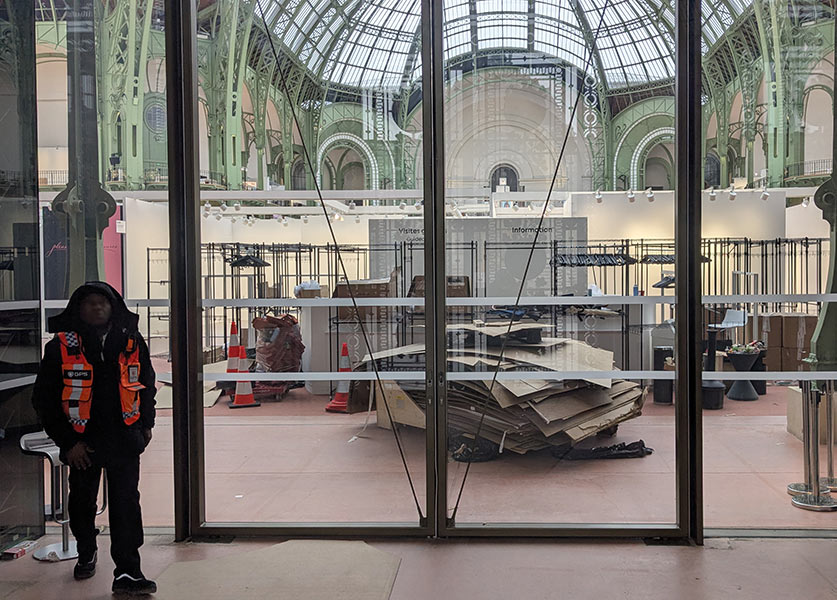
The consequences are even heavier for fairs. Art Basel Paris, which opened on Tuesday at the Grand Palais, closed permanently on Friday October 23 at 7 p.m., depriving its 211 galleries of the last two days. The organizers also had the monumental installations removed from Winston-Churchill Avenue. How many paying visitors come to Art Basel during the weekend? A few thousand among the 73,000 visitors welcomed in 2025, a loss of several tens of thousands of euros given the very high ticket price (€47). The economic impact is undoubtedly greater for upstairs galleries which rely on the weekend to make sales while ground floor galleries make their biggest sales during the week during VIP days.
Moderne Art Fair, Place de la Concorde, also closed permanently on Friday evening, further weakening a fair which is dwindling from year to year. Other off fairs have adopted different strategies. AKAA, at Carreau du Temple, and Private Choice closed on Saturday but announced their reopening on Sunday. Asia Now maintained its opening on Saturday, the last day of the fair. Menart Fair, in the Marais, was open on Sunday. Even if since Covid, fairs have protected themselves in their contracts against requests for reimbursement from merchants due to early closures, the reduction in opening days has economic consequences for their organizers.
The demonstrations of October 24 ultimately brought together 410,000 people in France, including 110,000 in Paris according to the Ministry of the Interior, while the incidents were out of all proportion to those of the previous week.