The Jewish Museum of Venice (Museo ebraico di Venezia) inaugurated renovated and enlarged rooms on Wednesday October 21, 2026, after a seven-year project. The redesign of the route aimed to create a coherent itinerary in order to give continuity to the museum, distributed in several historic buildings of the former ghetto, in particular by integrating three synagogues out of the five in the district.
The entire renovation required a budget of 12 million euros, financed initially by private donations, then with support from the Italian Ministry of Culture. The surface area of the museum complex increased from 1,290 to 1,700 m2, and an envelope of 5.5 million euros was dedicated specifically to the renovation of the German, Italian and Canton synagogues, all built in the 16th century.
The new route, whose circulation has been improved to provide better accessibility, includes a renovated entrance hall and reception areas, permanent and temporary exhibition rooms, a library keeping archives that can be consulted by researchers, and spaces dedicated to schools. A new room has been integrated into the tour, which presents itself as a reconstruction of a traditional Jewish home, with furniture that belonged to residents of the ghetto. It illustrates the ambition that guided the rehabilitation of the museum.
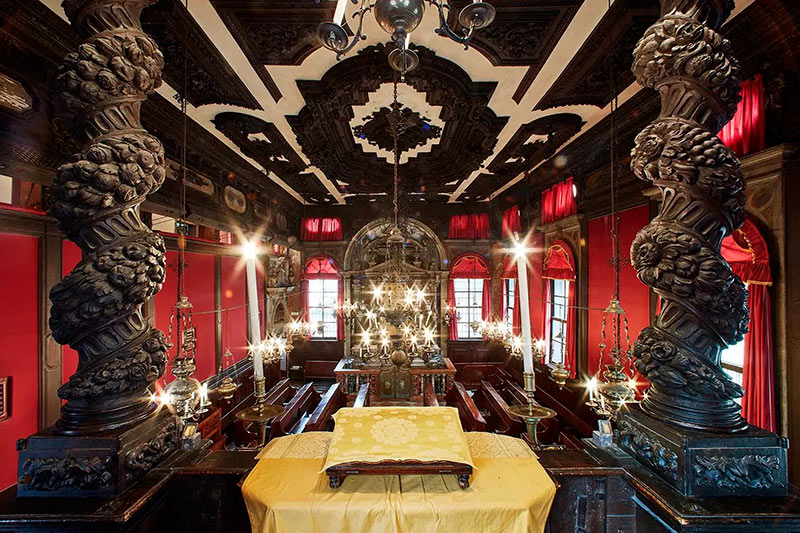
The Italian Synagogue of the Jewish Museum in Venice.
© Opera Laboratori
Refusing to limit itself to the religious dimension, the new museographic approach accords particular importance to the lifestyles and customs of this Jewish community, assigned to the Venetian ghetto from 1516 until the fall of the Republic of Venice in 1797. Ritual objects punctuate the route, presented as witnesses of the traditions to which they are attached, and of the contexts in which they are used. The inclusion of synagogues in the visit, whose furniture and decorative elements have been restored, allows us to show how religious practices are part of daily life.
The long closure was also an opportunity to modernize the museography. Multimedia installations and immersive content have been integrated into the permanent exhibition, which still presents its historical collections, composed of sacred fabrics, ritual silverware, goldsmithing as well as ancient manuscripts. Beyond their preciousness, these objects – a silver Hanukkah candlestick from 1736 or a Shaddai, a good luck charm that Mediterranean Jews place above the bassinets of newborns – embody Jewish traditions by providing a glimpse of a rich material culture.
Founded in 1954 by members of the Venetian Jewish community, the Jewish Museum of Venice has undergone several evolutions. Originally, it only occupied one room, still integrated into the current route. In the 1970s, it underwent initial developments, then was expanded in the early 2000s. During its period of closure, the museum organized visits to the Levantine and Spanish synagogues, to continue to transmit Jewish culture and religion to Venice. Director Marcella Ansaldi underlined the museum’s educational desire, declaring “If someone comes in with prejudice and leaves with one less prejudice, that’s already a victory. »