

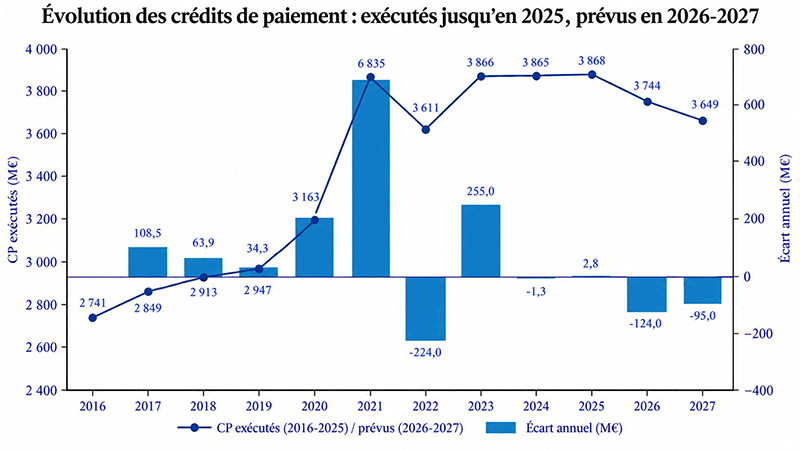
Paris. The deterioration of public accounts following the heatwave (resulting in aid to farmers), the blockage of the Strait of Hormuz (causing an increase in oil prices) and the surge in debt got the better of Emmanuel Macron’s last Culture budget. While the ceiling letters sent this summer to the various ministers indicated stability in the Culture mission’s budget, it will ultimately fall by 2.5% in 2027, representing a reduction in payment appropriations (CP) of 95 million euros out of a total budget of 3.649 billion euros.
In the finance bill (PLF) for 2027, the reduction is not evenly distributed between the three main programs of the Culture mission. “Creation” (visual arts and performing arts) and “Transmission of knowledge and democratization of culture” (higher education Culture, Artistic and cultural education, etc.) lose more than “Heritage”: 35 million euros (– 3.51%) and 29 million euros (– 3.91%) for the first two compared to 21 million euros (– 1.85%) for Heritage. But it is the analysis by type of expenditure (see table) rather than by program which allows us to better understand the decisions made by the minister to absorb the 95 million euros reduction.
Catherine Pgard has clearly favored operating budgets, those which are used to “run” cultural operators and services, to the detriment of investment expenditure (renovation of buildings for example) and intervention expenditure, that is to say aid and subsidies paid to third parties. The operating payment credits increase by 45 million euros when the CP for investment decreases by 52 million and those for intervention by 50 million. This is a classic choice in times of budgetary constraints: the State postpones major works and reduces its aid in order to maintain the activity of establishments in its sector. A very relative maintenance: taking into account inflation and the mechanical increase in the wage bill, the simple renewal of subsidies should force them to cut this adjustment variable that is programming.
© The Journal of Arts
The same logic governs the higher schools of culture where operating expenses increase by 8.90 million euros (+ 5.7%) while investment decreases by 18 million. However, the increase in operations is an illusion, since a good part is linked to the reclassification of contract teachers in architecture schools and in the National Conservatories of Music and Dance in Paris and Lyon, and to an accounting transfer for the National Schools of Art in the regions. There are therefore no new means for these schools.
“Center Pompidou 2030” and “Louvre-Nouvelle Renaissance”
The case of the Palace of Versailles and even more so that of the Louvre are symptomatic of the budgetary creativity of the ministry’s services. The subsidy of the two establishments for public service charges decreases on the grounds that the implementation of differentiated pricing for non-Europeans increases their own resources. This is not at all the business of the Louvre which had directed these additional revenues towards the financing of its “Louvre-Nouvelle Renaissance”. And to make matters worse, the State has not renewed in 2027 the 10 million euros of subsidy for investment initially planned until 2030. The financial equation is seriously complicated for the new president and director, Christophe Leribault. At this stage, the Louvre will barely be able to finance the restoration component of the site (estimated at €480 million) and does not seem able to finance the creation of a room for the Mona Lisa under the Cour Carrée (€600 million). Incidentally, the budgetary “blue” indicates that the Musée de l’Orangerie will soon implement differentiated pricing, but not the Musée d’Orsay on which it depends.
However, it is the historic monuments which are suffering from the 26 million euro drop in subsidies for investment works, because the work on a closed Pompidou Center must be financed! As a reminder, the State has committed to financing 283 of the 463 million euros cost of renovating the Center. He has already paid 91 since 2024, but must accelerate the tempo to keep the schedule. This is how the PLF has planned 51 million euros for the Center Pompidou, or 71% of the total budget, thereby postponing the hoped-for work at the Guimet Museum. On the other hand, the Museum of Art and History of Judaism saves the promised funding of 3 million euros for its extension project of 22 million euros (via intervention expenses). And Universcience (which is in the Transmission program) gets an extension of 7 million – but the 13 million from 2027 will mainly be used to complete the work on the Palais de la Découverte. Those of the Cité des Sciences which the Court of Auditors had estimated at one billion (one billion euros!) are postponed.
The biggest drop concerns intervention credits
It is the intervention credits which bear the greatest burden of the debt, particularly those of the Transmission program to which the Culture Pass is attached. A quarter of the total reduction in CP expected in 2027 comes from the reduction in intervention costs (€20 million) of the Culture Pass following the reform of March 2025. Before the reform, a young person could successively receive 20 euros at 15 years old, 30 euros at 16 years old and at 17 years old and 300 euros at 18 years old, i.e. up to 380 euros. Since March 2025, monetary grants at ages 15 and 16 have been eliminated; young people receive 50 euros at 17 years old then 150 at 18 years old, to which can be added a bonus of 50 euros subject to means testing or in the event of a disability. But curiously, the operating costs of SAS Pass culture, the commercial company which manages the pass and which has become a State operator, remains above 26 million euros, so that the costs of managing the pass represent almost 16% of the sums devoted to the individual and collective shares of the system in 2027.
There is no doubt that parliamentarians will be interested in the resources of the SAS, but also in other budget lines. Unlike Macron’s first five-year term, which benefited from a strong parliamentary majority, the 2027 PLF should certainly be highly discussed. The government will try to erase the impression left by the drop in the Culture budget in 2026 and 2027 by recalling the significant increase in its resources after the presidency of François Hollande.
Cancellation of credits, freezes and thaws
The document given to parliamentarians compares the draft budget to the initial finance law passed on February 2, 2026. Is this the right method to calculate the change from 2026 to 2027? At this time, the Culture mission budget has suffered two cancellations of credits for a total of 58 million euros which will undoubtedly be deducted from the precautionary reserve, which is of the order of 123 million euros. We do not know how much will be “unfrozen” by the end of 2026, and it is even more difficult to estimate the amount frozen in 2027 (the rate of this freezing is currently the same as in 2026). If, as is likely, there is no thaw in 2026 and 2027, then the drop is indeed around 2.5%. And even 4.3% in constant euros taking into account the inflation rate of 4.3%.
© The Journal of Arts