Paris. The exhibition-file “Auguste Bartholdi” presented at the Musée d’Orsay is intended to be modest: it includes around a hundred documents and works, often small in size. Its two curators, Juliette Chevée, director of the Bartholdi Museum in Colmar, and François Blanchetière, curator of sculptures at Orsay, nevertheless tell the story of a formidable human adventure. The event is accompanied by a virtual reality experience co-produced by Gedeon Experiences and BackLight, thanks to which the visitor is invited into the Parisian construction workshop of Freedom enlightening the world (the accidental fall of the enormous plaster head is sensational) or, in the bay of New York, climbs the statue to the point of dizziness.
Auguste Bartholdi (1834-1904) was a true sculptor. As proof, his Monument to Jean-François Champollion (1875), a marble previously exhibited in Paris in the courtyard of the Collège de France, was recently the subject of a protective measure: it is now kept in a safe place at the Camille-Claudel Museum, in Nogent-sur-Seine (Aube). However, its best-known statue, 46 meters high and reaching almost 100 meters with its pedestal, is often considered more of a technical feat than a work of art, and its author is considered an engineer. The exhibition shows that this is not the case.
The student of Ary Scheffer (1795-1858) drew and painted and the studies and models of some of his sculptures presented testify to his talent. What is also striking is his obsession with monumentality. Nourished by ancient culture, he preferred to the traditional Grand Tour passing through Italy a trip to Egypt in the company of the painter Jean-Léon Gérôme, before continuing, alone, towards Yemen (1855-1856). He thus experienced the force of gigantism and rushed, in 1869, to propose to the Khedive of Egypt to build a monumental lighthouse on which he had been working since 1867 and which he wanted to erect at the entrance to the Suez Canal, which had just been inaugurated. The project took the form of an Egyptian peasant woman brandishing – already – a torch.
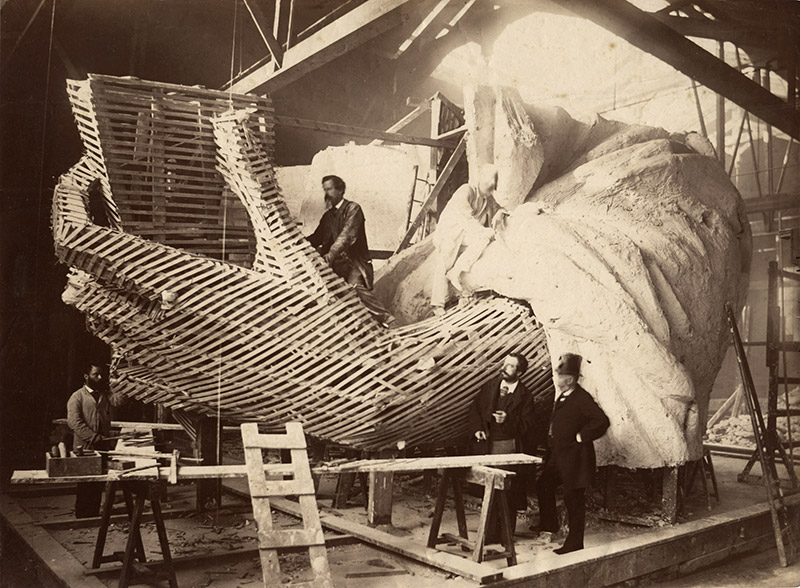
Albert Fernique (1841-1898), The Statue of Liberty assembled in the Gaget, Gauthier & Cie workshops1884, print on albumen paper glued to cardboard, 46 x 35 cm, Colmar, Bartholdi Museum.
© Bartholdi Museum / C. Kempf
A “community of thought and struggle”
Between the fellah of Suez and Freedom enlightening the worldthere is not only the erasure of a contrapposto a little too seductive, but the integration into French political and economic society of an ambitious and committed young man. This Protestant Republican, Freemason, revealed his ideals during the Franco-Prussian War. He created the first study model for the Lion of Belfort in 1874-1875 and the exhibition also presents a Model of the monument erected in memory of the aeronauts of the siege of Paris (colloquially called “the Ballon”, the monument dating from 1876 only found its location, Place des Ternes, in 1904). Since 1865, he has worked on a new lighthouse celebrating the centenary of the independence of the United States which will take place in 1876. A member of the circle of the eminent Republican jurist Édouard Laboulaye, he agrees with him that we must celebrate the“memory of a community of thought and struggle” between France and the insurgent Americans and that “the French who fought in the United States shed their blood for the principles they hoped to see triumph in France and throughout the world”he wrote in a text published in 1885 in the North American Review and cited in the exhibition catalogue.
“Republic” being synonymous with “freedom”, each detail of the sculpture must be thought of to refer to one or other of these notions. The successive drawings and models, compared to French works of the same inspiration, show this research work by the sculptor. The iconographic program of the Freedom was definitively stopped in 1875, but the subscription campaign for the project did not really begin until 1876 and the work arrived ten years late in New York. However, at the Centennial International Exhibition in Philadelphia in 1876, Bartholdi was able to display the torch of his statue in full size, which brought considerable publicity to his project. In 1878, he exhibited the bust at the Universal Exhibition in Paris and, as with the torch in Philadelphia, the public could go inside.
Artist and entrepreneur
Without weakening or doubting, the artist thus carries out the production of his sculpture and the publicity which should make it possible to raise the funds for the completion of the project. Derivative products keep the movement going, the press is regularly contacted and the copper monster gradually rising above the buildings of the Monceau plain attracts Parisians for walks and allows for striking photos, immediately published. Bartholdi is surrounded by powerful allies such as Eugène Viollet-le-Duc then, upon his death, Gustave Eiffel (who imagined the internal structure of the Freedom)but also Laboulaye who became a deputy in 1871 and senator in 1875, replaced in 1883 by Ferdinand de Lesseps, at the head of the Franco-American Union carrying the project. Until Joseph Pulitzer, who, noting the reluctance of his American compatriots to contribute to the costs of manufacturing the base of Lady Libertypromises to publish the names of the contributors in his newspaper, The World.
Along the route through the small rooms of the Musée d’Orsay, the different models of the statue, the photographs taken in the Gaget, Gauthier & Cie workshops where it was manufactured, the prints and reductions on various scales and in different materials, intended for the public as well as the leaflets and small souvenir objects, paint the portrait of a Bartholdi artist, entrepreneur and publicist inscribed in modernity.
This is also the image given in the small exhibition at the Museum of Arts and Crafts. After an introductory room presenting the sculptor, the project, the foundry which implemented it and a comparative political chronology of the United States and France between 1776 and 1876, the visitor enters a very successful immersive journey. The phases of creation of the statue are detailed, and an index finger and its face at real size are displayed, while the original 1/16 plaster model (1875) which was used to bring the statue to its final dimensions. Lady Liberty remained, majestic, in the museum chapel.