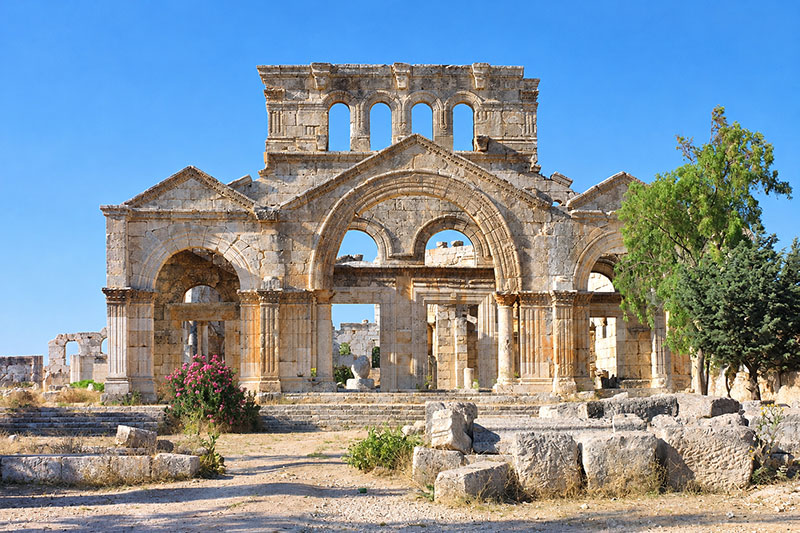
It is no coincidence that the government chose the date of September 28, World Tourism Day, to inaugurate the reopening of the monastery of Saint-Simeon-the-Stylite (Qaalat Samaan) in Aleppo. After more than a decade of closure linked to the civil war, the restoration of this archaeological site reflects the ambition of the new regime of Ahmed al-Charaa to revive tourism in the country by relying on its heritage.
The opening is, however, a little premature. Only a first phase of restoration has been completed for the moment, but the work is sufficiently advanced for the site to once again welcome public visitors. The debris was cleared, a tour route was created, and the administrative spaces and premises were secured. Highlight of the restoration, the reinstallation of the column of Saint-Siméon, destroyed during an airstrike attributed to Russia on May 12, 2016.
Built in the 5th century, the monastery of Saint-Siméon, also known as the castle of Siméon, was built around the column at the top of which the stylite would have lived, and which gives it its name. Composed of a church, a monastery, a baptistery, a processional route and a tomb, the site is a precious witness to Syrian monasticism and a historic place of pilgrimage for Christians. The monastery has had different uses, including that of a military fortress in the 10th century. Like many Syrian heritage sites, Qaalat Samaan suffered heavy damage during the war: bombings, the use of the site by armed groups and clandestine excavations had already seriously damaged it before the earthquake of February 6, 2023 made the situation worse.
Listed as a UNESCO World Heritage Site since 2011, as part of the Ancient Villages of Northern Syria, Simeon Castle joined the list of World Heritage in Danger in 2013, due to the threats weighing on the site in the context of armed conflicts. In 2025, UNESCO confirmed that it would remain on this list, despite the end of Bashar al-Assad’s regime.
The opening ceremony of Qalaat Samaan took place in the presence of several second-rank officials. The speeches of the different personalities linked the reopening of the monastery to the campaign to rehabilitate the archaeological and tourist sites of Aleppo, launched by the new government of Ahmed al-Charaa.
Since the fall of Bashar al-Assad on December 8, 2024, and the designation of Ahmed al-Charaa as transitional president in January 2025, the Syrian government has pursued a cultural policy, which includes the establishment of a national strategy for heritage over the period 2025-2035. Its main axes are the restoration of archaeological sites, the documentation of collections, the recovery of looted antiquities and the development of cultural tourism. In July 2026, the government reached agreements for the restoration of historic sites in Aleppo and Tartous, in the northwest of the country.