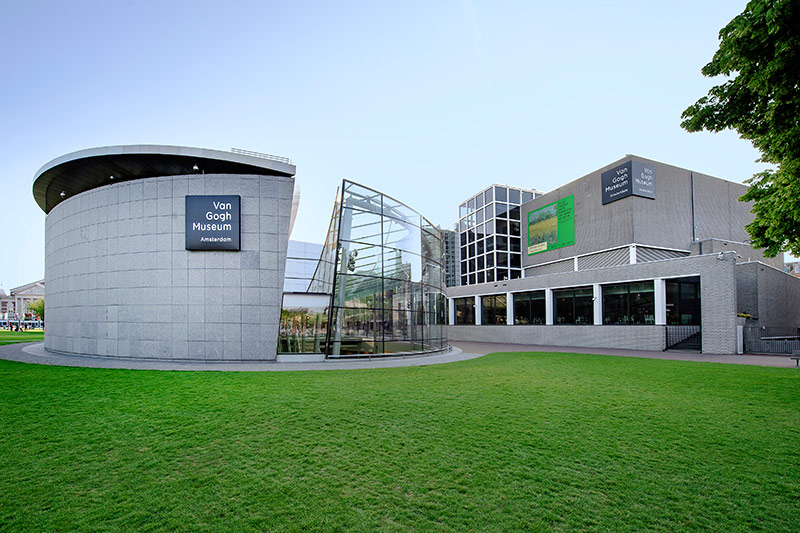
After several years of dispute over the financing of its renovation, the Van Gogh Museum in Amsterdam announced on October 8 that it had reached an agreement with the Dutch state following mediation. The compromise allows a project estimated at 104 million euros to begin in the fall of 2028, the financing terms of which remain confidential. The establishment will remain partially open during the work.
The construction site is expected to begin in the fall of 2028, and concerns maintenance and modernization work, which must adapt the building to future needs, particularly in terms of security, climate regulation and durability of the structure. Of the 104 million, 76 million is reserved for maintenance and replacement work, 23 will be used to guarantee the sustainability of the building, and 5 million will be used to improve equipment.
The agreement is the outcome of several years of difficult negotiations which culminated in 2025, with the filing of a complaint by the museum against the State. Originally, the museum asked the Ministry of Education, Culture and Science to increase its annual subsidy from 2.5 million euros to 11 million. The government rejected the request, ruling that the Van Gogh Museum, the second busiest in Amsterdam with more than 2 million visitors per year, was able to cover the costs of the work itself using its own funds and cash flow. However, in its forecast budget, the museum anticipated a deficit of 50 million in its income due to closures linked to the upcoming renovation, losses which it intended to compensate by drawing on its reserves.
According to its 2025 annual report, the museum recorded 77.7 million euros in revenue, 5.1 million euros in positive results and had 58.6 million euros in equity at the end of the financial year. These elements shed light on the dispute: the government believed that the institution could mobilize more of its resources, while management wanted to preserve its capacity to absorb operating losses linked to the construction site.
The conflict was based on the interpretation of the agreement concluded in 1962 between the State and the Vincent van Gogh Foundation, owner of the historical collection of the museum. In return for the transfer of the works to the foundation, the public authorities undertook to build and operate a museum guaranteeing their conservation and public access. The museum had initiated legal proceedings to have these obligations recognized. Suspended in spring 2026 to allow mediation, it will be withdrawn following the agreement, according to a letter sent to Parliament on October 8 by Minister Rianne Letschert. Furthermore, it is now agreed that the museum will remain partially open during the work, allowing the museum to collect commercial revenue.
Several years after the death of his parents, Théo van Gogh, younger brother of the artist, and Johanna van Gogh-Bonger, Vincent Willem van Gogh (1890-1978) created the Vincent van Gogh Foundation in 1960. The entire collection, managed by members of the family, is made available to the public at the Stedeljik Museum. In 1973, the current museum was inaugurated in a building acquired by the State, then expanded with a wing designed by Japanese architect Kisho Kurokawa in 1999.
The Van Gogh Museum houses the world’s largest collection of works by the Dutch post-Impressionist master, with more than 220 paintings, 500 drawings and 800 letters, most of them written to his brother Theo. Some of his most emblematic paintings of an aesthetic heralding modernism are visible there, such as Sunflowers (1889) or theSelf-portrait from 1886. Other contemporary painters of van Gogh appear in the collections, notably Paul Gauguin, Edouard Vuillard, Pierre Bonnard and Odilon Redon.