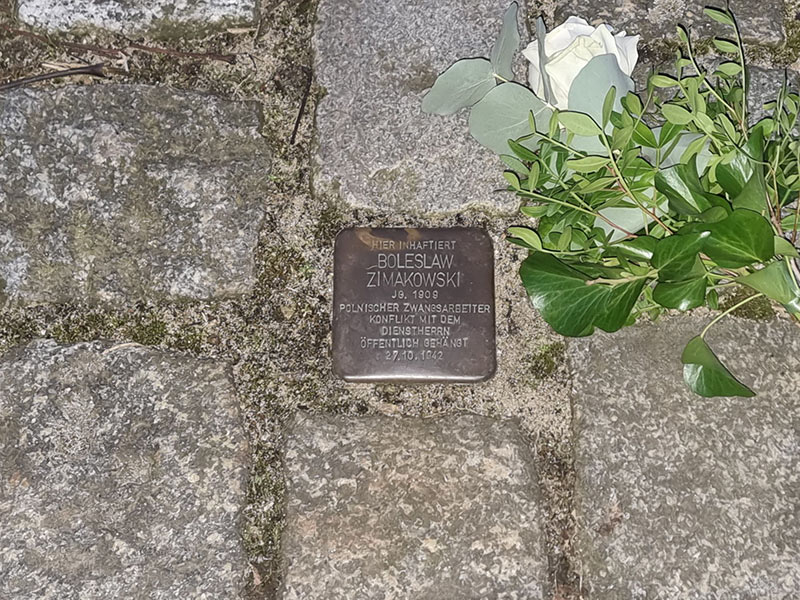
Literally “stumbling blocks”THE Stolpersteine have a symbolic significance far beyond what their name suggests. In the 1990s, German artist Gunter Demnig illegally placed these paving stones engraved with the names of victims of Nazism in front of the door of their last known home, to pay tribute to them. In 1997, the project obtained its first official public recognition, granted by the city of Cologne. Maintained by multiple sources of private funding, it today relies on a large network of organizations which contribute to its international dissemination.
In Heidenau, near Dresden (Saxony), a vote by the municipal council on Thursday September 24 put an end to this memorial practice in the region. Submitted by the Oberelbe Citizens’ Initiative for More Democracy (BOD), a local political group, a motion to prohibit the installation of new Stolpersteine in the streets of the town of 16,000 inhabitants has been validated. It benefited from the support of elected officials from the AfD (Alternative for Germany), the German far-right party, and the CDU (Christian Democratic Union), the party of Chancellor Friedrich Merz, and was thus adopted by 13 votes to 6 (and one abstention).
Faced with the criticism that this decision aroused, the bearers of the text justified their choice by affirming that certain descendants or relatives of victims of the Holocaust consider the Stolpersteine disrespectful, because passers-by walk on it. The arguments put forward are the same as those which prevailed in Munich in 2004, when the social democratic town hall of Christian Ude (SPD) rejected Gunter Demnig’s request to pose Stolpersteine on public property, and removed two paving stones installed without authorization.
A “Stolperstein” in Heidenau, Germany.
The councilor then benefited from the support of Charlotte Knobloch, president of the Jewish community of Munich and survivor of the Shoah. The Munich City Council confirmed its position in July 2015, after a re-examination of the issue had been demanded by some, favoring the installation of commemorative plaques or steles, according to a principle of remembrance “at eye level”.
In view of the comments made by certain members of the AfD, singled out as revisionist or relativist with regard to the Nazi period, the decision of the municipality of Heidenau raises questions. In 2017, the Verfassungsschutzthe German domestic intelligence service responsible for analyzing activities that could constitute a threat to democracy, considered that a statement by party co-founder Alexander Gauland, arguing that it was necessary to be “proud of the performance of German soldiers during the two world wars”helped to minimize the role of the Wehrmacht in the Nazi war of extermination and the involvement of some of its units in the Holocaust.
The CDU’s vote to ban Stolpersteine alongside the AfD has rekindled the debate around respect for the Brandmauer principle, which designates the tacit agreement between the main German parties to block the far-right party. Chancellor Friedrich Merz had already been accused of having betrayed this commitment in January 2025, when his party passed a motion in the Bundestag on migration policy, obtained thanks to the votes of the AfD, which ultimately did not result in law.
But that didn’t stop the town of Oderberg, in Brandenburg, from asking seven Stolpersteine in memory of victims of the euthanasia program conducted under the Third Reich, as well as a large commemorative stele paying tribute to forced workers.