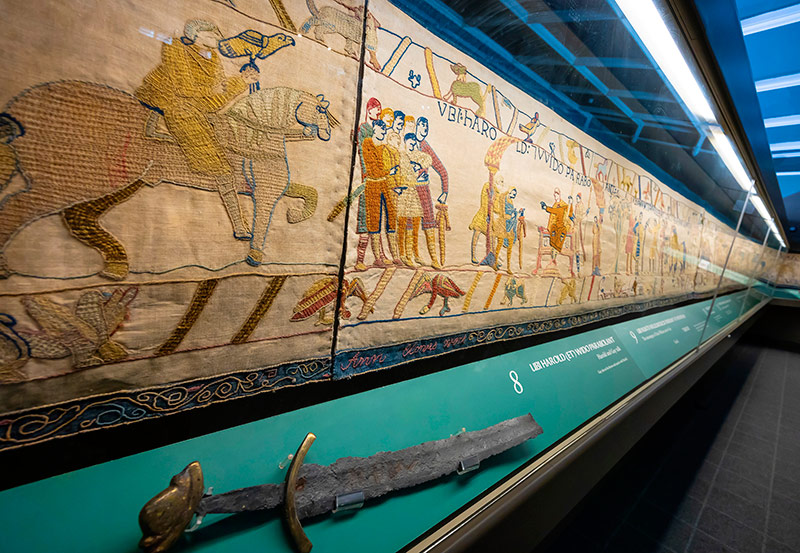
Reading, Berkshire, England. For the museum in Reading, a town accessible from London by the Elizabeth line, the loan of the Bayeux Tapestry to the British Museum was a blessing. Since 1895, the institution has had a life-size copy of what is in fact an embroidery. Made in the Victorian era, almost identically, this facsimile is available free of charge. It is one of the centerpieces of the museum. “1066 is an ingrained date in English history and we have lots of school visits, underlines Brendan Carr, the museum curator. We even have an educational workshop on tapestry for primary school students. »
But since the arrival of the original tapestry in London, the curator has observed an effect on visits. “We don’t yet have the figures for August, but in July attendance increased by almost 7% compared to the same period last year, he rejoices. We have also tripled the number of guided tours offered to the public to 10 pounds (€11.60). » While the museum doesn’t really have a marketing budget, Brendan Carr believes that no advertising campaign could have sparked such a surge of interest in Victorian work. As soon as the exhibition sold out in early August, the museum launched an online campaign to promote the copy.
Identify the differences
But visitors don’t just come because they don’t have tickets to the British Museum. Number of them “come to see the reproduction before the original because they want to prepare for their visit, he indicates. At the British Museum, you have to go quickly, whereas here visitors can take the time to better understand the work. » Brendan Carr also thinks that some will seek to identify the differences. For example, the copy from the prudish Victorian era does not feature naked bodies, unlike the original. But while the last painting of the original work has been lost, the Reading Museum has an asset. In 1996, Jan Messent, a renowned English embroiderer, received a commission to create an imaginary final scene of the tapestry. The museum exhibits a second, smaller version of this scene. “Jan Messent used the same techniques, stem stitch and couch stitch, to create a scene where William the Conqueror is crowned King of England, explains the curator. This is what we imagine to be the missing piece. » The museum has an annual attendance of around 110,000 visitors. Brendan Carr believes that the effect of this loan should last over time.