Next year it will be thirty since the death of Roy Lichtenstein, perhaps the pop artist who put the greatest emphasis on the possibilities of incorporating humor and comic resources into visual creation when representing consumer society, daily life and mass culture. In his images, only apparently simple, the use of primary colors stood out.
Born in New York and trained, in the late 1930s, at the Art Students League and at the Ohio State University in Columbus, where he was influenced by Hoyt Sherman in relation to his conception of art as a system where perception is organized, he initially earned his living as an art professor and window dresser. His first paintings addressed typically American issues with a style influenced by cubism and expressionism and were not very successful in what was his first solo exhibition in Cleveland, in 1951.
Already between 1957 and 1960 his production was carried away by certain features of the dominant current in American art at that time: abstract expressionism. Later, and after having experimented with a personal reading of cubism and constructivism, he returned to direct his attention towards everyday reality, dominated at that time by the prefabricated images of popular culture. He began a new type of painting – it was the beginning of pop – inspired by the themes and images of the new society that was emerging in his country, based on images taken from comics that would determine his work from now on. His striking technique imitated Benday dots, an industrial printing process used in comics that, using small colored circles, represented chromatic variations in a very schematic way.
The first exhibition of his work in 1962 at the Leo Castelli gallery was received with a certain strangeness by an audience that was not accustomed to seeing their closest world transformed into art. In any case, starting in the eighties his painting gradually became more complex, and at the end of his life he also experimented with sculpture.
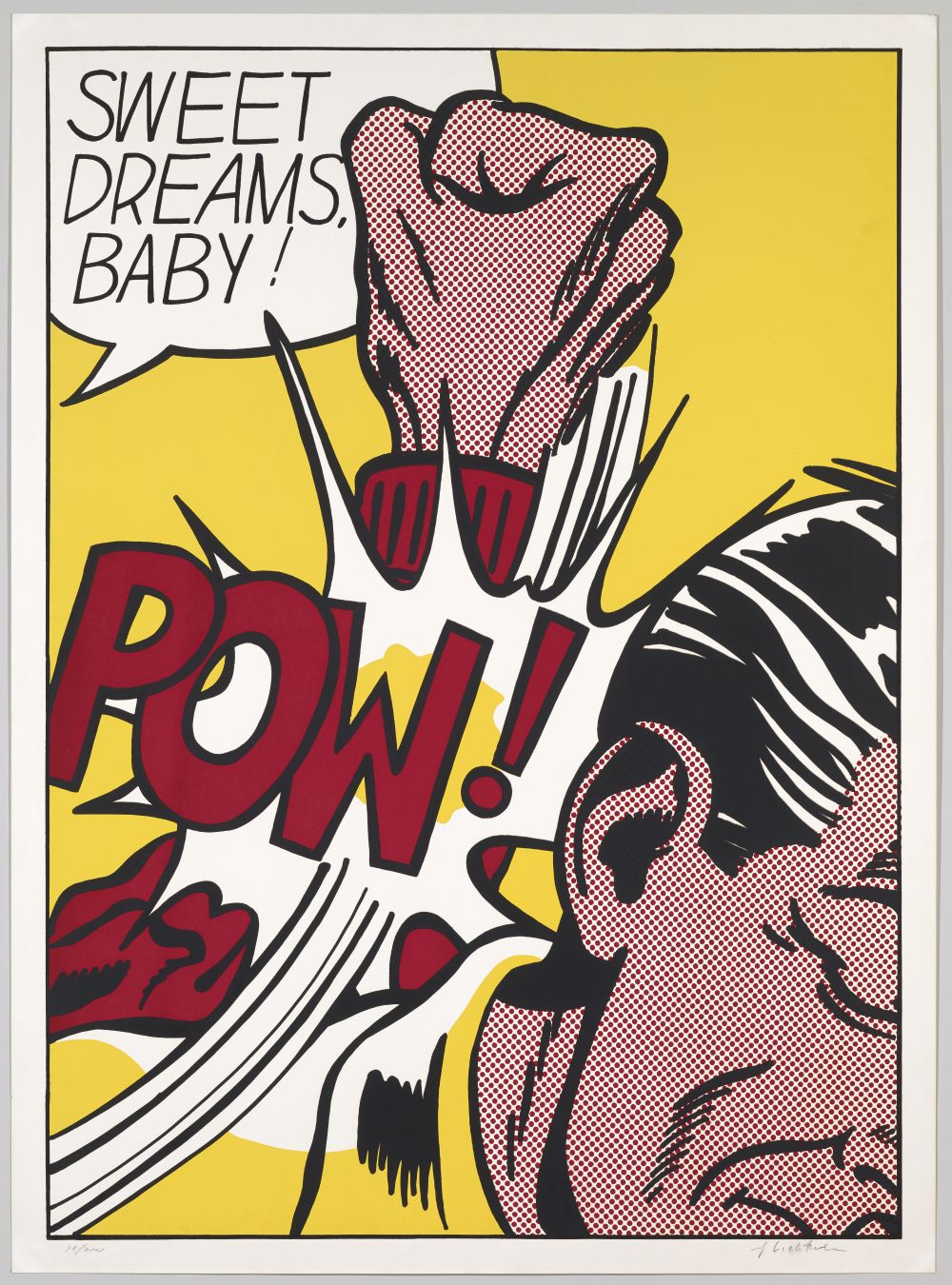
Roy Lichtenstein. Sweet Dreams, Baby!1965. © Estate of Roy Lichtenstein / 2026, ProLitteris, Zurich
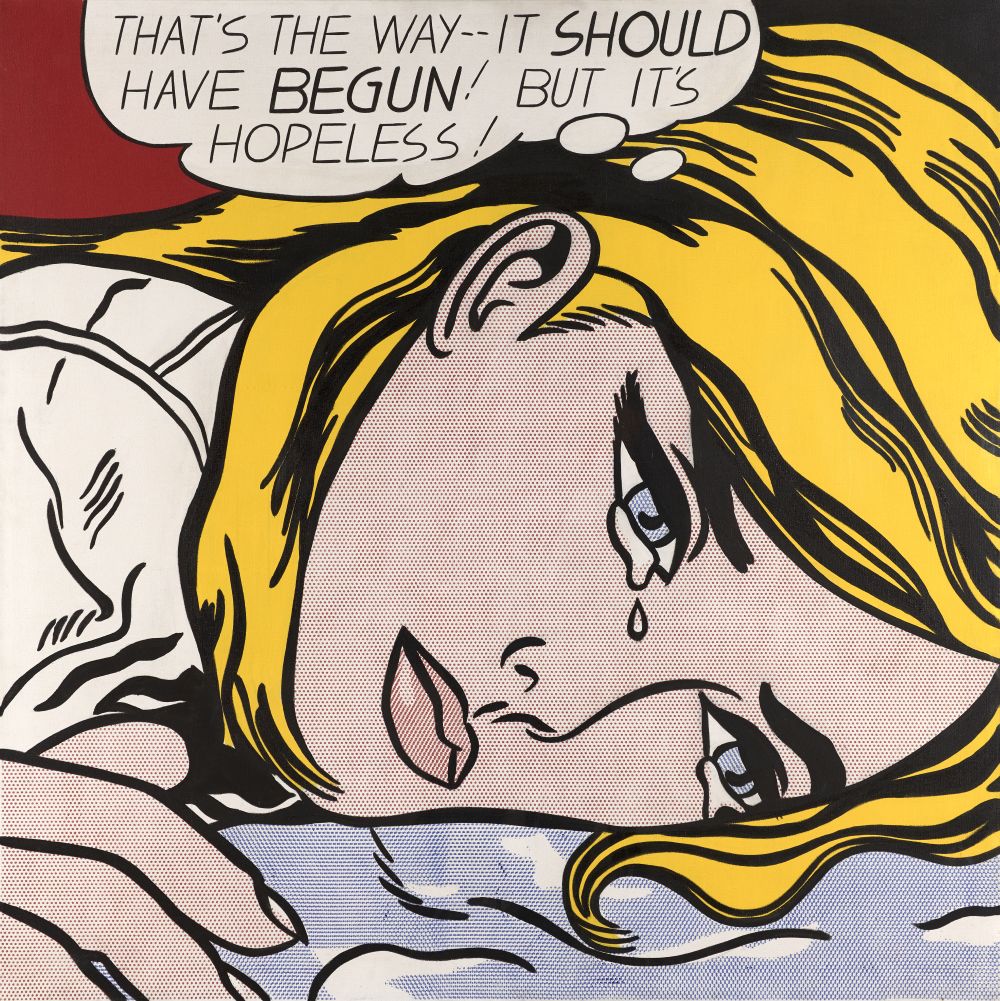
Roy Lichtenstein. Hopeless1963. © Estate of Roy Lichtenstein / 2026, ProLitteris, Zurich
The graphic aspect of his work is not the best known, which is why Kunstmuseum Basel has now decided to review it through nearly fifty pieces, many of them unpublished and, in part, coming from his own engraving cabinet, generously donated at the time by a foundation of the author, one of the most important Lichtenstein collections outside the United States.
The exhibition, titled «Roy Lichtenstein. Sweet Dreams, Baby!”, reveals how the New Yorker’s taste for experimentation and technical virtuosity were present in his career from the beginning, when, with large doses of irony, he transferred the visual language of consumer products, advertising brochures and shop windows to the visual arts. Lichtenstein especially embraced the comic strip aesthetic: enlarged details (close-ups), luminous colors, and halftone dots (those Benday dots) became his long-term hallmarks.
At first, American critics were somewhat dismayed by the emergence of pop art, in which they found a source of banality. However, the general public was inevitably attracted by an art that seemed to take it into account and, in this sense, engraving played a crucial role due to its reproducibility: Lichtenstein’s first works with a comic aesthetic were, precisely, posters and invitations for his exhibitions in the Castelli room. Affordable and with massive circulations, they contributed a lot to the artist’s recognition.
The American’s interest in this technique dates back to his student days: six examples from the late 1940s and early 1950s can be seen in Basel that illustrate how he was already actively researching different printing techniques at that time. From the late 1960s, he worked with prestigious printers, such as Gemini Graphic Editions Limited in Los Angeles, Tyler Graphics in New York, and Graphicstudio at the University of South Florida in Tampa; In close collaboration with them, he produced high-quality sheets and series. One of those compositions is Portrait (1989), the result of an eighteen-step printing process in which the combination of four different techniques—lithography, wood engraving, screen printing, and wax printing, developed specifically for this project by Graphicstudio—produced tremendously varied surface effects, from matte areas to patterns reminiscent of fluid brush strokes, including shiny and iridescent areas.
Over almost half a century, Lichtenstein created more than 350 silkscreens, etchings, lithographs, woodcuts and linocuts. To commemorate the centenary of his birth in 2023, the Roy Lichtenstein Foundation donated a hundred to the Albertina in Vienna, the British Museum in London and the Kunstmuseum Basel itself, thus generating three reference collections in Europe. Specifically, this last museum received thirty-three works that reflect the breadth of this facet of his, among them printed paper plates (Paper Plates1969), a reinterpretation of The sower by Vincent van Gogh (The Sower1985) and the monumental wallpaper Wallpaper with Blue Floor Interior (1992).
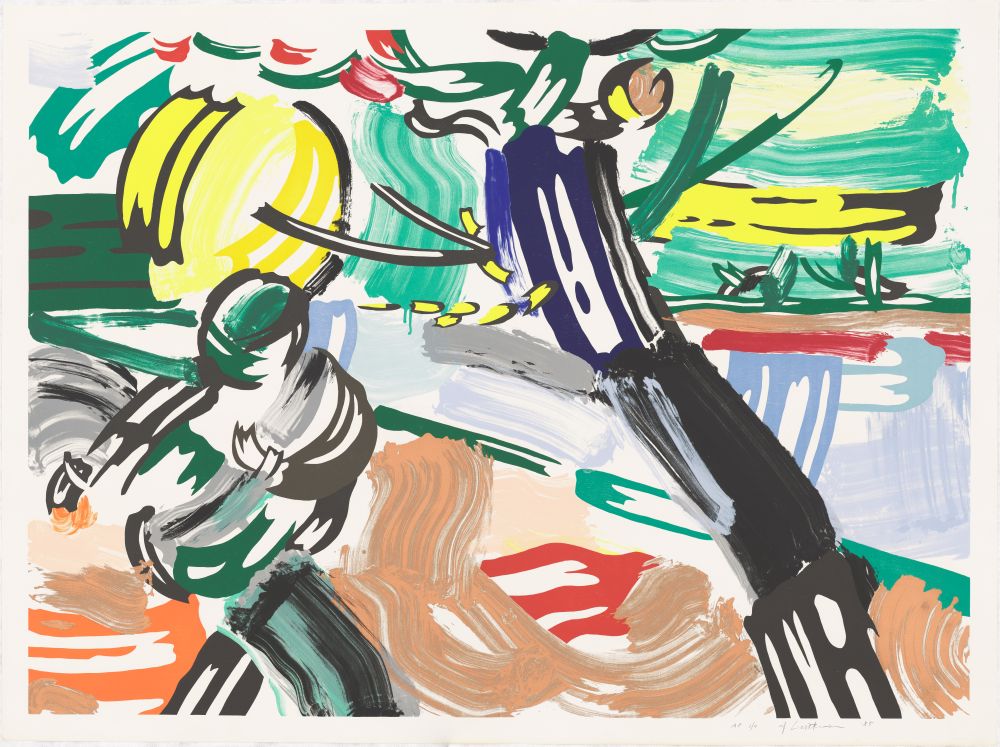
Roy Lichtenstein. The Sower1985. © Estate of Roy Lichtenstein / 2026, ProLitteris, Zurich
This exhibition displays this donation before the public for the first time alongside other graphic compositions by the artist, the first of which became part of the collection of the Kunstmuseum’s Department of Prints and Drawings in the 1960s, as well as a loan from a private fund (Entablature VI1976) and the paintings Hopelessness (1963) and Mirror #2 (1970), both on permanent loan.
The Roy Lichtenstein Foundation was founded in 1998 in New York by Dorothy Lichtenstein (1939-2024), his widow. Its objective is to make the artist’s work accessible to the greatest number of viewers; To this end, it has developed an online catalog raisonné that is continually updated.
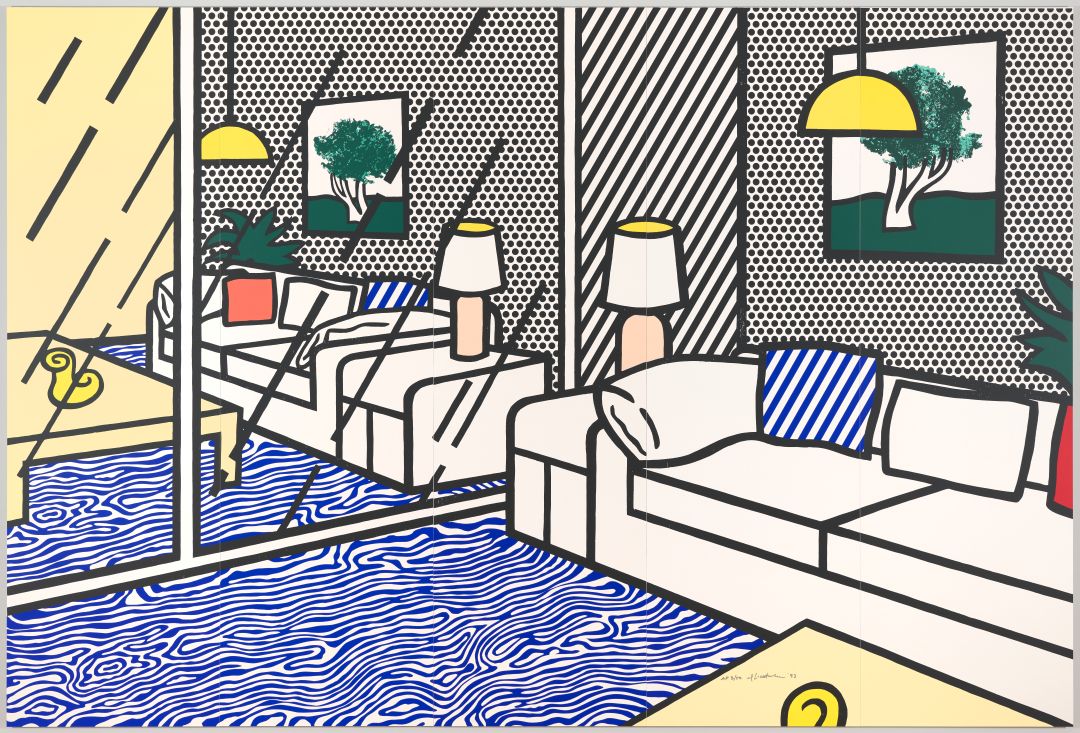
Roy Lichtenstein. Wallpaper with Blue Floor Interior1992. © Estate of Roy Lichtenstein / 2026, ProLitteris, Zurich
«Roy Lichtenstein. “Sweet Dreams, Baby!”
KUNSTMUSEUM BASEL
St. Alban-Graben, 8
Basel
From August 22, 2026 to March 14, 2027