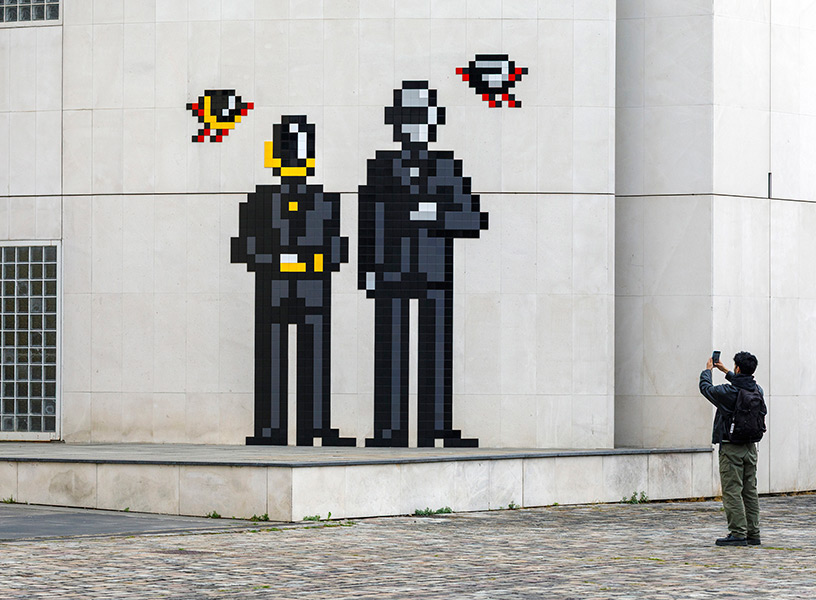
It also shares its attributes: spectacularity and immersion. A major show led by Roger Gastman, graffiti historian and curator straight from the United States and, for the French section, by Sarah Andelman, co-founder of the concept store Colette, the exhibition is already a well-established undertaking: Paris is its 5th stopover after Los Angeles (2018), New York (2019), London and Shanghai (2023). At first glance, it continues a long line of Parisian exhibitions devoted to urban art, from “Nés dans la rue” at the Fondation Cartier (2009) to “Capital(e)” at the Hôtel de Ville (2022). But from the same ingredients – historical depth, a documentary side, studio works and a hint of in situ interventions – it exceeds them in its scale. In “Beyond the Streets”, everything is hyperbolic. Starting with the list of artists: the exhibition displays around a hundred names, including a good proportion of world legends (Shepard Fairey, Invader, Vhils, Barry McGee, Todd James, the Beastie Boys, Futura, Pantone, and even Damien Hirst who perhaps acts as a substitute for Banksy here?), key figures of urban art and Parisian graffiti (Gérard Zlotykamien, Mode 2, Bando, Zevs, André, Lokiss, Fuzi…), photographers (Brassaï, Henry Chalfant, Martha Cooper, Gordon Matta-Clark, Sophie Bramly, Maï Lucas…), and even more confidential artists, but held in high esteem by connoisseurs (Julien Marmar, JC Earl…). This prestigious Areopagus is easily measured on the scale of the Grande Halle de la Villette thanks to a scenography inspired by the “Street market” exhibition (Jeffrey Deitch projects, 2000), which already wondered how to exhibit street art outside the street. From the moment we enter, “Beyond the Streets” dazzles us with a profusion of fake shops, painted signs, subways saturated with graffiti… This immersion in the colorful space of the city alternates with the very “white cube” presentation of a good proportion of studio works. It must be said that the exhibition is not only intended to restore the vitality of the urban scene: beneath its museum exterior, it turns out to be a formidable cash machine, where almost everything is for sale, from most of the works to the objects carefully arranged in the shop.

Similar Posts

Restoning and criticism: The new Belgian painting
About 150 works of seventy -four artists born from the seventies are part of “Painting After Painting”, new and ambitious…
Walker Evans and the country of the anonymous
Barcelona, Born in 1903 in St. Louis, Missouri, Walker Evans was an austere man who distrusted groups and political and…

MEPs want to subject works of art to wealth tax
On the night of Friday October 31, the National Assembly adopted an amendment aimed at transforming the Real Estate Wealth…
López Lejardi, poetic plastic
Santander, Luis López Lejardi is a more than familiar name, and for decades, for those who remain attentive to the…
David Goldblatt, the underlying apartheid
Madrid, If the literary exercise consisting of narrating, without any ostentation, the gradual breakdown of couples, families or countries in…
Igshaan Adams, the mark of the movement
Bilbao, In March 2025, the Guggenheim Museum Bilbao began the exhibition cycle On sitewhich invites international artists to create new…