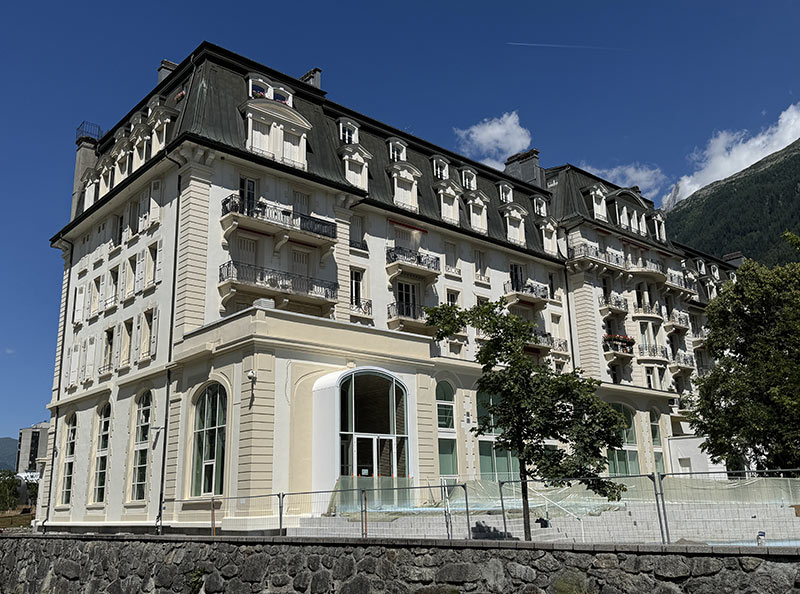
Chamonix-Mont-Blanc (Haute-Savoie). In the background, the spectacular Mont-Blanc massif. In the foreground, the Belle Époque facade of a former palace, a vestige of the golden age of Alpine tourism at the beginning of the 20th century. It is rare that the landscape provides such clear information about the content of the place. And for good reason, it is in this elegant listed building that the Mont-Blanc Museum is nestled, just reopened, and dedicated to the history of the territory and the practices of mountain sports. After five years of work carried out with a budget of 8.6 million euros, the museum has changed scale: supported by the community of municipalities, with the support of public and private partners, the project combined renovation, expansion and updating of the route. With the ambition to make the area known more widely, the facility hopes to welcome some 40,000 visitors per year, or double its attendance before closure, in 2021.
This intention is first manifested by a change of name, far from trivial. The site, formerly called the “Alpine Museum”, has become the “Mont-Blanc Museum”. A new identity designed to take advantage of the international notoriety of the highest peak in Europe, while making its territorial roots immediately perceptible. “Before, the public didn’t really know where he was coming from. He said to himself: “Alpine Museum? Am I going to see stuffed animals?” relates Gabrielle Michaux, director of the Chamonix valley museums. We wanted an approach more centered on the territory because that is what visitors come for. They wonder why Mont Blanc is so famous, why the Mer de Glace glacier is retreating…”. Thus, from their first steps in the museum, the visitor is greeted by a detailed map, followed by a chronology tracing the history of the valley over three centuries. Then the route successively explores on two levels the development of the territory, the evolution of mountaineering and the way artists view the Mont-Blanc massif.
Renovated exhibition room of the Mont-Blanc Museum.
© CCVCMB
A sedan chair, used during the visit of Napoleon III to Chamonix, testifies to the growth of tourism in the valley, while a beautiful copper model of the Cosmiques refuge illustrates the construction of new mountain facilities. Further on, we find the discreet yet emblematic stick of Jacques Balmat (1762-1834), used during the first ascent of Mont Blanc in 1786, a feat marking the beginning of mountaineering. The evolution of mountaineering equipment is then revealed through the centuries, up to the cutting-edge equipment designed by the manufacturer Simond. “We needed to bring a new dynamic to the museum, modernize its approach. We have also enlarged the route by reconfiguring all of the spaces,” explains Gabrielle Michaux. By investing here and there in a few premises belonging to the community of municipalities, the exhibition spaces now extend over 900 square meters, almost double their previous configuration. This has notably made it possible to create a real fine arts section, where posters and especially mountain paintings coexist, including the vibrant canvases of local artist Georgette Agutte (1867-1922).
Break the aging image
The route also gives pride of place to the striking paintings of the mountaineering painter Gabriel Loppé (1825-1913), a beautiful architectural gesture allowing a clear view from above. “We felt that we needed more height, more breathing”indicates architect Guillaume Girod (Spaces Architecture), not without pointing out the constraints inherent to the building.“It’s a palimpsest, since many changes have been made over time. And above all, we had the constraint of a condominium building (editor’s note, due to residential apartments above) “. It was therefore on an occupied site that it was necessary to break up, renovate and streamline access to this building which no longer met standards, the last major works dating back to the 1960s. The objective: to break the aging image of the place, while reconnecting with the spirit of the old palace. “We wanted to rediscover the double heights, preserve the historic settings, echo the brilliance of the Belle Époque,” specifies Guillaume Girod. The original rotunda, destroyed during the 1930s, has also been restored and now accommodates a games area.
In this redesigned museum, audiovisual devices occupy an important place, both to reveal other aspects of the collection and to give voice to researchers. A listening room offers keys to understanding the transformation of the mountain and the impact of climate change, providing information on current research in the field. A temporary exhibition room, non-existent on the old route, will allow you to explore various themes and renew the visiting experience. A decidedly more modern museum, therefore, focused on contemporary issues.
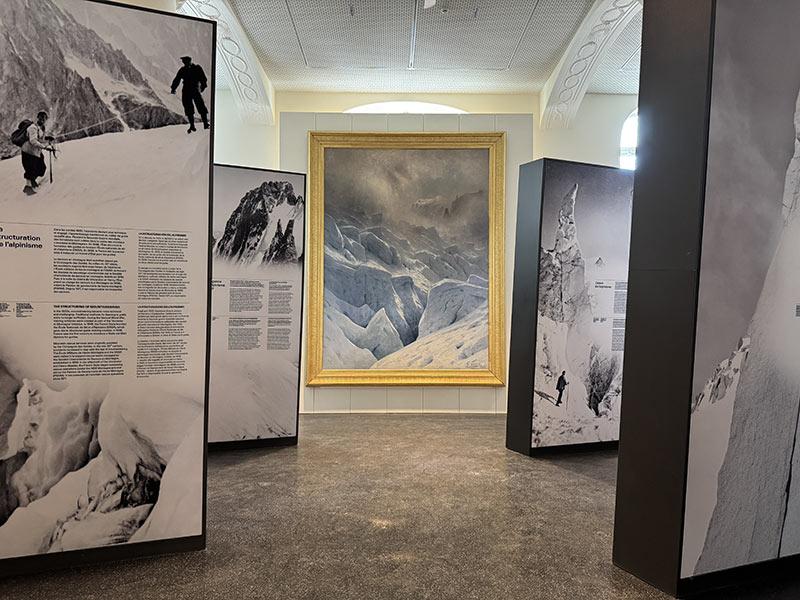
Renovated exhibition room of the Mont-Blanc Museum.
© CCVCMB