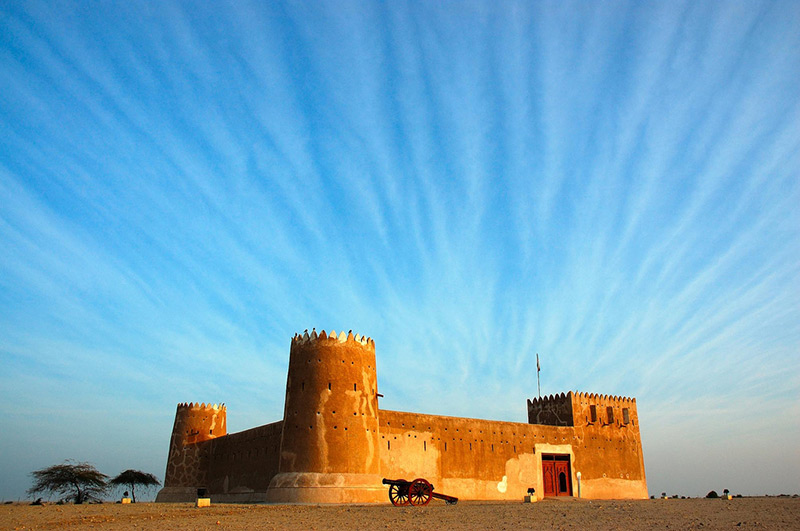
During a ceremony organized on July 7, four sites belonging to the Qatar Museum (QM) organization were awarded carbon neutrality certification established according to the ISO 14068-1:2023 standard, after an independent verification carried out by Earthood Services Limited, with the support of the Gulf Organization for Research & Development (GORD). It recognizes as carbon neutral, for the year 2025, the scope of operations and services retained by the National Museum of Qatar, the Museum of Islamic Art, the Fire Station cultural venue and Fort Al-Zubarah.
The latter, located within the perimeter of the archaeological site listed as a world heritage site, becomes the first facility on a UNESCO property in the Middle East to obtain this certification. The Museum of Islamic Art had already been certified for its 2021 operations and services, the National Museum of Qatar had already received certification for the period April 2022-March 2023.
Several steps are necessary to achieve carbon neutrality, pursued by the heritage sites concerned. First, greenhouse gas (GHG) emissions must be measured and then reduced as much as possible. The negative balance can be offset by financing projects to sequester or reduce carbon in the atmosphere.
The Qatar Museum of Islamic Art, designed by Ieoh Ming Pei and furnished by Jean-Michel Wilmotte, was inaugurated in Doha in 2008.
© Qatar Tourism
The calculation of the GORD includes emissions linked to the operations and services of the audited establishments. More precisely, it counts electricity consumption, water consumption, consumption of refrigerant fluids (air conditioning), solid waste, wastewater, travel of visitors and employees. However, it is not specified whether the transport of works and the travel of international visitors are taken into account. However, we know that the carbon footprint of visitors is the main source of emissions.
In France, no equivalent carbon neutrality certification has been awarded to a museum. For several years, the Ministry of Culture has adopted an ecological transition policy for culture, in particular with the publication in January 2024 of an “Orientation and inspiration guide for the ecological transition of culture”, intended for cultural institutions, to encourage them to measure their carbon footprint and develop reduction strategies. From this point of view, the certification obtained by Qatar Museums appears relatively pioneering, even if the question of visitors’ air travel remains a major question mark.