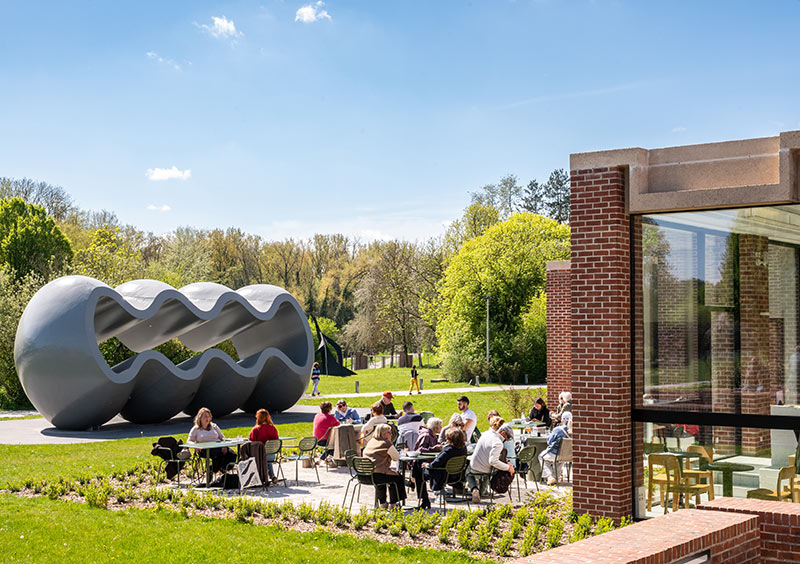
Villeneuve-d’Ascq (North). The LaM reopened its doors last February after eighteen months of work. Its inaugural exhibition, dedicated to Kandinsky, has already attracted more than 100,000 people in just a few months (when the museum’s annual attendance was estimated at 150,000 visitors before its closure). The influx of the public is due as much to the appeal of this flagship exhibition as to the effect of curiosity aroused by the renovation of the place. The most obvious changes concern the creation, on the ground floor, of a “café-estaminet” extended by a terrace (see ill.), and upstairs, of a locavore bistronomic restaurant, “Pigments”, also equipped with an open-air platform. In the park, which houses a dozen sculptures (including a glass and steel pavilion by Dan Graham recently installed), numerous poplars have been planted and seating areas laid out.
Other modifications have taken place, more difficult to detect, because they relate more to rehabilitation, such as the replacement of the 98 windows, now offering better thermal insulation and a UV filter. The roofs have been restored, the brick facades cleaned, as have the orange-brown tiles on the floor. The architecture of Roland Simounet – who now gives his name to a small “living room” with a view of the garden – is thus refreshed, like the blue stone path leading to the museum, whose slabs have regained their original shine. The metropolis of Lille invested 27.2 million euros to carry out this project.
View of the “Obsession” course with from left. to right. : Daniel Buren, The three cabins split into one (1980), Louise Bourgeois, Welcome (1995) and Madge Gill, Untitled.
© Frédéric Iovino
© Adagp Paris 2026
A transversal presentation of the works
Since June 12, the museum has also been inviting its public to discover the new route through its collections. This is in line with the previous “transversal” re-hanging unveiled in 2023, on the occasion of the 40th anniversary of the establishment – at the time, under the direction of Sébastien Delot. Defined by two donations, that, founding, of the collection of the Masurel couple (with a hard core around the cubist period of Georges Braque, Henri Laurens, Fernand Léger and Pablo Picasso), then in 1999, that of the raw art fund of the Aracine association (more than 3,500 pieces), the LaM has also opened up to contemporary art. In 2023 therefore, the institution had imagined a presentation putting works of modern art, contemporary art and outsider art on the same level. Sébastien Faucon, the current director, intends to continue this process of decompartmentalization, for a “more inclusive approach to art” – in particular thanks to the texts of the cartels which eliminate the “pathological” approach to the production of self-taught artists.
Placed under the sign of Obsession – in homage to Harald Szeemann and the “Museum of Obsessions” of the famous Swiss exhibition curator – the route is divided into two parts. The first, chrono-thematic, displays its declassification bias from the start with a wall of paintings which mixes works by Fernand Léger, Picasso, André Lanskoy, but also Augustin Lesage – André Breton’s favorite spiritualist artist – or Séraphine Louis. The Portrait of a Mediuma watercolor by Modigliani evoking an occult session – a recent acquisition – underlines the existence of a common inspiration between the masters of the history of modern art and those who created in its margins. Naïve art encounters the limits of erudition from the beginning of the tour, in a room where, in addition to landscapes by André Bauchant and Léon Beaugrain, several stone figures by “Barbus Müller” attributed to Antoine Rabany and whose ambivalent archaism made the art dealer Paul Guillaume believe for a time that they dated from the 9th century.
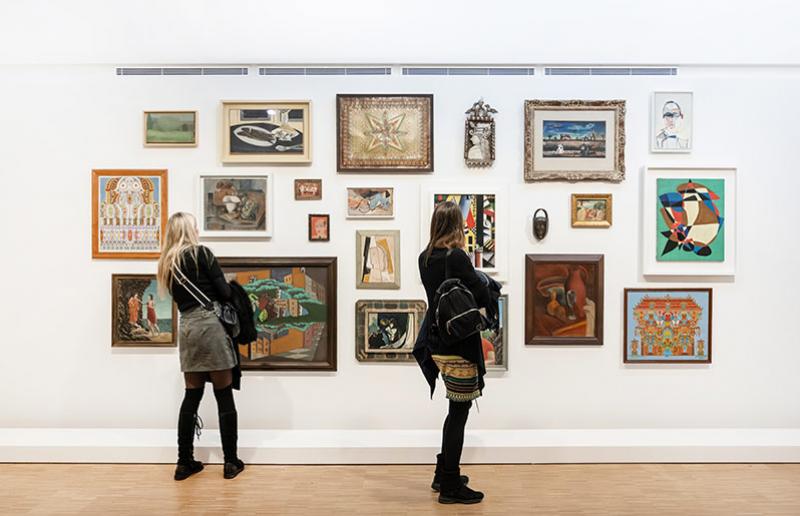
View of the new tour of the LaM permanent collection, “Obsession”.
© Frédéric Iovino
Interspersed here and there, monographic highlights focus on emblematic artists of the museum, such as André Derain and Amedeo Modigliani, or, more surprisingly, Bernard Buffet. We may regret that the short chapter “Desire”, with the promising title, does little to highlight the four female artists (Louise Bourgeois, Madge Gill, Mimi Parent and Ursula) to whom it is dedicated – due in particular to the configuration of the room which welcomes it, with the entrance hall in perspective. A weakness that the fall exhibition, “Singulières”, dedicated to anonymous or little-known outsider art creators, will attempt to compensate.
In the second part, a junction takes place with the contemporary art collection (enriched by an important deposit from the CNAP), around an axis formed by three sculptural pieces by Mike Kelley, Matt Mullican and Jean-Marie Appriou, whose shapes, organic or tangled, suggest a porosity with certain visions of self-taught artists. The proportions are reversed in this second section, housed in the annex of the building designed by the architect Manuelle Gautrand, which unfolds in a star: art brut dominates the hanging, interspersed with works of modern and contemporary art, such as this beautiful photographic set by Joana Hadjithomas & Khalil Joreige magnifying the objects made by the prisoners of the Khiam camp, in the south of Lebanon.
A collision without reference
Ritual, Spiritism, Automation and other writings, mental cartography, Objects, Creatures (such as those, in clay, bristling with thorns, of Shinichi Sawada, creator of outsider art whose notoriety has gone beyond the borders of Japan)… the multiplicity of categories will be able to stun the visitor, as will the countless references and possible readings. This is the risk incurred by a clash which erases, at the same time as the demarcations, the benchmarks sometimes useful for better understanding. And which produces, in addition to a gaggle of labels, an impression of dilution, instilling a little art brut in modern and contemporary art, then the reverse.
Finally, among the new features included in this reinvention of the museum, the RAW space, dedicated to young creation, is inaugurated with a solo by the artist Jessy Razafimandimby. He designed his exhibition in close collaboration with scenographer Madeleine Oltra. Between domestic interior and film set decor, the space, dressed in wood paneling and fabric panels in muted tones, evokes the confined atmosphere of a bourgeois apartment from the 1950s. The artist was able to make the most of this windowless gallery. By mixing his works (paintings and sculptures) with pieces from the art brut collection, and by giving the decor the same importance as his borrowings or his assemblages of scraps cobbled together with refinement, his work goes to the end of a logic of circulation of images and ideas, ultimately established as an aesthetic principle.
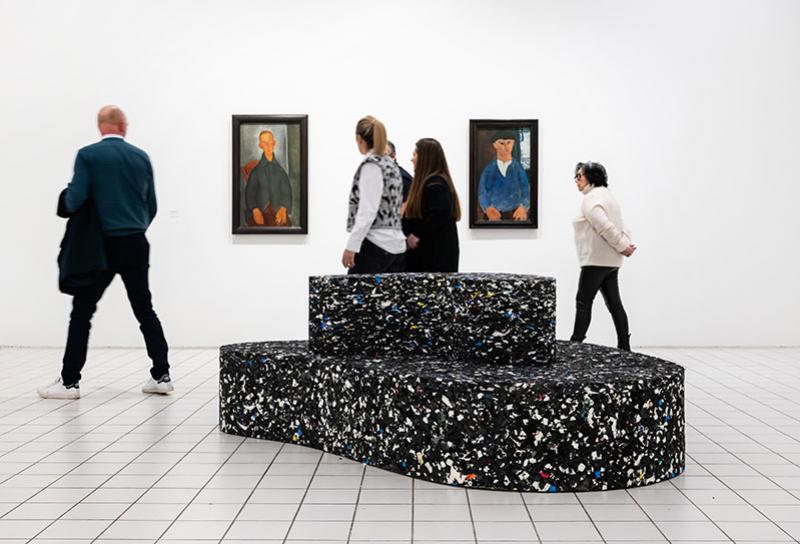
View of the new tour of the LaM permanent collection, “Obsession”.
© Frédéric Iovino