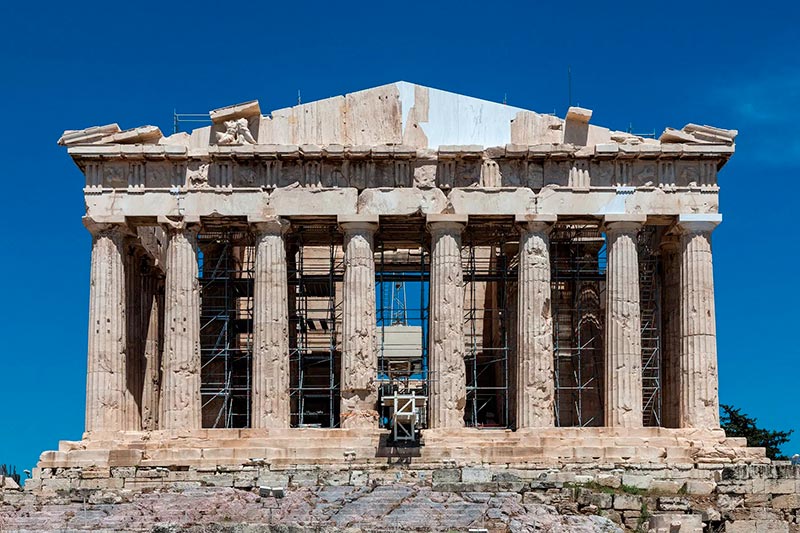
A masterpiece of classical antiquity, a key stop on the Grand Tour of European intellectuals in the 19th century, the Parthenon of the Acropolis of Athens regains its west pediment “in its most complete form after 220 years”announced Greek Culture Minister Lina Mendoni. The restoration of the west pediment is completed after nearly nine years of work, marking a decisive stage in a laborious project which has lasted since 1975.
The finalization of the pediment closes the last phase of the work on the west facade, mainly financed by the European Union Recovery and Resilience Fund. In March 2026, two orthostats (marble blocks) were added in locations that had been empty for more than two centuries. One includes ancient fragments, the other was carved from Pentelic marble, taken from the same place as that which had been used in the 5th century BCE. If the pediment has not completely regained its original antique appearance, the anastylosis technique is favored during the restoration, in compliance with the Venice Charter of 1964 and the principle of reversibility of reconstructions.
Led by the Acropolis Monuments Conservation Service (YSMA) and the Committee for the Restoration and Conservation of the Acropolis Monuments (ESMA), created specifically for this purpose, the Parthenon restoration program appears to be nearing its end. Between 1984 and 1991, the east facade was the subject of interventions aimed, on the one hand, at strengthening its structure by the addition of modern materials and, on the other hand, at reorganizing the antique blocks in a way more faithful to their original layout. In the 1990s and 2000s, restoration focused on the pronaos and the opisthodome (the front and rear porches), then on the northern peristyle.
The Parthenon with the restored west pediment.
© Greek Ministry of Culture
Funded mainly by the European Union and the Greek State, the modern site stands on giant shoulders: it is one of the oldest continuous heritage projects in the world. Interventions are still planned on the facades, but the scaffolding which covered the temple for around twenty years has been removed and replaced by a more discreet framework. Developed over a long period of time, the site took advantage of the arrival of new technologies to carry out precise analyzes on the original marble blocks, facilitating a more faithful restoration.
Today’s architects do not want to repeat the mistakes of the past. One of the challenges of modern restoration aimed to correct the interventions of Nikolaos Balanos, a Greek architect who was entrusted with the reconstruction of the Parthenon and its reinforcement after an earthquake, from 1894 to 1938. His use of unsuitable iron rods had notably caused significant damage to the Pentelic marble. Decades later, this choice led to significant delays in the work, forcing the architects to dismantle the blocks one by one in order to remove the internal structure and replace it with titanium, a more resistant material.
If the Greek Ministry of Culture welcomes this decisive step forward in the renovation of the Temple of Athena, Lina Mendoni renewed the State’s desire to recover marbles from the British Museum during her speech on June 18. Between 1801 and 1805, while Greece was still under Ottoman domination, almost half of the statues from the Parthenon were removed. The kidnapping was orchestrated by Lord Elgin, British ambassador to the Ottoman Empire, who sold them to the British Museum. The sculptures of the pediment, part of the Ionic frieze of the cella, metopes and other elements are to this day distributed in European collections. While the Vatican returned three fragments of the Parthenon in 2023, the most important part of the whole, kept at the British Museum, has been the subject of a repatriation request from the Greek state since 1983.
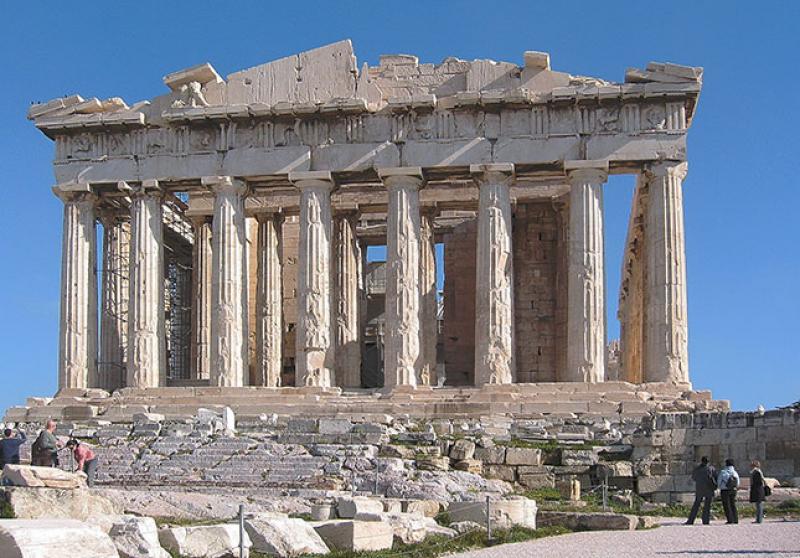
The Parthenon on the Acropolis of Athens in 2006.