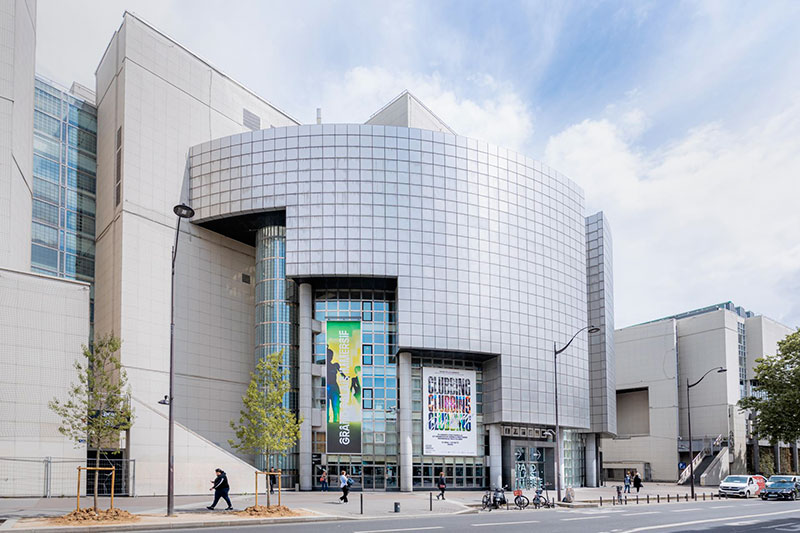
Paris. It’s a room closure that doesn’t say its name. Since October 2025, the modular hall of the Opéra Bastille, designed by architect Carlos Ott to host shows, has been empty. No exhibition announced. No reopening date. The Grand Palais Immersive (GPI), born in 2022 from the marriage between the Réunion des musées nationaux (RMN), the Banque des Territoires, Vinci Immobilier and, since 2024, the Chargeurs Museum Studio group (CMS), has returned the keys. The initial temporary occupation authorization signed for three and a half years from the beginning of 2022 ran until mid-2025. It was tacitly extended until 2026, time to run a few final productions. Its president, Delphine de Canecaude, also general director of CMS, says it bluntly: “The Opera will carry out major renovation work and, as part of this, it has recovered its hall whose destination will also change. It would become a rehearsal room. » In short, the GPI is leaving Paris since, from now on, it no longer has a place to perform.
Christophe Chauffour, deputy general director of Grand Palais-RMN, is also closing all doors to a possible relocation to the capital. Including at the Grand Palais. “The subject was studied and did not appear relevant for a whole set of legal, financial and programmatic reasons, he explains. Efforts are focused internationally and it works. » Because the paradox is cruel. Chargeurs Museum excels internationally: in 2024 it designed the permanent exhibition of the White House Museum in Washington, the spaces of the Sheikh Zayed Grand Mosque in Abu Dhabi, and is working on 44,000 square meters in Mumbai (India). Her exhibition “Meet Mona Lisa” has been a hit in Hong Kong since 2025. And in France, it’s a near failure.
Paris, laboratory at a loss
The attendance figures speak for themselves. According to data not denied by the president of the GPI, the immersive Grand Palais welcomed between 550,000 and 600,000 visitors in total over three years of operation. The best performance is that of Pompeii with 169,000 visitors recorded from December 2024 to May 2025. While ten minutes away by metro, the Ateliers des Lumières, managed by Culturespaces, have 3 million visitors over the same period. Christophe Chauffour sums it up himself. “The dividing line is not easy to find between the emotional and immersive dimension on one side, and the scientific requirement on the other. »
Why, in these conditions, did Chargeurs acquire a stake in GPI instead of creating its own structure? Delphine de Canecaude offers an explanation: “Our challenge was to establish strong partnerships with French institutions, and taking a stake in the GPI allowed us to run exhibitions internationally in accordance with our positioning. We are not an entertainment player, we are a museum player. » Paris was not the goal. And for good reason, Chargeurs is drowning in international contracts. “France is 5% of our market, and having a room or not is not a big deal, because we have won a lot of projects that we must now complete. » But Chargeurs remains discreet about the financial results of its adventure at the Opera; GPI lost 15 million euros in 2023 when Chargeurs acquired 52% of GPI’s capital and had to reinject 3 million euros into the structure.
Fallback into the Muse network
Without a Parisian venue, the GPI falls back on the little-known Muse network. This Grand Palais-RMN regional broadcasting system is deployed in three cities. Christophe Chauffour speaks about it with sincere conviction. “It’s a great tool for the school and local public but also from a tourist point of view in the city’s cultural offering. » However, the state of the network revealed by the 2023 attendance figures is not looking good. The three sites welcomed a total of 29,485 visitors over the entire year. The former branch of the Banque de France in Maubeuge (North) received 17,201 compared to 10,038 in Saint-Dizier (Haute-Marne). And Barentin, in Normandy, recorded only 2,246 entries. The highlight of the network dates from 2023 with the exhibition on The Mona Lisa which totaled 12,919 visitors over seven months, including 3,570 from schools. The Ateliers des Lumières make this figure in one week. Since then, the network has crumbled. The City of Barentin has just let go of Muse. The project to renovate the Badin industrial wasteland in Barentin, chosen for the location of the GPI exhibitions, was abandoned by the re-elected mayor. “The project is being reoriented because the mayor has other cultural priorities”confirms Christophe Chauffour, who assures that he is in discussions with new municipalities. “Negotiations are advanced with one city and contacts are established with others, between one and five,” he specifies, hastening to add: “We also know the state of the finances and, each time, it is an investment for the City. »
The GPI seems to be moving towards a reorientation of programming and even of the artistic line. Exit contemporary artists or abstract themes. Make way for more “bankable” exhibitions. Christophe Chauffour announces it clearly. “We have a program of developing exhibitions over several years around major figures in history or art history such as The Mona Lisa. » The next one will be dedicated to Napoleon. In short, a readable line for the general public. And exportable. Chauffour himself concedes:“The world-famous figure of Napoleon offers export potential. » This is a logic that the RMN had not entirely anticipated when it founded the immersive Grand Palais in 2022 with state money. Does Delphine de Canecaude still envisage a return to Paris in the future? “You have to have places that are in the heart of Paris like the Opera hall and it’s not easy to find. »