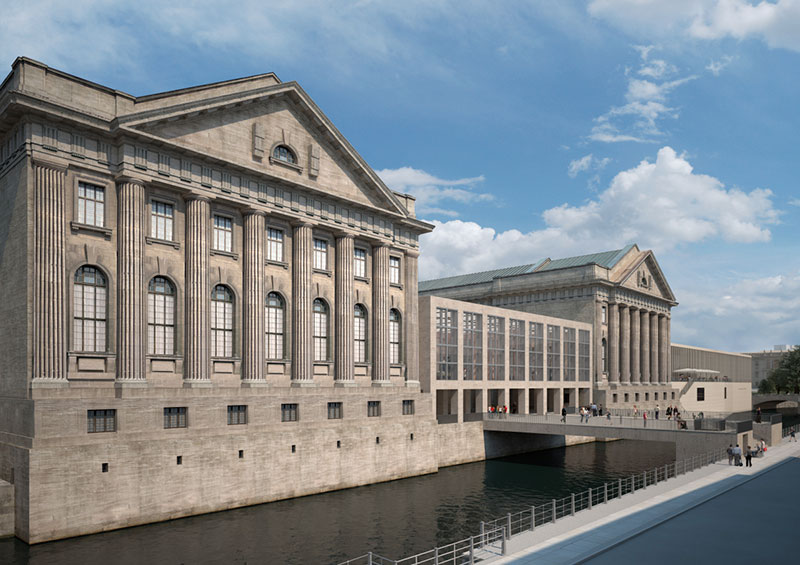
Closed since October 2023, the Pergamon Museum, on Museum Island in Berlin, will partially reopen in June 2027. This reopening will only concern the north wing and the central part of the building. For the entire museum, long the most visited in Germany, we will still have to wait. The deadline remains set at 2037, even if some internal estimates already suggest 2043. The Prussian Cultural Heritage Foundation (SPK), which manages the museum, has indicated that reservations for groups will open on July 1.
Renovation and extension work began in autumn 2012 on the north wing and the central section of the building. They follow the plans of Oswald Mathias Ungers, who designed the transformation of the museum into a modern building meeting current standards while preserving its status as a historic monument. The project also plans a fourth connecting wing and an underground archaeological “promenade” connecting four of the five buildings on Museum Island.
This reopening will coincide with the bicentenary of Berlin’s Museum Island. The Pergamon Altar, a centerpiece that has been absent from view for more than ten years, will once again be visible. However, it will close again for five months in 2034, while it is connected to the archaeological promenade.
Great Pergamon Altar in the Pergamon Museum in Berlin.
The collection of classic antiques will also reopen. The Museum of Islamic Art will be presented in a completely redesigned permanent exhibition in the north wing. It will notably bring together the facade of the Mchatta Palace, the Aleppo Chamber and the dome of the Alhambra, all restored. The Near East Museum will exhibit several major pieces from its Babylonian collection. A new “Tempietto”, a small entrance pavilion, will serve as temporary access to the museum. It will close again in 2030, at the launch of phase B of the project. On the other hand, the Ishtar Gate, the Processional Way of Babylon and the Market Gate of Miletus, located in the south wing, will not reopen until the 2030s.
The project has become a textbook case of budgetary excesses in Germany. In 2016, the cost estimate almost doubled, from €261 million to €477 million, after the discovery of a huge underground concrete caisson left in place since the original construction. The timetable was then pushed back four years.
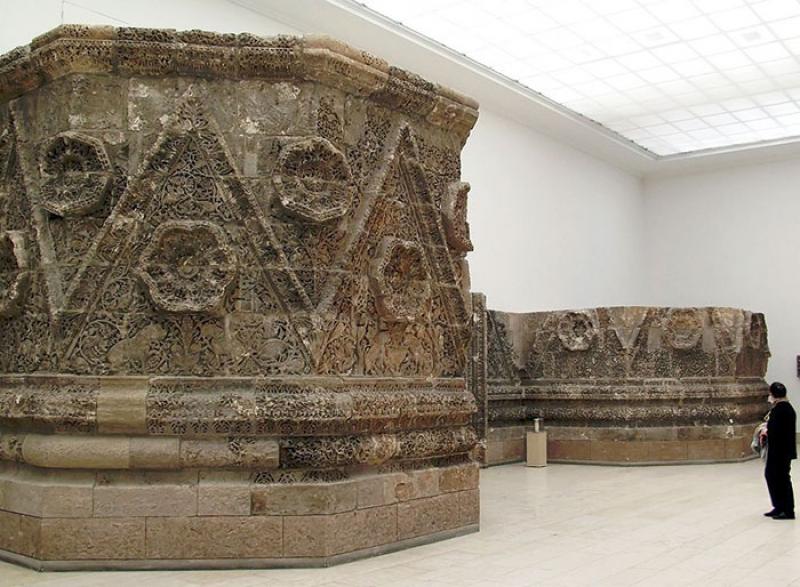
Frieze from the facade of the Mchatta Palace (8th century) at the Museum of Islamic Art in Berlin
In 2024, the overall cost of the two phases of the project was estimated at 1.5 billion euros. This amount includes 1.2 billion euros for renovation and extension, plus a 300 million euro reserve for risks and price increases. The magazine Der Spiegel nicknamed the construction site “Pergamonster”. In May 2024, internal SPK documents showed that funds allocated for the first phase were almost exhausted. The termination of a construction company’s contract even threatened the reopening date.
Since the closure, the SPK has implemented several solutions to maintain access to the collections. The exhibition “Pergamonmuseum. Das Panorama”, installed opposite Museum Island, offers a 360-degree panoramic view, 15 meters high, reconstructing the Acropolis of Pergamon in 129 AD. Yadegar Asisi’s installation is accompanied by approximately 80 original pieces from the collection of classical antiquities, including the large Telephos frieze from the Pergamon Altar. Some works are loaned to Berlin museums, such as the Hamburger Bahnhof and the Cabinet of Graphic Arts. Cooperation is also in preparation with international institutions, including the Louvre. The Near East Museum has also put online a virtual tour of its former permanent exhibition.
Built between 1910 and 1930, the Pergamon Museum was designed by Alfred Messel under the direction of Ludwig Hoffmann. It was designed from the beginning to accommodate the great archaeological discoveries reported by the Prussian royal museums, especially in Greece and Turkey, notably in Pergamum and Miletus. The building, organized into three wings, is located in the heart of Museum Island, a UNESCO World Heritage Site.