Metz (Moselle). It would seem that 2026 will be the year of European recognition for Beverly Buchanan: in addition to the presence, from next May, of her work on the walls of “In Minor Keys”, the 61st International Art Exhibition of the Venice Biennale curated by the late Koyo Kouoh, the African-American artist (1940-2015) is the subject of a major retrospective carried by three Western European institutions. After the Haus am Waldsee in Berlin, the monographic exhibition stops at the Frac Lorraine before flying to the Spike Island art center in Bristol, England. The first presentation of the artist’s work to the French public, the Metz section highlights her attachment to the way of life of rural black communities in the southern United States.
Vernacular architecture
After a childhood marked by the horrors of segregation, Beverly Buchanan left South Carolina for New York in the mid-1960s. She studied at the Art Students League with Norman Lewis, a figure of the Harlem Renaissance, and took her first steps in the art world. But it didn’t take long for her to feel nostalgic for her native South. She moved to Georgia in 1977, a territory still bearing the scars of slavery that she continued to portray until her death.
Beverly Buchanan, Lamar County, GA2003, oil pastel on paper, 56 x 76 cm.
© Estate of Beverly Buchanan / Andrew Edlin Gallery
© Adagp Paris 2026
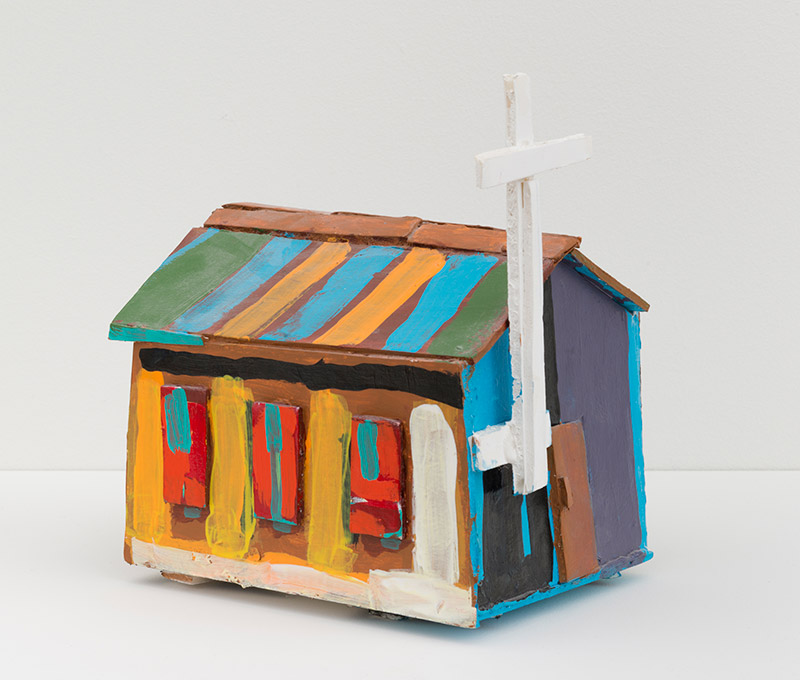
His study of the vernacular architecture of black communities in the Southern States began in the 1980s: the artist is interested in old slave huts rehabilitated by their new occupants as well as in the sheds built ex nihilo using wooden planks gleaned here and there. In a large number of vibrant oil pastel compositions, Buchanan transcribes the wobbly structure of the sheds by tracing the edges of the walls obliquely. Thanks to the expressive use of shimmering and strongly contrasting colors, she manages to give her huts a warm and lively atmosphere – Buchanan literally paints a portrait of her huts, which become sort of reifications of their architect-owners. The entire series turns out to be as modest as it is fascinating. But his sculptures in the spirit of Arte Povera like the large cabin of the installation South Inside Out (1990), made from recycled materials (wooden planks, sheet metal, wire), the “7 houses” (1997) made of featherboard and the “charred sheds” form a body of equally great interest.
Fanny Gonella, director of Frac Lorraine and curator of the exhibition, chose to disseminate documentation in several rooms. Thus, numerous archives (letters, photographs and texts written by the artist) allow us to discover his links with institutional actors in the art world and artists of the time, such as Ana Mendieta (1948-1985), but they are also precious testimonies of a scrupulously recorded artistic approach. The result is a rich and comprehensive exhibition that pays homage to all facets of the artist. After Clemen Parrocchetti, the Frac Lorraine therefore continues, with rigor and relevance, its rehabilitation of forgotten contemporary art close to “do-it-yourself”.