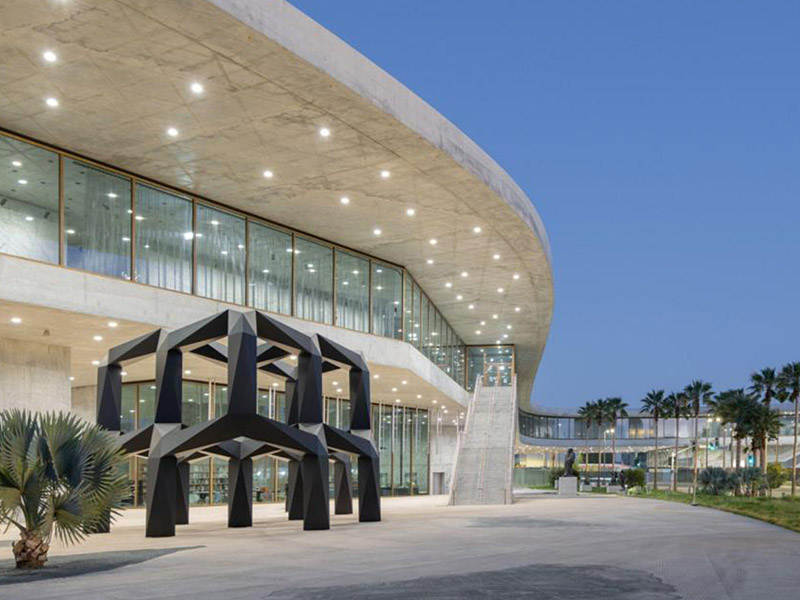
The Los Angeles County Museum of Art (LACMA) inaugurated the David Geffen Galleries, after twenty years of construction above Wilshire Boulevard. A 300 m horizontal slab crosses the avenue to unify the museum campus. Seven raw concrete pavilions support this mass which seems both heavy and floating. The single platform, 9 m high, houses 32,000 m² of exhibition space, divided into 90 open-plan spaces which abolish departmental hierarchies. Below, a free “park level” opens the museum to all audiences. Terraces, outdoor sculptures, theater and circulations ensure a continuous urban presence.
Forty-five curators from all departments collaborated on the inaugural hanging. This structures the permanent collection around the Pacific, Indian, Atlantic and Mediterranean oceans. On 10,220 m² of exhibition space, the presentation focuses on human migrations, commercial exchanges and cultural syncretisms. Picasso interacts with pre-Columbian pottery, Warhol rubs shoulders with Dogon sculptures. Andean textiles meet Japanese ivories in a transnational narrative. Lacma asserts that all the works occupy the same plane, literally and metaphorically. Rotations will occur.
Aerial view of the new Lacma building in Los Angeles.
© Atelier Peter Zumthor / The Boundary
Architecturally, the rectangular volumes of unequal sizes follow one another without hierarchical composition. No solemn entry really structures the whole. The architect of the new spaces, the Swiss Peter Zumthor sums up this indeterminacy with the formula “neither in front nor behind”. Running along the facades over 4,366 m², a perimeter glass promenade serves both as an additional gallery and a lookout over Hancock Park.
Raw concrete amplifies this sensory ambivalence. Etched equilateral triangular patterns mark all ceilings, aligning precisely with LED lighting and ventilation grilles. Irregular streaks streaking the walls were made manually by craftsmen. Textured floors absorb echoes in the vast volumes. This mineral roughness enhances the delicacy of a Monet painting through brutal contrast. Mayan monumentality gains in intensity. Natural overhead light floods the central rooms.
Nearby natural tar pools inspired the building’s undulating form. Peter Zumthor compares this horizontal mass to a puddle of bitumen spread on the ground. Large exterior stairs and elevators lead to the gallery floor. Critics speak of a “highway blob” devouring Wilshire Boulevard, disconnecting the avenue from its pedestrian crossing. Defenders welcome a civic infrastructure open 24 hours a day.
The production cost 720 million dollars (612 million euros) in total. David Geffen contributed 150 million dollars (127 million euros). Los Angeles County financed a substantial portion of the public works.