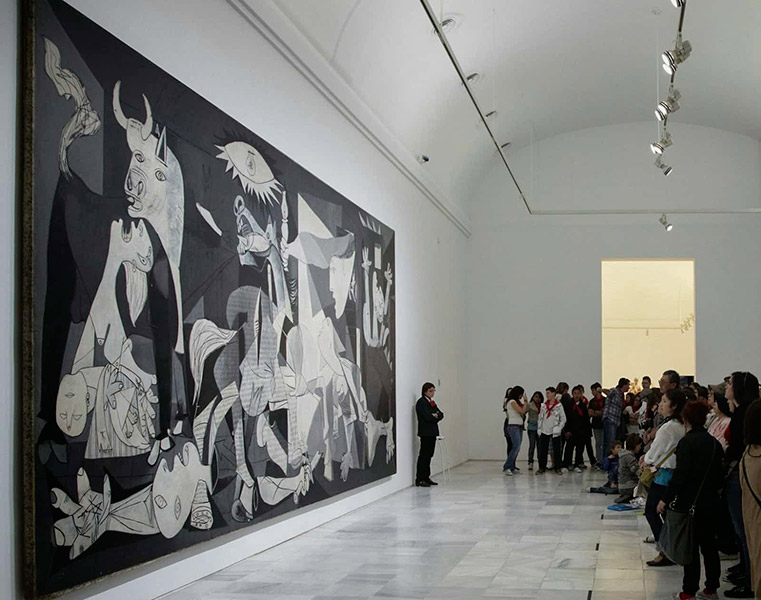
Madrid. At the beginning of April, the Spanish government closed a file that the Basque Country hoped to reopen on the occasion of the 90th anniversary of the bombing of Gernika. Requested by the Basque government, which wanted to see the painting exhibited for nine months at the Guggenheim Bilbao, between October 2026 and June 2027, the Minister of Culture, Ernest Urtasun, refused, relying on the technical opinions of the Reina Sofía Museum.
This is not the first time that Bilbao has been refused. In 1997, on the occasion of the inauguration of the Guggenheim Bilbao, a first loan request was rejected. In 2007, a new request for an exhibition at the Guggenheim was also formally refused by the Reina Sofia Museum. As compensation, the Madrid museum agrees to lend only twenty-four preparatory drawings and a variation of Guernica for an exhibition organized in Gernika-Lumo.
Bilbao has never been the only rejected applicant. The Reina-Sofía also refused requests from MoMA (New York) in 2000, the Royal Ontario Museum (Toronto) in 2006, the Fuji group for Tokyo in 2009 or even the Gwangju Museum of Art (South Korea) in 2012.
The argument put forward is first of all conservative. In a report dated March 25, the conservation-restoration department of the Reina-Sofía recalls that the canvas, immense, complex and weakened by its numerous past movements, is particularly vulnerable to vibrations. These could cause new cracks, lifting and loss of pictorial material, or even tears in the support.
Painted by Picasso in 1937 for the pavilion of the Spanish Republic at the Paris International Exhibition, Guernica is inseparable from the bombing of the Basque town on April 26, 1937. For the Basques, the work touches on a major place of memory. Gernika is not only the martyr town of the civil war, it is also one of the symbolic high places of Basque freedoms, associated with the Tree of Gernika under which the Basque sovereigns traditionally came to swear to respect the firesor Basque laws. This is why the Basque government still presents the arrival of the painting today as a gesture of symbolic reparation.
But the history of the work also pleads, in the eyes of Madrid, for its sedentarization. After circulating for a long time in Europe and the United States, then being kept for decades at MoMA, at Picasso’s request until Spain regained democratic freedoms, the painting returned to Spain in 1981, six years after Franco’s death. First installed at the Casón del Buen Retiro, it then joined the Reina-Sofía in 1992. For the Spanish State, Guernica is now a heritage asset of universal value, whose conservation in Madrid must take precedence over any territorial claim, even if highly symbolic.