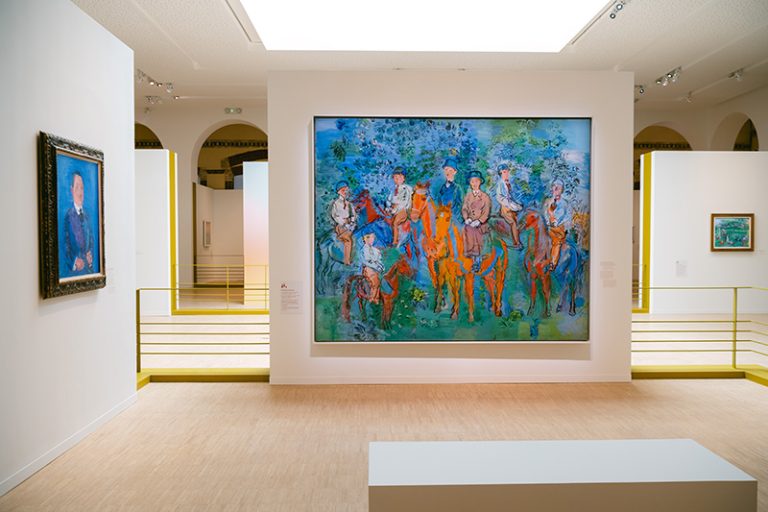
Romainville (Seine-Saint-Denis). There is a painter who never stopped resuming his paintings even on the walls of museums: Pierre Bonnard (1867-1947). Inspired by the endless retouching of the master Nabi, the curatorial collective Le Bureau/ is interested in the place of impermanence and the unfinished in contemporary art and highlights issues worthy of being addressed within the framework of museology conferences: does (re)creation have its place in the institution once the work is included in the inventory? What consequences can retouching a work have on the management of a collection? If the questions are pushed, it is because the commissioners are not at their first attempt. Twelve years after exploring the “Bonnard Syndrome” at the Villa du Parc, in Annemasse, from the MAMCO Geneva collection, the curators are this time diving into the Frac Île-de-France funds to write the new chapter in their curatorial saga.
Three axes of the exhibition shed light in a completely convincing manner on the forms that the notion of impermanence can take in contemporary creation. The curators are initially interested in the purest heritage of the “Bonnardian” model with a selection of fans of retouching, like the painter Jean-Luc Blanc (born in 1965) – the surface of his enigmatic painting A little narrow (2014) keeps track of his successive interventions. Another interesting variation, the canvas 4 wefts 30°, 120°, 150° starting from an angle, 180 cm mesh (1977) which François Morellet (1926-2016) extended with neon tubes on the occasion of the 20th anniversary of the Frac in 2003, and which the establishment chose to include in the inventory under a new title, In a new light, we play overtime.
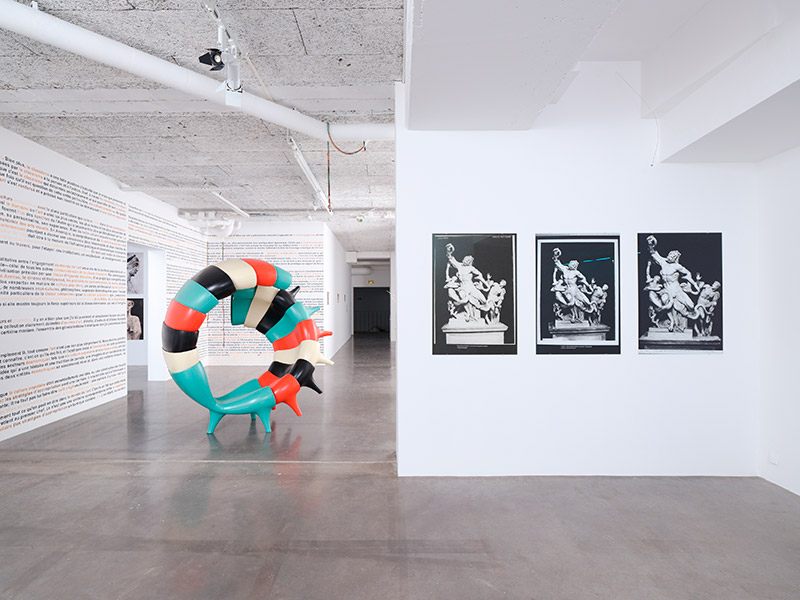
The exhibition “The Bonnard Syndrome” at the Frac Île-de-Franec – Les Réserves.
© Aurélien Mole
© Adagp Paris 2026
Further on, the curators look at another meaning of retouching through the reuse of old productions in new works – this is particularly the case with the installation Bison4 (2026) for which Stéphanie Cherpin (born in 1979). rearranged assemblages produced as part of a monographic exhibition at the Les Capucins art center in Embrun. This section pertinently shows that the works produced by institutions can have very varied outcomes. Finally, the exhibition addresses the essential question of protocol works, the reactivation of which implies new interpretations and therefore, necessarily, formal developments.
Despite its many qualities, the exhibition suffers from a pitfall: the curators tried to pull too many threads from their initial concept. In certain sections, “The Bonnard Syndrome” ceases to be interested in the moving forms of works to embrace much broader questions such as the circulation of motifs in the history of art and the evolution of the view of works according to societal changes. This is a matter of tautological reasoning: if not all works are “Bonnardian”, the interpretation and appreciation of all works are constantly evolving: this is the nature of art. The exhibition would have been more impactful if it had focused on two or three strong axes, presenting its concept in a narrow manner.