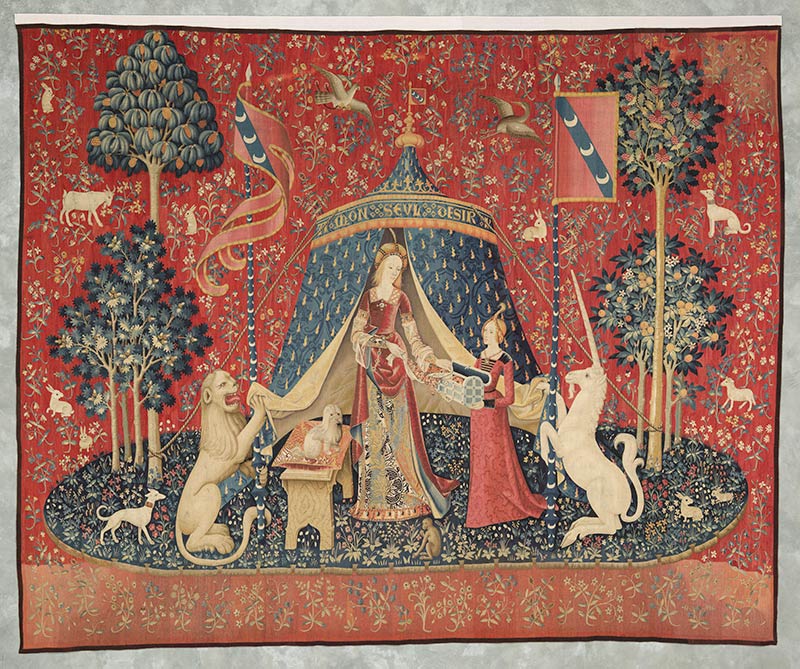
Paris. By choosing a widely appreciated theme, the Cluny Museum is playing it safe. The unicorn is trendy, attracts young and old, and guarantees a certain attendance. The museum, which houses the famous tapestry of the Lady with the unicornhad already dedicated an exhibition to the fantastic creature in 2018, focusing on two periods: around the 1500s (period of creation of the tapestry) then on the resonance of the motif in modern and current art. If the subject is not new, the museum has the merit, however, of offering a new exhibition that is much more extensive and documented. The frequent visitor will find some essentials already present in the previous tour, such as an aquamanile with a twisted horn (around 1400) or the hanging of Saint Stephen (around 1500), where the unicorn is among the wild beasts surrounding the body of the martyr. But the selection of works presented nonetheless remains of very high quality. The association with the Museum Barberini in Potsdam (Germany), which hosted the exhibition last year, offers the possibility of admiring Germanic pieces that are otherwise difficult to bring in – or at least little known. A wooden sculpture from the stalls of a chapel in Augsburg shows the unusual iconography of a prophetess holding a small unicorn. An Italian silk chasuble, discovered during the exhibition, features the captive unicorn motif.
View of the “Unicorns! » at the Cluny Museum – national museum of the Middle Ages.
© Dubontemps / Cluny Museum
Here lies the whole point (and interest) of the exhibition: showing the unicorn in all its variety of meanings and representations.“When we began researching unicorns six years ago, we realized that they were represented in many cultures, and that they took many forms in science, medicine, natural history books, travel stories…,”lists Michael Philipp, curator at the Museum Barberini, in charge of the curatorship with Béatrice de Chancel-Bardelot, curator at the Cluny Museum. Christlike unicorn as wild, healer as fighter, chaste as lover… by opting for a thematic division, Cluny fully illustrates all the ambivalence of the motif, even if it means presenting a somewhat fragmented journey. Small engravings, from the “Little Cards” series» to play the Master ES, associate him with wild men and women forming an idyllic society which sings the praises of God. Further on, a large pharmacy sign recalls the healing virtues attributed to the unicorn horn. Above all, the exhibition emphasizes the ambiguous nature of the fabulous animal which, if it is today commonly considered peaceful and benevolent, could also be aggressive. A bas-relief from the cathedral of Ferrara, sculpted in the 13th century, is the most eloquent example: on the verge of falling into the abyss of hell, a man is threatened by a quarrelsome unicorn who prevents him from climbing back up.
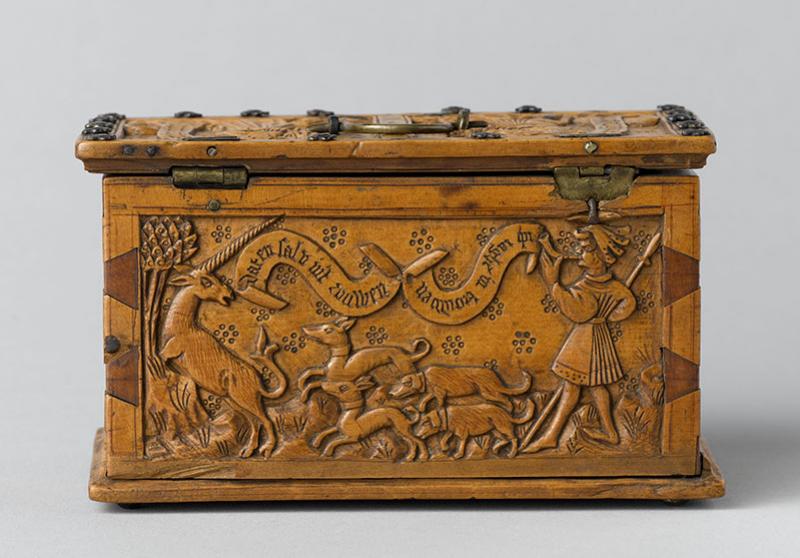
Rear panel of a box representing a unicorn hunt, Middle Rhine, circa 1500, boxwood, Musée de Cluny – national museum of the Middle Ages.
© GrandPalaisRmn / Jean-Gilles Berizzi
From the appearance of the motif to modern art
Taking the scientific approach further, the exhibition questions the appearance and propagation of the motif. A brief but welcome foray into non-European arts reveals that the unicorn animal already appeared on a seal dating from 2000 BC, even if the white horse unicorn did not become established until the end of the Middle Ages. A creature inhabiting paradise, symbol of Christ coming to recharge his batteries in the lap of his mother, she then accompanies the chaste young girl and can also represent the unfortunate lover. And this extraordinary and inaccessible animal, the exhibition does not fail to anchor it in reality: a narwhal tooth once confused with the unicorn’s horn, but also travel stories and scientific drawings which helped to give it substance and shape the myth.
The transition to modern art, on the other hand, is more abrupt. Barely announced by the hanging of a few advertising posters from the 20th century, where the unicorn serves as an automobile and maritime transport emblem. It is upstairs that a small selection of works highlights its importance in artistic creation, from the end of the 19th century to the 21st century. Graceful symbolist paintings, amusing unicorns by Niki de Saint Phalle (1930-2002) and Aurélie Nemours (1910-2005), performance playing on the hybrid by Rebecca Horn (1944-2024) or even the symbol of a threatened nature by Suzanne Husky (born in 1975): the reinterpretations hit the mark, but suffer from the crampedness of the room. No doubt they would have resonated more if they had been punctuated throughout the route, which logically ends with the six tapestries of the Lady with the unicorn. An essential final point, the hanging, always partly enigmatic, embodies all the richness and complexity of this iconography. A unicorn which, even today, has not finished revealing all its mystery.