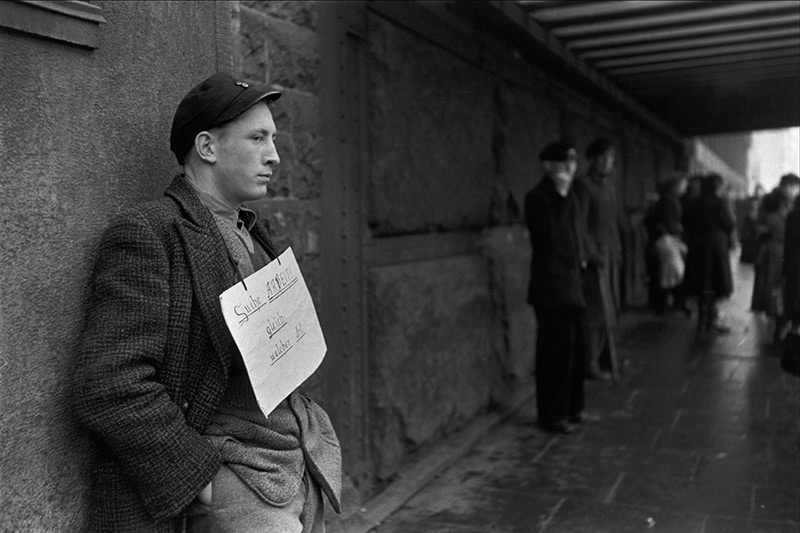
Paris. In October 2025, the Henri Cartier-Bresson Foundation reissued The Europeanswork published in France by Verve in 1955 and by Simon and Schuster in the United States. Clément Chéroux, director of the Foundation, then justified this reissue by the wish “to bring out of the shadows this extremely important book that the success ofImages at La Sauvette, published in 1952 by Tériade, the founder of Verve, had eclipsed; important because this book, composed of 114 photographs taken between 1950 and 1955 in ten European countries, represents Cartier-Bresson’s position on Europe through those who inhabited it in the post-war period..
The Cartier-Bresson exhibition which opened at the Foundation at the end of January in turn revisits the work through the presentation of around fifty of his photographs from the published set, and explains it in an educational way through different documents, such as the original gouache by Joan Miró created for the cover of the book. Also on display is the “front page” of the magazine. American Holiday, which, in 1954, a year before Europeans, published under the title “The Face of Europe” (“the face of Europe”) a portfolio of photographs from the series.
Henri Cartier-Bresson (1908-2004), Burgos, Spain1953.
© Henri Cartier-Bresson Foundation / Magnum Photos
Most of the images selected for the “Europeans” were in fact distributed in France and internationally in the magazine press, then in full expansion, and the publication of the book was part of a time when many publishers were producing photo books on countries or cities, as the exhibition reminds us. “Many photographers then made their living doing this type of work and a large number of important books in the history of photography are associated with countries such as those of Paul Strand, born from his travels undertaken in Europe between 1949 and 1957, or the New York of William Klein,” underlines Clément Chéroux. Like them, Cartier-Bresson brings together in The Europeans a diversity of ordinary scenes sketched from life to form “a series of physiognomic studies of different social groups”. From Spain, where he covered the civil war before returning there after the war, to Germany and the Soviet Union, we see the politically engaged man that Cartier-Bresson was.
After the unforgettable exhibition “Richard Avedon, In the American West”, presented as part of the 40th anniversary of the iconic work, continues with “The Europeans” a fascinating exploration of the books that have marked the history of photography, while giving us a chance to see these images again beyond the one passed down to posterity of this little boy from rue Mouffetard carrying a bottle of wine in each arm.