A federal decision led last January to the removal of panels on slavery at the President’s House in Philadelphia before a judge today ordered their reinstallation. The National Park Service (NPS) in Philadelphia had removed several of these signs (“Living as a Slave,” “The Business of Slavery,” etc.). The removal followed an executive order signed in March 2025 by President Donald Trump – “Restoring Truth and Sanity to American History” – which directed the Department of the Interior to remove from public sites anything that could criticize Americans of the past, in order to restore the greatness of the nation’s history. The City of Philadelphia quickly challenged this decision, arguing that it could not be made without its prior consent.
Federal Judge Cynthia M. Rufe issued an interim order directing the President’s House to completely reinstall the exhibit as it was before the removals. She opens her decision by quoting George Orwell (1984): “As if the Ministry of Truth in 1984 now existed, with its motto ‘Ignorance is Strength'” (1), before adding that the federal government does not have “the power it claims to distort and dismantle historical truths.” This decision, pronounced on Presidents’ Day (February 17), applies immediately pending the judgment on the merits of the summons.
The judge ruled that the withdrawal of the exhibition was “arbitrary and capricious”. Even if the executive had invoked its decree of March 2025 to justify the deletions (arguing that it was necessary to “restore truth and reason” by removing aspects deemed negative), the court recalls that this presidential order does not exempt from respecting existing laws.
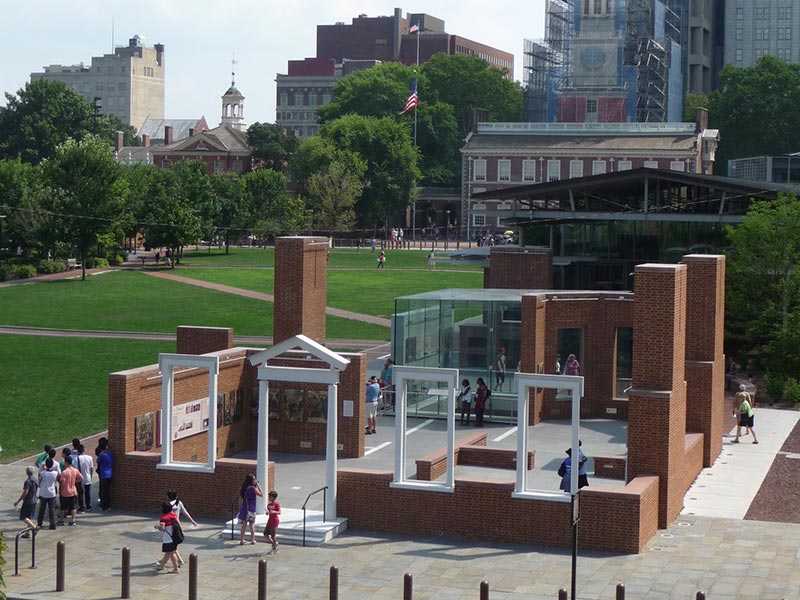
The President’s House in Philadelphia is the former official residence of Presidents George Washington and John Adams in the 1790s. Since 2010, an outdoor exhibit, entitled “Freedom and Slavery in Building a New Nation,” honors the nine slaves who lived there during the Washington Administration. The exhibition included 34 explanatory panels and videos retracing the lives of these people and, more generally, the history of slavery in the early days of the American republic.