Rome. The years pass but the controversy remains. How can we honor the memory of Mario Sironi (1885-1961), a major artist of the 20th century but one of the artistic pillars of Benito Mussolini’s regime? Long victim of a real damnatio memoriaethe importance of his work has nevertheless been recognized and re-evaluated in recent years. The “distinction between the man and the artist” seemed to have helped to calm the debate around the figure of a leading protagonist of the futurist avant-garde. It is once again revived with the announcement at the very beginning of the year by the Minister of Culture Alessandro Giuli of a project to open a Sironi museum in the heart of Rome for “restore its rightful place”to an artist whose genius has long been obscured by his unfailing adherence to fascism.
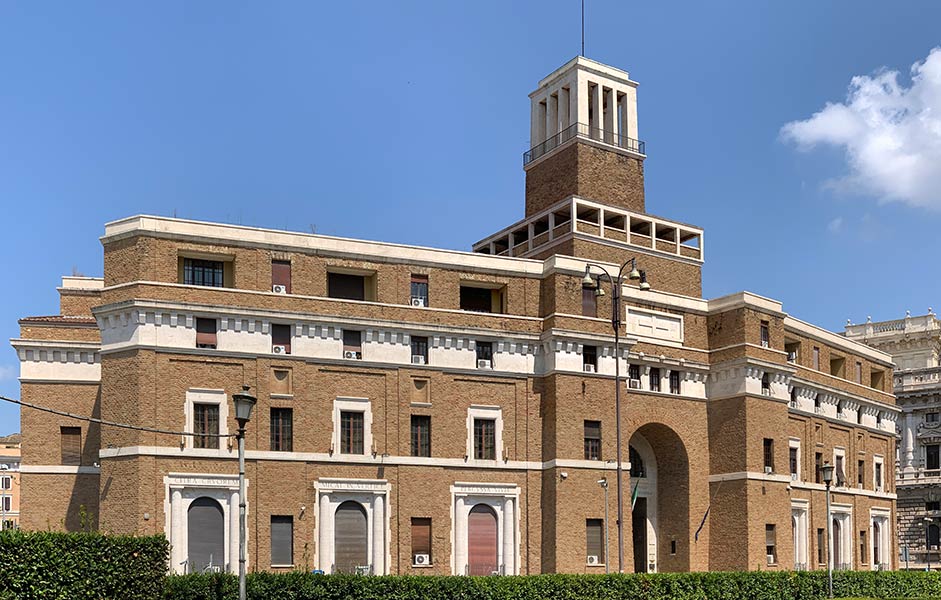
The future museum will not be located in a neutral space, but in the Casa Madre dei Mutilati e Invalidi di Guerra (see ill.), located in Piazza Adriana opposite Castel Sant’Angelo. This choice is far from trivial. Designed by the architect Marcello Piacentini (a leading figure in fascist urban planning and close collaborator of Mario Sironi), the building is a manifesto of Italian rationalism. An architectural movement whose recognition had also suffered for decades from having emerged in the heart of the fascist dictatorship. The Casa Madre dei Mutilati ed Invalidi di Guerra already houses in situ works by Mario Sironi, in particular cycles of monumental frescoes celebrating sacrifice and the homeland with the exaltation of the Duce as a warrior chief.
The project for this new museum is structured around two axes: a permanent exhibition tour and the creation of an archive center dedicated to the artist. The aim is to bring together a collection capable of tracing the stylistic evolution of Mario Sironi, from his futuristic beginnings to his famous melancholic “urban landscapes”, to his late, darker and tormented expressionism. The most scientifically relevant aspect remains the creation of an archive center to centralize the documents, sketches and correspondence hitherto dispersed. The aim is to document not only the work of the painter, but also that of the press graphic designer (notably for Il Popolo d’Italia), whose influence on visual communication in the 20th century was immense.
Works exhibited everywhere
The future Sironi Museum is designed as a reference center dedicated to the study and influence of the artist. This project is based on a strategic partnership: the Quadriennale Foundation provides scientific direction, while the National Association of Disabled War Members provides the premises (with rent free during the year of work). Enriched by a collection of works donated by the Sironi Archives, the museum which should be inaugurated by the end of 2026 will play a central coordination role, structuring an “outside the walls” route through the sites in Rome housing monumental works by the artist (La Sapienza University, the Ministry of Business and Made in Italy as well as Farnesina, headquarters of the Ministry of Foreign Affairs). The ministry justifies this creation by the need to “fill a void”.
If the intention is laudable, it comes up against direct criticism from the most respected art historians, including Fabio Benzi. For this eminent specialist in futurism, the project suffers from a fundamental ambiguity, both on a museographic and political level. “A museum dedicated to a painter either brings together a group of works sufficient to describe his artistic career, or constitutes, for example, a house museum which illustrates different aspects, he explains, raising a practical objection: “A monographic museum only makes sense if it has a critical mass of masterpieces. However, Sironi’s largest paintings are already distributed between the National Gallery of Modern Art (GNAM) in Rome, the Museo del Novecento in Milan and private collections. Creating a new structure risks leading to a museum that is incomplete by definition; public money would be better invested in the acquisition of major works to enrich existing national collections. »
But it is not the museographic question which raises the most reluctance. The nationalist right-wing government currently in power in Italy is all the more open to the accusation of political exploitation as the party of the president of the council Giorgia Meloni is a post-fascist party. Mario Sironi never renounced his convictions in favor of the regime of Benito Mussolini. By installing his museum in a place saturated with fascist symbolism, the risk is to transform the artistic tribute into an ideological mausoleum. “ The project could obscure the Sironic tragedy, specifies Fabio Benzi, thisthe daughter of a man whose artistic genius is inseparable from a total and disastrous political commitment. The risk is to legitimize a certain authoritarian aesthetic under the guise of cultural rediscovery of a major artist. »