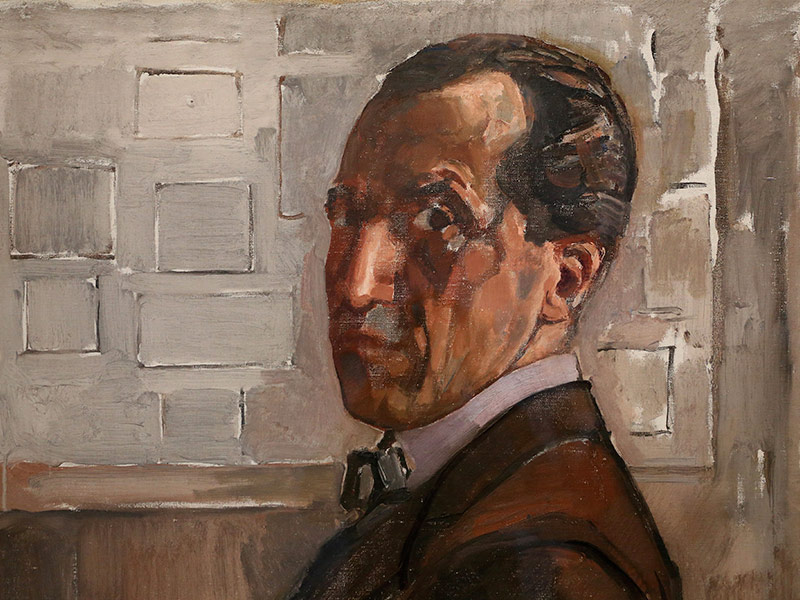
Paris, 1977. The inauguration of the Georges-Pompidou National Center for Art and Culture, today called “Centre Pompidou” and nicknamed “Beaubourg”, reveals the shortcomings of its modern art collections, particularly in the field of foreign painting. It is true that purchases have remained low, large donations are still rare and donations, which made their legal appearance in 1972, are slow in coming. Among the flagrant cases, that of Pieter Cornelis Mondriaan, known as “Piet Mondrian” (1872-1944), who nevertheless lived for twenty-two years in Paris. Only one work by the leader of geometric abstract art was acquired, in 1975 for $400,000 from a Parisian dealer in the Faubourg Saint-Honoré: Composition in red, blue and white II (1937).
It is in this context that the writer and art critic Michel Seuphor submits a tempting offer to Germain Viatte, curator of the National Museum of Modern Art: Simone Verdé wishes to part with three unpublished paintings by Mondrian; she would get them from her late husband. A purchase project quickly materialized for the sum of 6 million francs (more than 4 million euros), especially as Verdé also offered to make a donation of a painting by the lesser-known Dutch artist Bart Van der Leck. The paintings are delivered to the Center Pompidou for examination. Seuphor is delighted to see Mondrian’s three masterpieces heading to national collections while a commission from the Museums of France expresses its unanimous positive opinion. But a few days later, disaster struck. Two phone calls from Switzerland alert Germain Viatte: Mondrian’s paintings are fakes! The dream turns into a nightmare. Simone Verdé is unable to reconstruct the history of the provenance of the works – which would certainly raise questions these days – and the Center Pompidou therefore denounces the act of sale and files a complaint against X for artistic fraud and use of false certificates.
In 1895, the Bardoux law against artistic fraud
At the end of the 19th century, the scandal of the fake painting of Camille Corot acquired by Alexandre Dumas fils showed that neither civil law nor criminal law made it possible to convict the usurper. It was necessary to wait for the law of February 9, 1895 on fraud in artistic matters, known as the “Bardoux law” (named after its author Senator Agénor Bardoux), for it to be affirmed that they are liable to imprisonment and fines. “those who have fraudulently affixed or caused to appear a usurped name on a work of painting (…) (And) those who (…) will have fraudulently and with the aim of deceiving the buyer about the personality of the author, imitated his signature or a sign adopted by him”, these penalties being “applicable to any merchant or agent who has knowingly concealed, put on sale or put into circulation objects bearing these names, signatures or signs”. The Bardoux law therefore intends not only to protect buyers, but also very largely artists whose authorship is violated.
The criminal investigation demonstrates, following chemical analyses, that the works date after the suggested dates. An order of March 23, 1984 refers Simone Verdé to the Paris Criminal Court for receiving stolen property in the context of artistic fraud offenses and for using false certificates, and Michel Seuphor for complicity – this aspect, concerning facts for which he will be acquitted, is not mentioned in these columns for practical reasons. For Simone Verdé, the Bardoux law cannot be applied to her since she does not carry out the activity of a merchant or commission agent and she is acting in good faith.
On September 26, 1984, the Paris criminal court ruled that the Bardoux law must apply since documents prove that Simone Verdé had been selling paintings since 1972. After a careful analysis of the facts, the judges affirmed that she knowingly concealed, sold or put into circulation the five works. The defendant is therefore sentenced to two years’ suspended imprisonment for artistic fraud and use of false certificates. Simone Verdé and the prosecution appeal. On December 3, 1985, the Court of Appeal held that she had made false statements throughout the negotiations with the Center Pompidou and that her only motive was profit. His conviction was confirmed and even increased by a fine of 10,000 francs (€3,300). Simone Verdé persists and appeals to the Court of Cassation.
A law that has now become ineffective in the face of the counterfeit market
On May 12, 1987, the Court of Cassation dismissed its arguments since “the Court of Appeal presented without insufficiency the findings from which it sovereignly deduced that, the alleged actions having taken place, at least in part, in France, the material element of the offense prosecuted was constituted, with regard to (from the Bardoux law) ». Also, “the court of appeal has, (…) without in any way reversing the burden of proof, sufficiently characterized the intentional element of each of the offenses of which it found the plaintiff guilty.. The Court of Cassation therefore rejects Simone Verdé’s appeal and puts an end to the dispute.
With this “Mondrian affair”, now forgotten, the judges were able to give one of the most beautiful and incredible applications of the Bardoux law. However, this law should not mask its ineffectiveness in the face of the diversity of fake works of art found on the market today. To tell the truth, the law is more a matter of legal history than of positive law. Also, a bill was tabled on December 5, 2022 by Senator Bernard Fialaire to repeal the Bardoux law in order to redefine, within the heritage code, artistic fraud by focusing it more on the work itself and not solely on the protection of the buyer, and without considering it from a contractual angle either. After a reading before the Senate and the National Assembly, this text is currently at a standstill. In any case, the Center Pompidou has since enriched its collection with a few Mondrians, while Germain Viatte, who died in 2024, has drawn from this sad affair a confession book published in 2021: The other side of the coin: Mondrian, Dubuffet, public authorities and public opinion (ed. L’Atelier contemporain, Strasbourg).