
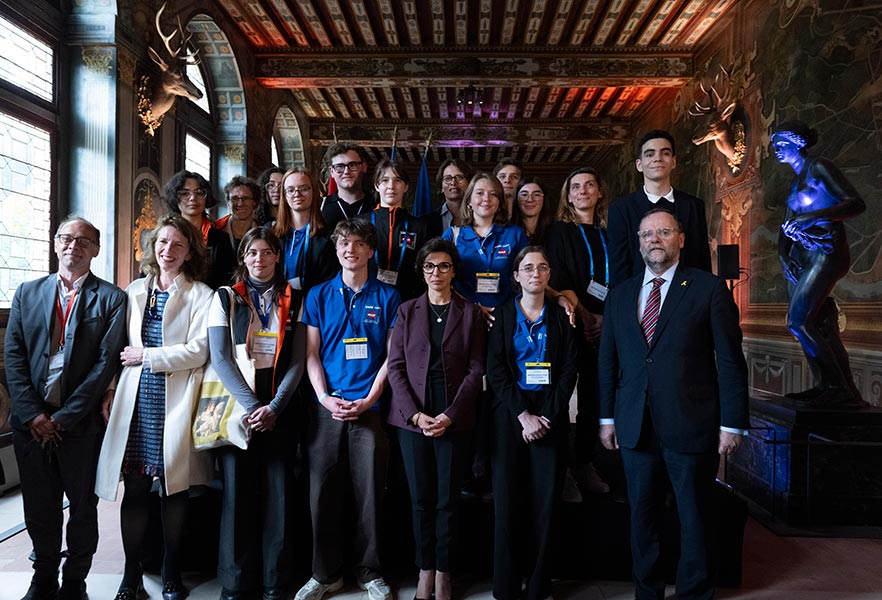
France. The initiative is still in its infancy, but is gradually starting to take shape. Last June, Rachida Dati, Minister of Culture, announced that she wanted to create “youth councils” within cultural establishments. A few months later, in December, the project was ratified by decree, which then specified that these councils “will allow young people aged 13 to 17 to become involved in the cultural life and governance of these establishments, with an advisory role”. Concretely, these teenagers will be able, at a few meetings per year, to give their opinion on the programming of the place and its visit route, participate in mediation or even get involved in the museography.
A framework is then defined, limited to fifteen establishments selected to implement the system. “The idea was to have a varied field of experimentation, argues the Ministry of Culture. Among the national operators under the supervision of the ministry, we wanted to select actors from both the creative and heritage sectors, while ensuring diversity in terms of territorial coverage. » The majority of institutions concerned are still concentrated in Île-de-France. As for museums, there are the Louvre, the Quai Branly-Jacques Chirac and the Musée d’Orsay. On the castle side, Fontainebleau and Versailles. And on the live performance side, the Paris Opera, La Philharmonie, the Grande Halle de La Villette, the Comédie-Française, the Théâtre de la Colline, the Théâtre de Chaillot and the Théâtre de l’Odéon. In the region, the National Theater of Strasbourg and the Mucem in Marseille will also host a council. Finally, the Center of National Monuments (CMN), with its network of 110 monuments throughout the territory, is also expanding the perimeter.
Most of the pilot institutions are already familiar with this type of initiative. Children’s Council for 8-12 year olds at the Philharmonie, Youth Assembly at the Palace of Versailles for 16-28 year olds, “Objective Louvre” program for young people aged 16 to 25 in the integration phase… Although these are generally participatory projects less structured than a council, the Ministry of Culture intends to draw on these experiences to facilitate the deployment of the system. The objective: for all establishments to submit their project to their board of directors before the summer, to be able to launch it at the start of the 2026 school year. “This project will undoubtedly already be much more accomplished and formalized for some, more experimental for others”nuance the Ministry of Culture.
Tailor-made youth advice
If the decree establishes a common base, each institution then constructs its own strategy. “The final form of this advice will vary from one establishment to another. Everyone will start from their pre-existing projects, from their own levers, from what they seek to produce to renew their policy. adds the Ministry of Culture. Because the modes of operation and the challenges differ depending on the location. Attention to programming freedom, for example, will not translate the same way for a national theater as it would for a historic site. “We do not want these young people to work only with the educational sectorindicates Anne Mény-Horn, the general administrator of the Château de Fontainebleau. The idea is also that they discover all the professions, work with the surveillance teams, in the gardens, that they can give their point of view and participate in specific projects…” For the castle, the council consolidates a previous system, the “Heritage Ambassadors”, which already involved adolescents in cultural mediation actions. “This structuring is important since it will allow us to open up missions and broaden the field of possibilities. In particular, we have the project of having these young people work on a temporary exhibition”she confides.
Behind this system, the challenge is clear: to succeed in involving a particularly complex age group to reach. “ It is undoubtedly the most difficult target to reach and interest, points out Cécile Dumoulin, head of the public department at Mucem. It is therefore essential to give these young people a voice, to ask them about all our fields of activity, to see what could further motivate them to visit a museum. » This is especially true since initiatives targeting 13-17 year olds are specifically lacking.“We noticed that work with adolescents seemed a little behind, compared to the many proposals aimed at children and young adults”corroborates the Ministry of Culture, which therefore takes up the Anglo-Saxon model, where the principle of teen councils has been adopted by a number of institutions.
In fact, the application of such advice will be on a case-by-case basis. Of course, the Ministry of Culture makes some recommendations: select between 10 and 20 participants, ensure a certain balance between ages, respect parity and organize a meeting at least once per quarter. But the terms will be set by the establishment. At this stage, the Château de Chambord is considering a group of ten young people committed over a period of two years. For the CMN, the model will be logically different. “It seems important to us not to imagine a single council in Paris, but rather several councils which will be embodied in the territory, explains Hélène Amblès, the director of cultural development and audiences at the CMN. For the moment, we are thinking of creating a council in four or five monuments, encouraging cross-fertilization between them, and then rolling them out more widely if it works. »
To recruit these young people, the CMN relies on its partnerships, whether it is the Une pathway pour tous association or the MJC network in France. The Mucem intends to appeal to the dozen young people who already form an educational microstructure within the museum, and who all have an anxious school refusal. “ The goal is to combine several recruitment methods, to identify interested young people through solidarity associations, partnerships with schools, with local authorities, etc.”, details the Ministry of Culture. But who says volunteerism, also says limited representativeness. It is difficult, in fact, to integrate young people unfamiliar with museums and a priori less inclined to apply. A limitation of which institutions are well aware, and which is accompanied by its share of other challenges. “ We are faced with the problem of transport, that of insurance, the availability of these young people outside of school hours, our own availability…”,lists Anne Mény-Horn. As a ministerial budget is not deployed for the system, any possible expenditure is the responsibility of the establishment. But it is above all human time that is invested here. It is about succeeding in articulating advice with the other actions of the structure, managing to adapt to schedules. An initiative which will undoubtedly require flexibility.


