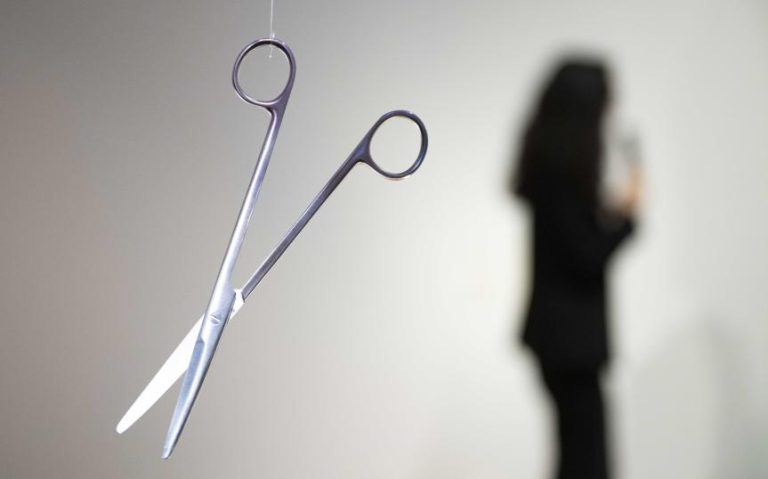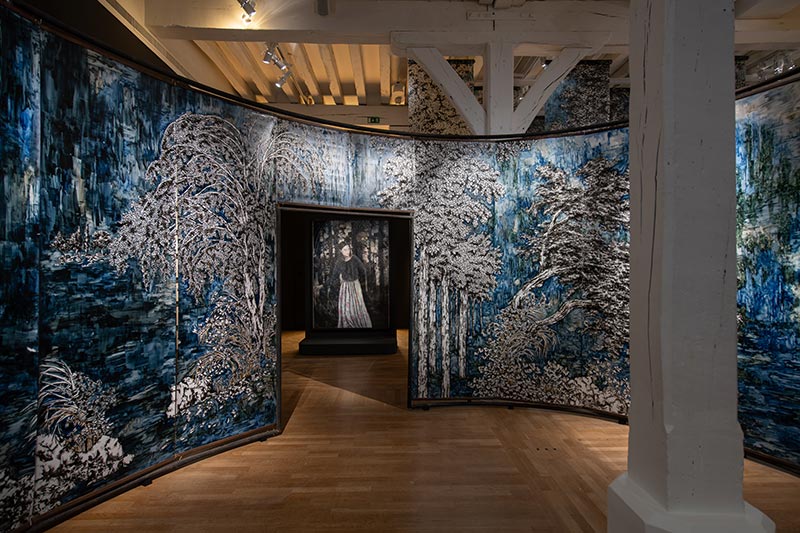
Nantes (Loire-Atlantique). A large forest made of paper panels, bathed in the rustling of leaves and the croaking of frogs. It is in this contemporary interpretation of the sylvan universe imagined by the artist Salomé Fauc (born in 1993) that the visitor wanders before finding themselves face to face with the disturbing stuffed animals with plush heads by Annette Messager (born in 1943). At the castle of the Dukes of Brittany, immersion is required to question the resonance of the figure of the witch across the centuries. A fantastic and poetic introduction to this journey which aims to have great historical rigor. It is through this prism that the museum chooses to explore a subject which today is a cliché.
Witches have in fact rarely been so fashionable, as evidenced by the exhibition that the Pont-Aven Museum (Finistère) dedicated in 2025 to the witch in the 19th century, or the future exhibition (from October 15) at the Aquitaine Museum in Bordeaux on a more regional history of witchcraft. “It’s a subject that has inspired several exhibitions, recognizes Krystel Gualdé, scientific director of the Nantes History Museum and curator of the exhibition.But never from such a long chronological perspective nor with such a broad spectrum of objects .
View of the “Witches” exhibition at the Nantes History Museum. © David Gallard / LVAN
View of the “Witches” exhibition at the Nantes History Museum.
© David Gallard / LVAN
Demonization, condemnation
The route immediately gets to the heart of the matter with a map showing the scale of witchcraft trials in Europe, which reached its peak in the 17th century. And he does not depart from this historic speech, deployed with clarity throughout. Here, there is no question of illustrations of tales, of a repertoire of witch archetypes… The fantasy that the motif summons is found above all in the very successful scenography of Marc Vallet, who recreates a dark atmosphere by working on the lighting, taking inspiration from the mysterious universe of the forest. The exhibition follows a chronological thread that it takes back in time, wisely showing how the figure of the witch draws its origins from that of the ancient sorceress. The demonization of magical practices then took shape in the medieval period, under the influence of theologians. Rare miniatures of the “infamous kiss” which symbolizes the pact with the devil, copy of the famous Malleus Maleficarum of 1486 which codified the crimes of heresy and made witchcraft a feminine specificity… The rich selection of works underlines how the condemnation of witchcraft, if it begins with religion, quickly becomes a state affair. “In the Renaissance and then in the modern era, we controlled pleasures, knowledge and populations by controlling, in a certain way, the powers attributed to the witch”,
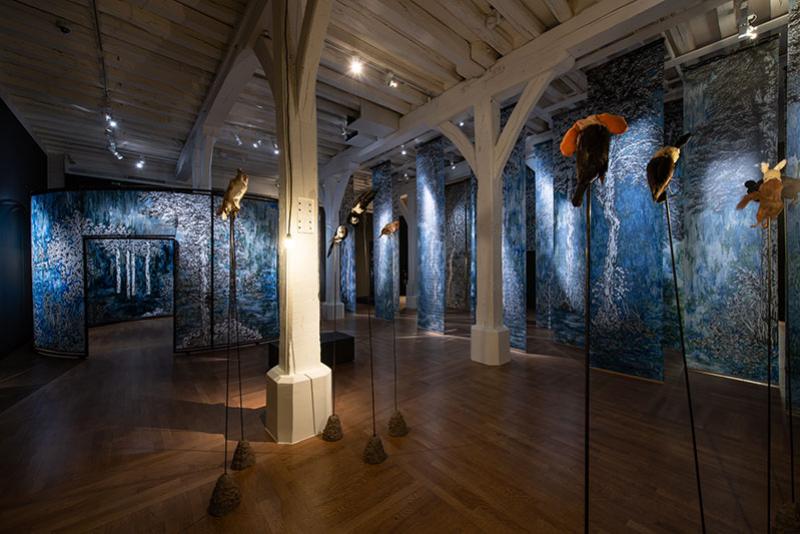
View of the “Witches” exhibition at the Nantes History Museum. © David Gallard / LVAN
View of the “Witches” exhibition at the Nantes History Museum.
© David Gallard / LVAN The ritual of the Sabbath, the object of the most fanciful beliefs, nourishes the imagination of artists. The bringing together of several 17th century paintings, most of them little-known, offers a striking demonstration of this, depicting with wild inventiveness the preparations for the rite, limping dances and monstrous creatures. Alongside this fanciful imagination, a very concrete reality emerges: that of the trials, which would have caused between 60,000 and 90,000 executions between 1400 and 1750, without a more precise estimate being able to be put forward. The archives and engravings on display recreate the violence of these accusations and tortures, anchoring this history of witchcraft in everyday life. The latter is, however, a little less consistent at the end of the course. The 19th century witch is quickly presented as a femme fatale with fascinating beauty, like the superb Circe [voir ill.](1911, ) by John W. Waterhouse. A vision which, certainly, imposed itself following the publication in 1862 of the sulfurous essay devoted to The Witch
by the historian Jules Michelet, without however obscuring the darker image of women, unstable, hysterical, which developed in this century when psychiatry was born. The witch as an emblem of revolt would also have deserved to be more developed, she who crystallizes feminist demands by gradually becoming a symbol of resistance to patriarchy.“We can only work by focus, the subject is so dense”
Erratum – February 24, 2026
Contrary to what was published in JdA n°671, the future exhibition on a more regional history of witchcraft will take place at the Aquitaine Museum in Bordeaux and not at the Customs Museum.