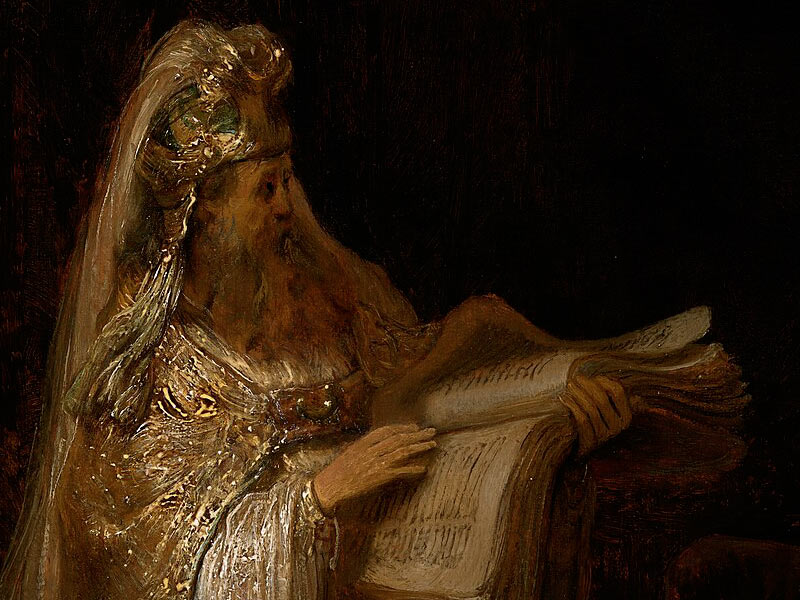
Excluded from Rembrandt’s corpus, the Vision of Zechariah in the temple (1633) was long considered a simple workshop copy or a student’s work. But today he is rehabilitated. The painting had disappeared from public view since its sale in 1961 to a private collector, to the dealer P. de Boer. It represents a biblical scene from the New Testament taken from the Gospel according to Saint Luke. It depicts the moment when the high priest Zechariah receives an unexpected visit from the archangel Gabriel. This divine messenger announces to him that he and his wife Elizabeth, despite their very advanced age, will have a son, Jean-Baptiste.
Rijksmuseum general director Taco Dibbits said an anonymous couple contacted the museum several years ago after inheriting a painting from their father that they described as modest in appearance. The assessment, carried out over two years, puts an end to sixty-six years of decommissioning. In 1969, German art historian Horst Gerson based his rejection on the examination of low-resolution black and white photographs, without direct confrontation with the panel. This judgment was based on a state altered by a “gray veil” (heavily oxidized varnish) masking the initial chromatic depth.
Rembrandt (1606-1669), Vision of Zechariah in the Temple1633, oil on wood, 58 x 48 cm.
During this period, the work was attributed to contemporaries or students such as the two Dutch painters of the Golden Age, Salomon Koninck and Jan Lievens. The version kept in Schwerin (Germany) was unfairly promoted to the rank of original. Current analyzes demonstrate that the latter is in fact a workshop copy.
Dendrochronology, a method of dating wood, confirms that the two oak panels come from Lithuania. The wood was identified as being available for workshop use between 1625 and 1640, validating the date of 1633 inscribed on the work. Spectroscopy revealed a palette typical of the 1630s: lead white, ochre, bone black and lead-tin yellow. The preparation of the support, composed of a chalk base covered with a light brown imprimatura, conforms to Rembrandt’s habits. Finally, microscopic and infrared examinations confirm that the inscription “Rembrandt f. 1633” was applied in fresh paint, proving its precedence to the complete drying of the pictorial layer.
The Vision of Zechariah in the Temple thus becomes the 25th autograph work by Rembrandt to join the national collection. From a simple workshop production estimated at a few thousand euros, the work has reached the status of an autograph masterpiece whose value is now measured in tens of millions of euros. The conclusions of this investigation will be the subject of the international symposium “New Directions in Rembrandt Research” on March 24, 2026. As Taco Dibbits points out, the discovery of an unpublished Rembrandt is comparable to finding a needle in a haystack. The work, on long-term loan to the Rijksmuseum, is on display from today in its collections.