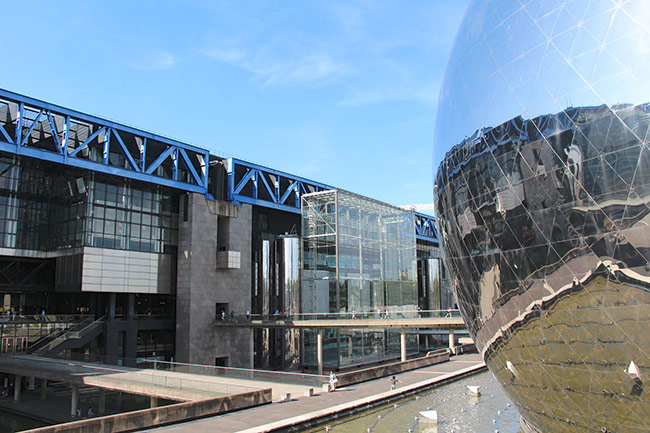
The Court of Auditors’ report on Universcience highlights weaknesses but above all describes a public establishment installed in a structural crisis. The main French operator of scientific culture remains recognized for its role and its influence, but it is now faced with three intertwined perils: problematic real estate assets, a financial situation described as “now critical” and human resources management considered rigid, costly and insufficiently controlled.
The first point of alert concerns buildings. Universcience manages a total area of 221,390 m², including 196,086 m² on the La Villette site. However, according to the Court, spaces directly linked to its museographic mission represent less than 20% of the surfaces. This disproportion weighs heavily on the establishment, which must maintain aging buildings, while carrying out two major operations: the renovation of the Palais de la Découverte and the much more uncertain renovation of the Cité des sciences et de l’industrie. Since 2018, 62 million euros have already been dedicated to real estate investments, out of 115.5 million euros of total investments. By 2027, forecast spending would reach 166 million euros.
The renovation of the Cité des Sciences is the hottest subject. Inaugurated in 1986, the building requires a major overhaul. But the classic complete renovation scenario was estimated at between 1.3 and 1.6 billion euros. The Court notes that the savings identified are not enough to make the operation financeable. The Budget Department drives home the point in its response: the studies conducted since 2011 “did not result in a duly supported project” And “the financing of real estate investments is not assured at this stage, whatever the scenario considered”.
Faced with this budgetary wall, the new president of Universcience, Sylvie Retailleau, highlights the study entrusted to Lacaton & Vassal, based on a “frugal and sustainable repair” of the building. This new renovation plan would avoid a complete closure of the City and would, according to initial figures, allow the cost of a renovation to be divided by more than two. But she recognizes that the hypothesis still needs to be technically consolidated, particularly with regard to the reparability of the facades and the constraints of bringing them up to standard.
The Discovery Palace is not out of the woods either. Its reopening is announced for March 2027, but disagreements with GrandPalaisRmn on charges, spaces and the economic model remain sensitive. Sylvie Retailleau indicates that the negotiation on the “just re-invoicing of charges” is not “still not finished” and wants solutions to ensure that the operation of the Palace is profitable as soon as it reopens.
The real estate crisis aggravates an already very deteriorated financial situation. After two profitable years in 2018 and 2019, Univercience’s net income became negative from 2020 to reach -20.1 million euros in 2024. Ticketing revenue, which peaked at 15.8 million euros in 2019, fell to 10.6 million in 2024. The “Étincelles” of the Palais de la Découverte plateau around 110,000 to 120,000 annual visitors, compared to more than 500,000 previously for the Palace, while the Cité des sciences sells around 500,000 paid tickets, below its 2019 level.
The Court sees in this trajectory a real scissors effect: decline in revenues, increase in expenses, rigid fixed costs and heavy investments. Cash, which reached 74 million euros in 2018, was reduced to 42.5 million in 2024. The initial 2026 budget provides for only 1.1 million euros in cash as of December 31, with a possible need for 10 million euros at the start of 2027.
Former president Bruno Maquart defends a less accusatory reading. He recalls that the establishment had reached nearly 3 million visitors in 2019, then suffered a succession of crises: strikes, Covid, inflation, increase in energy, closure of the Palace, construction site of the Children’s City. According to him, operating expenses only increased by 10.4% between 2018 and 2024, in a context of inflation of 18.4%, and state assistance would have decreased in real terms by more than 21%. But this argument does not defuse the central diagnosis: Universcience has consumed a significant part of its reserves and no longer has the necessary margins to finance its investments.
The third part of the report is the most brutal: human resources. The Court describes a management marked by the increase in the wage bill, inadequate control of working hours and costly social dialogue. She notes that control of working time is non-existent for nearly 40% of staff, or around 400 people. It targets in particular scientific mediators, who carry out on average one to two mediations per day, i.e. 45 minutes to 1 hour 30 minutes, with attendance obligations considered low.
The Court also denounces the financial effects of union practices that have long been poorly regulated. She mentions an exceptional number of CSE meetings, the cost of which was estimated at around 350,000 euros in 2021, and recovery counters fueled by delegation hours taken outside of working hours. Certain balances would have given rise to payments of up to 60,000 euros per agent, in a context where the establishment would have remained “paralyzed by fear of union reactions”.
The time savings account (CET) adds another risk. Since the 2021 agreement, employees can accumulate up to 150 days, compared to 60 for civil servants. The Court judges this ceiling “strongly deviating from common law” and regrets that no budget simulation was carried out before the negotiation. Between 2018 and 2024, the number of days recorded on CETs increased from 2,716 to 12,155, and the corresponding provisions from 0.49 to 2.6 million euros. Voluntary retirement compensation is also noted: employees receive on average 28,000 euros upon departure.
Sylvie Retailleau responds that the workforce reflects the specificity of a model based on human mediation and the operation of two large technical sites. She also highlights a negative employment pattern of 13 FTEs (Full Time Equivalent) in 2025 and 15 FTEs in 2026. But she admits that the dynamics of the payroll, working time, CET, senior agreement and severance pay will have to be re-examined.
The other considerations in the report — refocusing of the offer, governance, place of industry and digital technology, articulation with the territories, role of the library or the Cité des métiers — fuel the debate on the vocation of Universcience. But they take second place to the 3 emergencies.