Cherré-Au (Sarthe). A cultural center, a luxury hotel, or a health establishment? In Cherré-Au, the future of the Château du Haut-Buisson is currently being considered. To collect their proposals on the future of the site, the small town launched a consultation with its approximately 2,500 residents. But at this stage, it is difficult to see a clear direction for the castle while its restoration project remains at a standstill. The municipality cannot, in fact, assume the cost of the work that remains to be undertaken.
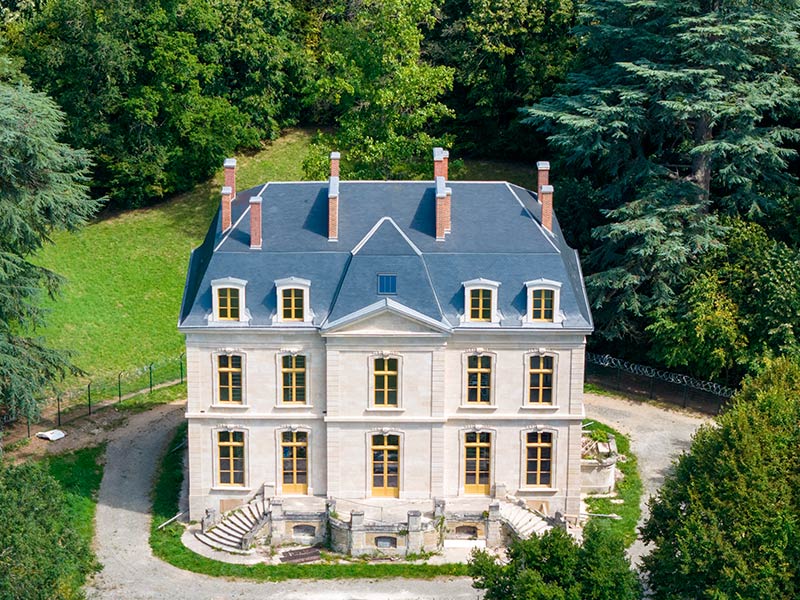
From the outside, the site is brand new. Unleading, securing, repair of the framework, dormer windows and zincwork, waterproofing of the terrace, repair of the frames, restoration of the joinery and shutters… Renovation of the roof also proved necessary, numerous infiltrations having caused the beginning of sagging at the floor level. The project, completed in January 2024 after three years of work, was then able to be carried out thanks to the support of the Heritage Foundation, the Principality of Monaco and the State, which financed half of the 2 million euros necessary. The restoration of the steps, for its part, should be launched soon.
A neglected interior
Inside, however, the situation is quite different. From the attic to the basement, the castle is very dilapidated: damaged ceiling and parquet floors, dismantled fireplaces and walls covered with tags. On its five levels, which have around forty rooms, everything needs to be restored. A state of dilapidation incommensurate with its former glory, at the time when the castle, built by the Marquis de Jumilhac in 1847, served as a place of residence for Princess Alice of Monaco (1857-1925) in the absence of her navigator husband, Prince Albert I.
Interior view around 1900 of the Château du Haut-Buisson.
Nothing remains today of the furniture and refined woodwork since the place has been abandoned and looted on numerous occasions. In fact, when the site was sold to the Sorbonne in 1952, upon the death of the princess’s son, it was then used as a plant biology department for students before being gradually abandoned, the space having become unsuitable. For more than fifteen years, the Château du Haut-Buisson remained disused, until the town bought the estate in 2009 with the aim of reopening it to the public.
But before considering any reopening, between 4 and 5 million euros still need to be raised to carry out this second phase of work, which promises to be substantial. The municipality displays a clear principle: restore identically. If the castle is empty today, the objective is to preserve as much as possible the original elements still existing, whether stained glass windows or moldings on the walls. Ultimately, the ambition is not to focus solely on the 1,200 m2 castle, but to promote the entire estate which also includes several outbuildings and 120 hectares of gardens, woods and meadows. With this in mind, the municipality recently renovated the orangery, planning to transform it into a reception room. She also purchased the caretaker’s house and the teacher’s house nearby, for an amount of 900,000 euros. It is precisely this potential that the municipality is banking on to attract a private investor, and thus hope to relaunch the project.