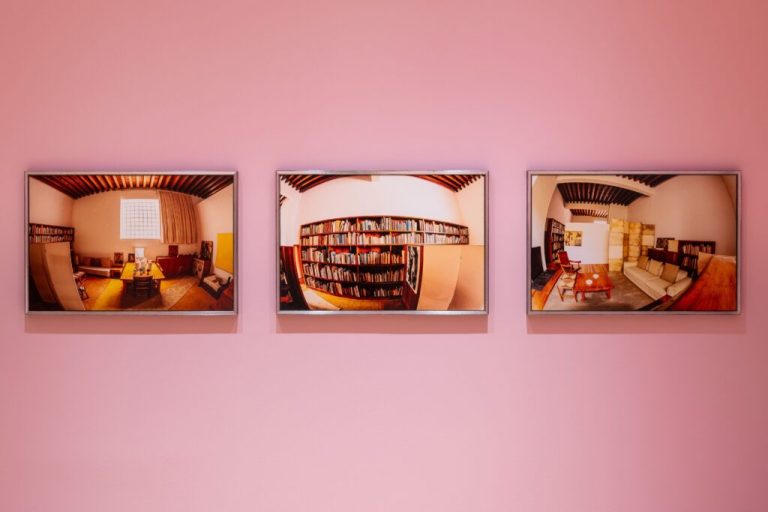
Sint Martens Latem (Belgium). Art is often a matter of transformation, transformation of forms, materials and views. The Belgian artist Edith Dekyndt (born in 1960) chose as the starting point for her first institutional monographic exhibition since 2016, the meeting, in the summer of 1933, of Albert Einstein (1879-1955) and James Ensor (1860-1949) at the table of a restaurant in Coq-sur-Mer. Behind the anecdote, the meeting of these two men symbolizes the transformation of one world into another.
Housed in an all-white modernist building nestled at the end of an alley in a residential town in the Lys region, the Dhondt-Dhaenens Museum was created in 1968 at the request of the collector couple Jules Dhondt and Irma Dhaenens.
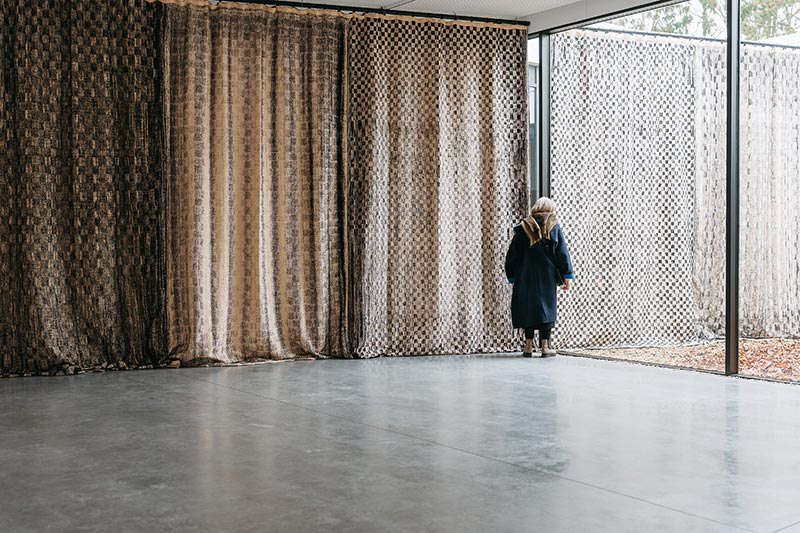
It is in this refined setting that, upon entering the exhibition, the first glance is on Still life with Chinoiserie, 1907, isolated on a white wall. In this oil by the painter James Ensor (1860-1949), the brilliance of the light and the pearly materials launch the last shards of a vanished world. In her works, Edith Dekyndt is interested in the transformation of a world – and its materials – haunted by the poisonous mushroom that rose in the sky of Hiroshima on August 6, 1945. Large curtains woven in wool, cotton and polyester fibers, whose patterns recall those of kimonos, cross the patio, like a break between past and present. On a series of small, gently rounded formats, the artist screen-printed the photographic images of the sky which allowed the bombs to be dropped.
View of the exhibition “Edith Dekyndt, It could be James on the beach. It could be. It could be very fresh and clear” at the Museum Dhondt-Dhaenens.
© Adagp Paris 2026
Edith Dekyndt transforms materials by making them unrecognizable or by creating surprising grafts. Several pieces are made from animal skins such as Boolean Matrix2025, whose whiteness is reminiscent of a pillow which still bears the imprint of the sleeper. In Chasha2025, and Lady Kasuga (2025), she arranges animal skin with bandages and plaster, jagged shapes that combine debris and traces of a disaster with resilience through care. In the patterns of his woven pieces, Dekyndt draws a parallel between textile production and digital logic which also comes from the mathematical organization of time. In other works, she creates 3D prints that mold like a second skin the organic crevices of burnt wood to fuse into a new organism. In the transparency of a suspended veil, the artist brings out the torn wallpaper which appears in the background of certain paintings by James Ensor.
The transformation can be the result of human activities, chemistry, salt and the surf of the swell as evidenced by It could be very fresh and clearan ongoing series that brings together artifacts found on beaches, competing in colors, shapes and textures, lined up on a transparent wall shelf.
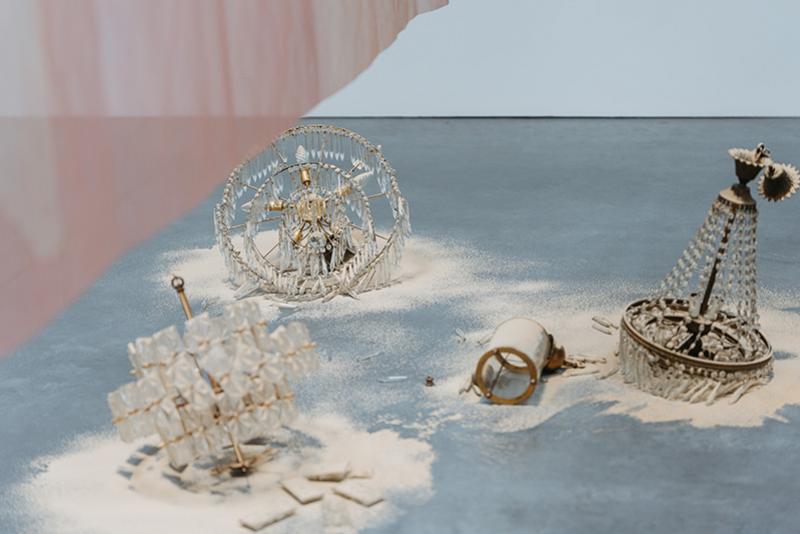
View of the exhibition “Edith Dekyndt, It could be James on the beach. It could be. It could be very fresh and clear” at the Museum Dhondt-Dhaenens.
© Martin Corlazzoli
© Adagp Paris 2026