After a year of closure, the Musée de la Reddition in Reims reopens its doors with a completely redesigned museography, reinforced conservation systems and a clarified route. This renovation was completed on a symbolic date: May 7, the anniversary of the signing in 1945 of the unconditional surrender of Nazi Germany in the map room of the Allied headquarters in Reims.
The map room was at the heart of the site. The original maps, exhibited documents and objects from the war room showed signs of wear. The paper was deteriorating. The colors were fading. The lighting was insufficient, the humidity was poorly controlled and certain supports were weakened. The work initially focused on the conservation of the collections. Protective glazing was installed, ventilation adapted, and lighting redesigned. Before reassembly, the collections were treated in anoxia in order to eliminate agents of degradation. The museum closed in May 2025 to allow this major intervention, financed to the tune of around 2 million euros.
The renovation also changed the way the visitor is guided. The museography, entrusted to Kascen, a Belgian scenography agency, has been completely revised to offer a clearer chronological story. The route no longer just shows the signature of May 7; it recounts the path towards capitulation, occupation, the allied presence in Reims, liberation, then the post-war period, reconstruction and reconciliation.
Signature of the surrender of the German army on May 7, 1945 in the map room of the Jolicoeur modern and technical college in Reims, renamed Franklin-Roosevelt high school in 1945.
The museum now exhibits 17 uniforms, 130 objects and weapons, as well as 65 archival documents. There we find newspapers dated May 1945, the act of capitulation, staff objects, military uniforms, and several personal objects linked to the protagonists of the capitulation, including General McAuliffe’s jacket.
The new presentation also seeks to better respond to the foreign public, which represents a significant proportion of visitors. Mediation tools have been strengthened, with more multilingual content and a more accessible understanding of military and diplomatic issues.
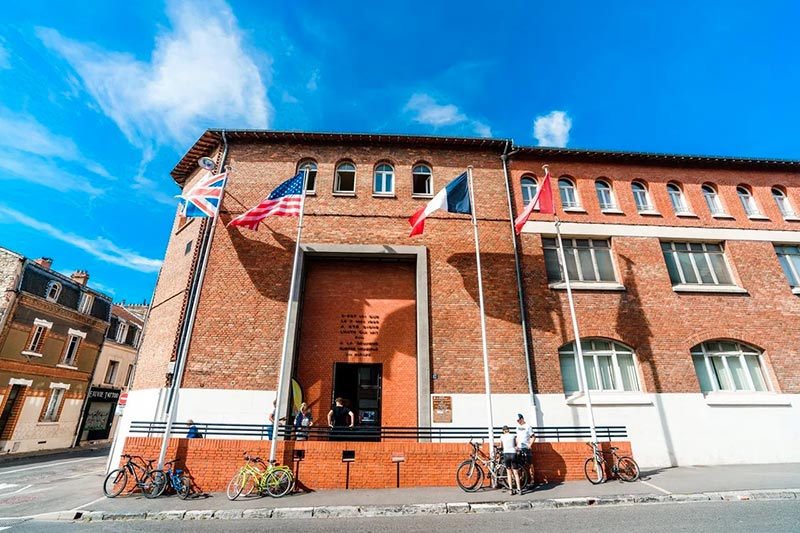
The museum still occupies part of the former college on Franklin-Roosevelt Street, today Roosevelt High School, where American General Dwight Eisenhower installed the supreme headquarters of the Allied Expeditionary Forces in Europe in September 1944. General Alfred Jodl had signed for Germany, alongside Admiral von Friedeburg and Commander Oxenius. Walter B. Smith had signed for Eisenhower’s staff. Soviet General Sousloparov had signed, while General François Sevez represented France as a witness at the last minute. This first act was then doubled, on May 8 in Berlin, to satisfy the Soviet requirement for a separate ceremony. This dual chronology has long eclipsed Reims in official memory, even though the surrender was signed there first.
The museum itself was born from this history. On July 7, 1945, the keys to the map room were given to the mayor of Reims, Michel Sicre, in a symbolic gesture which made this room a place of memory even before the creation of the museum. The institution officially opened in 1985, for the 40th anniversary of the capitulation, then was modernized in the early 2000s.
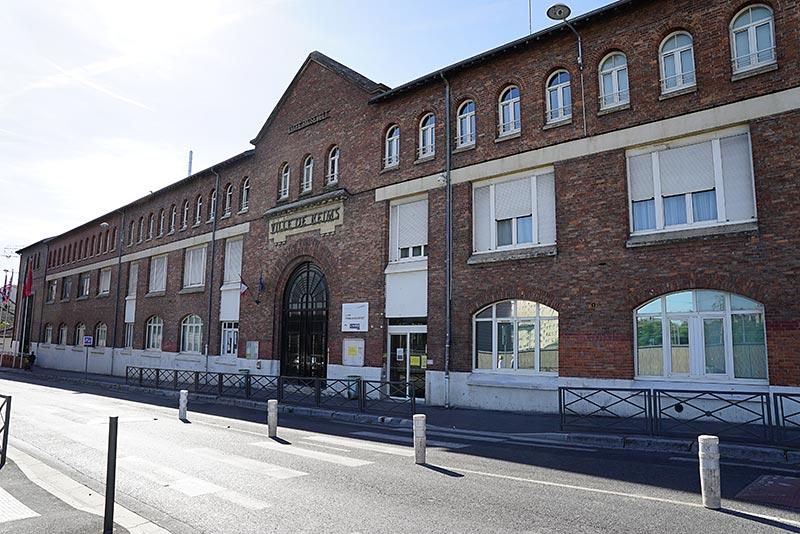
The Jolicoeur modern and technical college in Reims was renamed the Franklin-Roosevelt high school in 1945 and has housed the Surrender Museum since 1985.