Paris. “Dazzling, breathtaking, exceptional…”rarely has such a deluge of laudatory adjectives greeted an exhibition to this extent. Both the press and artistic magazines devote long articles – when they are not special editions or supplements, which are not very inclined to criticize – to the polyphonic work of Gerhard Richter. Not that the event presented at the Vuitton Foundation does not deserve such a welcome. Complete, perfectly hung, accompanied by remarkable educational tools and a catalog precisely analyzing all the facets of this plastic production, the exhibition is being held. But could it be otherwise with an artist whose notoriety gradually turned into a monument?
Is it this intimidating status which explains why Richter’s work is now perceived as a flawless block? However, few artists have achieved such stylistic and technical diversity. At the Foundation, the route alternates between blurred, monochrome figurative canvases, often gray, abstract paintings with shimmering and moving colors, huge color charts, photographs partially covered with rubbing or scrapings, digital prints, etc.
Richter, who knows how to do everything thanks to rigorous training acquired in the academies of East Germany, belongs to an artistic family that could be described, for lack of a better term, as “horizontal”.
Gerhard Richter, Carrot [Möhre]1984, oil on canvas, 200 x 160 cm, Fondation Louis Vuitton, Paris.
© Gerhard Richter 2025
An artist open to all plastic options
Certainly schematically, we can distinguish, within the creative approaches of the 20th century, two major trends. The first, called “vertical”, brings together artists who found or chose a style very early on which they continued to develop throughout their lives – Mondrian is the example par excellence.
The second, “horizontal”, designates those whose work opens up to multiple plastic options, sometimes to the point of offering singular syntheses. In this context, Richter’s originality lies in his refusal to consider his artistic career as a linear progression and in his ability to make constant stylistic back and forths, often accompanied by subtle variations. However, if the quality of each of these “solutions” is beyond doubt, their respective relevance deserves to be questioned.
Let’s start with the blurred figurative canvases, where the artist’s personal history intertwines with that of the Third Reich. Taken from photographs taken from family albums and transposed onto canvas, these works blur the boundary between photography and painting, offer an indistinct vision of the surrounding world and question the so-called “natural representation” of reality.
Sometimes tragic reality: Aunt Marianne shows the smiling face of Richter’s aunt, a victim of the Nazi euthanasia program. Likewise, a family scene on the beach reveals the presence of the artist’s father-in-law, Dr. Heinrich Eufinger, an obstetrician involved in this despicable project.
History painter, then? Unquestionably. Richter belongs to the generation of artists revolting against the silence that reigned in their country regarding an era that people were trying to erase from collective memory. Born before the war, a few years older than Baselitz, Kiefer or Lüpertz, he confronts this past in a more discreet, more restrained, even more subtle way.
![Gerhard Richter, Apfelbäume [Pommiers]1987, oil on canvas, 67 x 92 cm, private collection © Gerhard Richter 2025](https://paintandpainting.com/wp-content/uploads/2025/12/1765373707_176_The-pictorial-polyphony-of-Gerhard-Richter.jpg)
Gerhard Richter, Apfelbäume [Pommiers]1987, oil on canvas, 67 x 92 cm, private collection.
© Gerhard Richter
Other, more innocuous images punctuate his journey: misty landscapes, forests, portraits of his daughter executed with the precision of a Vermeer… At the same time, the artist developed an abstract practice, using various tools – paintbrushes, brushes, scrapers, spatulas. Some of these monumental canvases are constructed from geometric shapes distributed according to rigorous patterns; others are covered with a complex network of colored lines and knots that intersect and overlap. The latter, in line with abstract expressionism, although sometimes too busy, contributed – unsurprisingly – to Richter’s resounding success in the United States.
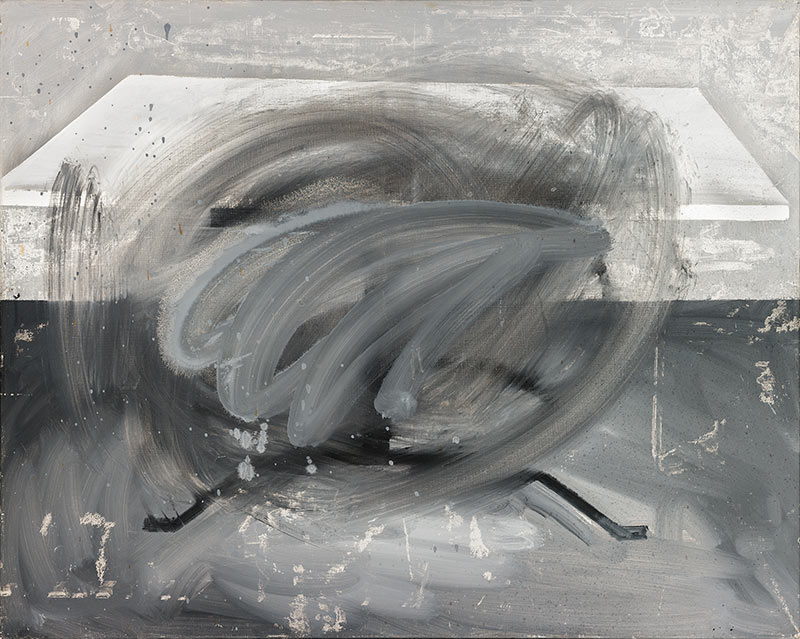
So, Richter, unclassifiable? Rather an artist who combines figuration and abstraction with virtuosity. Two emblematic images open and close the route to the Foundation. The first, Tisch (1962), (see ill.), represents an ordinary object – a table – reproduced from a design magazine, but partially erased by a stain of solvent which invades the center. Symbolically, Richter placed this painting at the top of his catalog raisonné, after having destroyed all the previous paintings.
The last, painful, overwhelming, presented in a separate room, is called Birkenau. The four photographs of the crematoria, taken at Auschwitz by a deportee, are matched by four abstract paintings by Richter. But this abstraction hides the representations of the ovens that the artist had tried to reproduce before deeming this task impossible. With this palimpsest, this wordless cry, the painter masterfully confronted History.