Villeneuve-d’Ascq (North). Built in 1978 by Roland Simounet, the main building of LaM is made up of red brick cubes placed in a sculpture park. The museum, opened in 1983, initially hosted the Masurel donation, a set of 219 works from the 20th century, including a collection of Cubist works and works by Modigliani, Léger, Derain. In 1999, the museum received a donation from the L’Aracine association, consisting of 3,500 works of outsider art: the LaM therefore also became a museum of outsider art. After the construction of an extension in 2010, the LaM occupies an area of 11,000 square meters, including 4,000 for exhibitions.
All of the spaces have been “reimagined” during the work according to director Sébastien Faucon, who adds that this work was “revealed the building and brought it closer to its initial appearance”. The project cost the European Metropolis of Lille, the main financier of the museum, 27.2 million euros. The second phase of the work will end in June 2026 with the reopening of the building dedicated to outsider art. If the temporary exhibition rooms are blind, the permanent exhibition takes place in glass rooms opening onto the park. This has benefited from an overhaul, with “redesigned paths, new plant complexes and restored sculptures”, according to the director. Finally, the museum now has a cafeteria and a restaurant run by chef Florent Ladeyn, whose dishes are inspired by the museum’s programming: the restaurant occupies a beautiful space on the first floor overlooking the park, a space previously allocated to the museum administration.
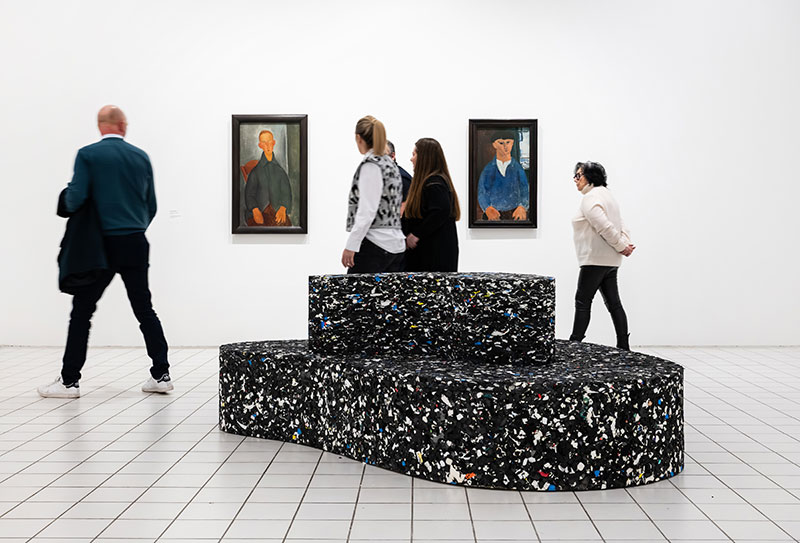
View of the new tour of the LaM permanent collection, “Obsession”.
© Frédéric Iovino
A permanent route in dialogue with the park
In the permanent route, the visitor can therefore see the park from various angles, in dialogue with the exhibited works and the white walls of the rooms. Sébastien Faucon indicates that he chose emblematic works from the collections, including contemporary works since the LaM has a fairly active acquisition policy: the museum now has 11,000 pieces in its collections. Note that some of the works on display come from a deposit of the National Center for Plastic Arts (CNAP). The first rooms of the route are relatively narrow, and contain small-format works, notably paintings by Braque and Miró. This route alternates thematic rooms (landscape) and monographic rooms (Derain, Picasso, Buffet), with a chronological progression from the French avant-gardes to contemporary art, on the theme of obsession. At the bend of a room where the museum presents works by Léger, the visitor sees through a window the building built in 2010 whose openings in the shape of a moucharabieh are inspired by a canvas by Léger placed to the right of the window: the new route therefore proceeds through touches and formal analogies.
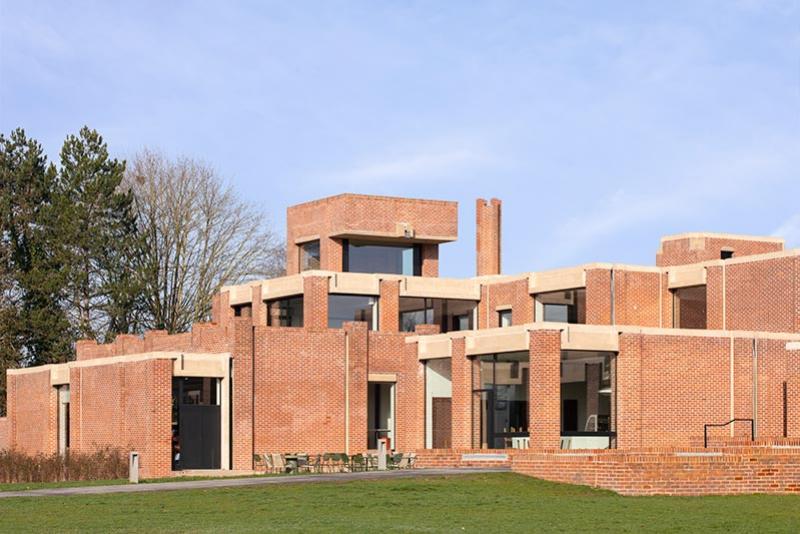
The LaM in Villeneuve d’Ascq.
© Nicolas Dewitte
It is the same in the other rooms, such as the one entitled “Stories” where Séraphine’s paintings respond to the wooded lawns of the park. A blind room, in the middle of the route, exhibits an exceptional set of works by Henry Darger, works on paper in panoramic format: the room text warns of the shocking content of the works (child nudity, scenes of violence) and usefully puts them in context. It would have been wise to do the same for other rooms where the context of production of the works remains absent. This context is a little better presented in the contemporary art rooms, notably that devoted to a beautiful ensemble by Miriam Cahn, Das Wilde Lieben. However, a structured discourse is missing to unify all the rooms: the notion of“repetition”mentioned by Sébastien Faucon is not enough to ensure the coherence of this “thematized point of view”especially since certain works seem off-topic like Buren’s large colorful installation, out of step with the other works.
In parallel with this course which will be redesigned every two years, the LaM presents a solid exhibition on Kandinsky and images, in collaboration with the Center Pompidou. Using archives and sometimes unpublished works, the exhibition traces the visual sources that inspired Kandinsky, from current images in magazines to geometric symbols and Scandinavian runes. Co-curator Hélène Trespeuch (Bordeaux-Montaigne University) specifies that the artist “was not cut off from reality, he used current photographs and scientific images in his classes at the Bauhaus” . In addition to rarely seen originals from the Blaue Reiter almanac, the exhibition shows sketchbooks and cards from Kandinsky’s “iconothèque”, where his attraction to geometric shapes and patterns is revealed. Co-curator Angela Lampe (Centre Pompidou), explains that in these images “Kandinsky was looking for formal laws and structures to legitimize his abstract art.” The latest works on display show that the artist had turned towards biomorphism, with canvases where colorful amoebae and strange biological cells swim.