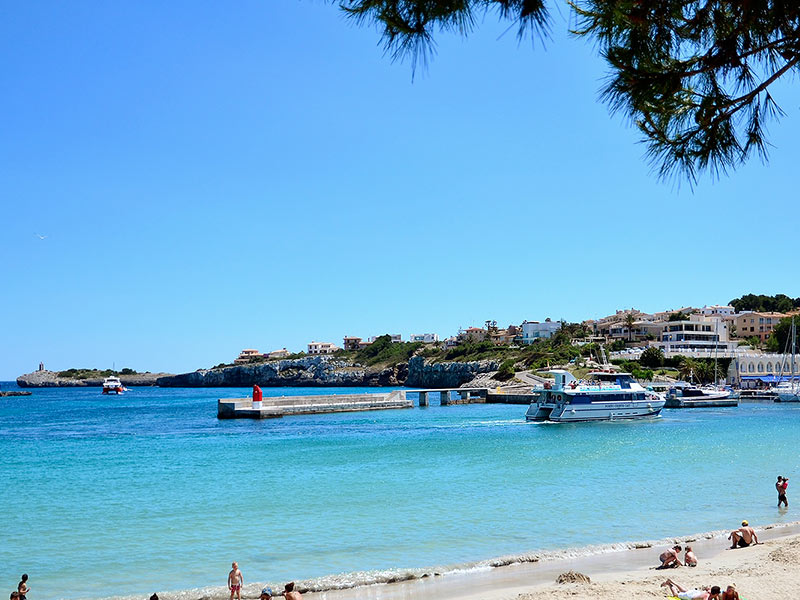
Announced in 2022 as a pioneering project in the Mediterranean, the Porto Cristo underwater park on the island of Majorca, in the Balearic archipelago, in Spain will ultimately not see the light of day. The aim was to reconstruct, on the seabed, four wrecks of ancient ships, discovered in the bay of Porto Cristo in the mid-20th century. These full-scale reproductions, based on the remains studied by the Balearic Maritime Archeology Research Institute (IBEAM), were to include a 1st century Roman ship approximately 20 m long.
The objective was twofold: to create an artificial reef in order to restore local marine biodiversity, affected by decades of human activity, and to offer a diving site with a tourist and scientific vocation.
To realize this ambition, presented as unprecedented in the Mediterranean, the town hall of Manacor (on which Porto Cristo depends) received a European grant of 2 million euros via the recovery funds of the European Union, Next Generation EU. An interpretation center was also to be built, with an interactive museography (augmented reality, educational modules) in order to present the history of the wrecks and underwater archeology techniques. The project, described as a flagship investment for the municipality, was due to be completed within three years, i.e. in July 2025.
But the creation of the underwater museum came up against multiple constraints. The schedule proved to be particularly tight. A one-year extension (until 2026) was obtained to try to revive this program, which is considered very ambitious. It wasn’t enough.
It was first necessary to obtain authorizations from several administrations (Costas coastal authority, water agency, maritime harbor master’s office, etc.), which considerably lengthened the processing of the file. Furthermore, the installation of structures at a depth of 30 m required technical studies and specialized equipment, which were difficult to mobilize within the allotted time frame. Finally, European financing required delivery before June 2026, a deadline that had become untenable given the accumulated delays.
Rather than losing the funding obtained, the municipality plans to reallocate the 2 million euros before June to an alternative operation compliant with European criteria.