Angers (Maine-et-Loire). As much as Miguel Chevalier’s exhibition at the immersive Grand Palais last year seemed sepulchral, the one mounted by curator Philippe Piguet at the Angers Museum of Fine Arts currently is engaging. The artist born in 1959, and very influenced by Op art, very early on invested in digital art to the point of becoming one of its leading figures. However, digital art is struggling to flourish. The reason? Its smooth, cold, disembodied aesthetic hardly manages to arouse emotion. And, at a time of multiplication of screens, it tends to lose its originality, its singularity. It also lost its soul by not distinguishing itself enough from digital “Panini stickers” certified by an NFT (CryptoPunks and other funny monkeys) and marketing stunts like “Everydays: The First 5000 Days” from Beeple.
Fortunately, the exhibition highlights very few screens, and favors works that are similar to paintings: flowers printed on paper supports, behind glass and put together in series. In other windows, the flowers unfold in three dimensions to take the form of stylized, white objects. Nature is the theme of this exhibition: a digitalized, reconstructed and pixelated nature, recreated in a digital version, but which engages the senses and retains a tangible link with the real world.
Between real and digital
And to better anchor itself in reality, the exhibition room hosts in its center a huge open-plan library where artificial flowers made by computer mingle, and above all, objects like one usually sees in a Natural History Museum: herbariums, coconut palms evoking the body of a woman… A veritable cabinet of curiosities (see ill.), non-virtual, tangible (well, not quite) in contrast with the refrigerating cyber universe. Everything happens as if the artist and the curator have tried to move away from digital art to dilute it in a concrete environment closer to the traditional codes of fine arts.
Miguel Chevalier, Cabinet of curiosities2025, view of the exhibition at the Angers Museum of Fine Arts.
© Thomas Granovsky
© Adagp Paris 2025
However, and we should undoubtedly have started with this, as it is immediately striking, these paintings, these 3D digigraphies, this cabinet of curiosities are drowned in three immersive installations which plunge the single exhibition room into darkness making it difficult to contemplate the works.
Born from digital art, the immersive has emancipated itself to become a form of art in its own right at the crossroads of the playful, the participatory and the image. Upon entering, the visitor is immediately struck by a floor covered with floral patterns that react to movements. The children, captivated, instill an energy through their games and exclamations which generates an unusual atmosphere, breaking with the solemnity of a fine arts museum.
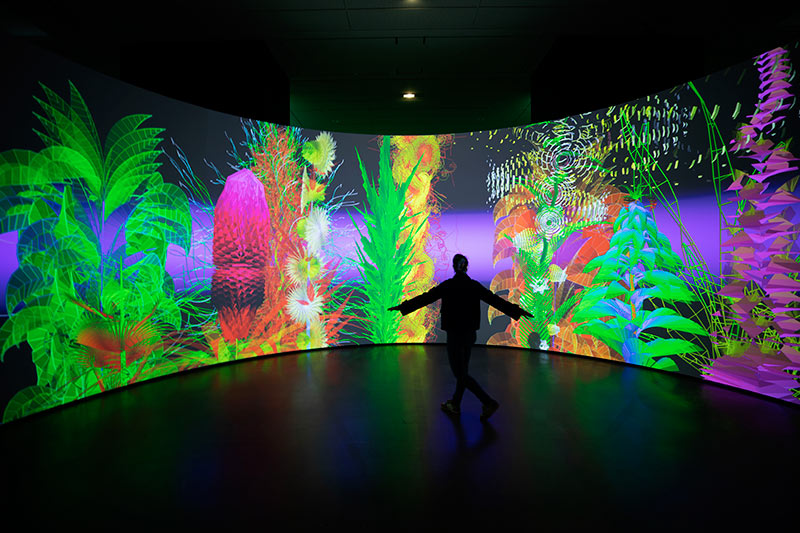
The third installation raises the gaze towards a huge curved screen on which colorful, invented plant forms are projected, which move in a constantly evolving virtual garden. Lying on cushions, the visitor lets himself be lulled by these images, produced by artificial intelligence software, controlled by a series of instructions. But very quickly, a question arises: “All that for that? » The installation amuses, relaxes, seduces… but what meaning does it have? Barely a few months after the invasion of generative AI like MidJourney, the eye is already starting to tire of these smooth shapes and these spectacular effects. “Meta-Nature AI”, the name of this installation, could well mark the peak of purely graphic immersive AI… before a decline.