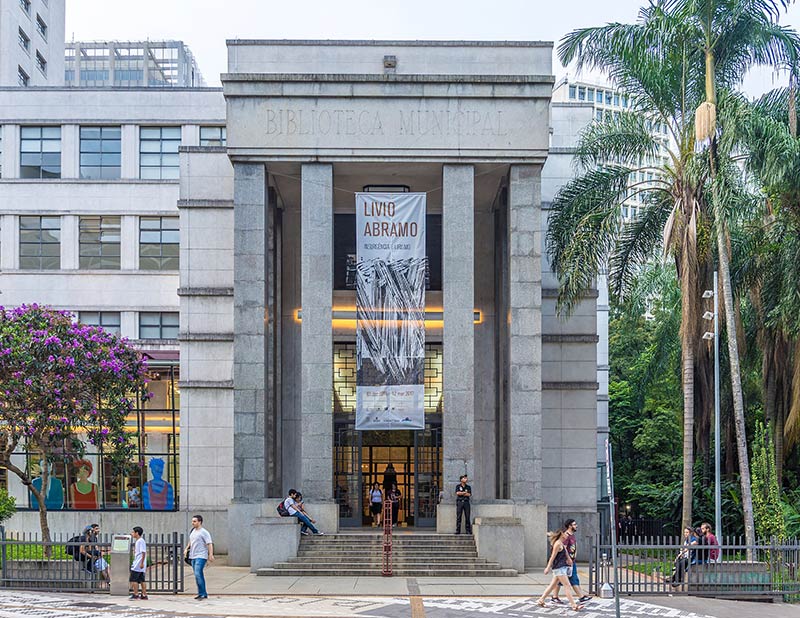
They brandished a gun, stole works of art and disappeared into the subway. On Sunday, December 7, the Mario de Andrade Library in São Paulo was robbed in broad daylight during the From Book to Museum exhibition. Eight prints from the series Jazz by Henri Matisse – The clown, The circus, Ringmaster, The White Elephant’s Nightmare, The codomas, The swimmer in the aquarium, The sword swallower, The cowboy – as well as five prints by the Brazilian painter Candido Portinari, from the Menino de Engenho collection, were stolen. One of the robbers threatened a security guard and two visitors. The thieves were last seen in the Anhangabaú metro station. The value of the works has not yet been estimated, but they are said to be insured. Surveillance cameras made it possible to take images of the thieves.
This is not the first time that the institution has been targeted. In 2008, twelve rare 19th century engravings were stolen from the same establishment. They came from the work Memories of Rio de Janeiro by Johann Jacob Steinmann (1834-1835), composed of hand-drawn illustrations of Rio landscapes. At the time, the library explained that the works had been cut with a cutter. They were able to be recovered in 2024, sixteen years later, thanks to a joint operation by the Brazilian federal police and Scotland Yard (the British police). The prints were owned by a Brazilian collector, who claimed to have acquired them legally at an auction in London.
According to the magazine Pesquisa FAPESPBrazil now ranks 26th in the world among states with the highest rates of theft of cultural objects, while displaying one of the lowest recovery rates. In 2023, Icom published its twentieth Red List, specially adapted to the Brazilian context, particularly for archaeological heritage. The diversity and scale of Brazilian heritage make it a prime target for organized criminal networks.
The problem is old and structural. In 2013, only 16% of museums were equipped with video surveillance systems. Lack of investment in security remains one of the main factors of vulnerability. In 2024, the Historical and Geographical Institute of the Federal District received 1.2 million Brazilian reals (1.9 million euros) from the local government. A night guard was able to be recruited. But payments stopped in July 2025, due to budget restrictions. The guard left his post.
Added to this fragility is the pressure of trafficking in art objects. The president of the Sao Paulo Art Museum explained that the thieves of the Pablo Picasso and Candido Portinari stolen in 2007 were professionals hired by unscrupulous collectors. In 2020, the federal police launched Operation Dom Pedro II to find works stolen in the 2000s in Rio and São Paulo. Behind certain collectors and dealers lies an entire industry. In 2019, pieces worth more than a million Brazilian real (1.5 million euros) were recovered during public sales and in private collections.
In 2024, the Brazilian Federal Prosecutor’s Office reached a milestone by suing the National Institute of Historical and Artistic Heritage (IPHAN), the Brazilian Institute of Museums (IBRAM) and the federal government for negligence. IPHAN counts 1,700 missing objects, 48% of which are sacred objects. Administrative monitoring is weak: the databases have not been updated since 2018.
The federal police from time to time carry out targeted recovery operations, in conjunction with Interpol and international bases such as the Art Loss Register. But prevention remains limited: less than 5% of IBRAM’s annual budget is devoted to investments in building maintenance, including security.