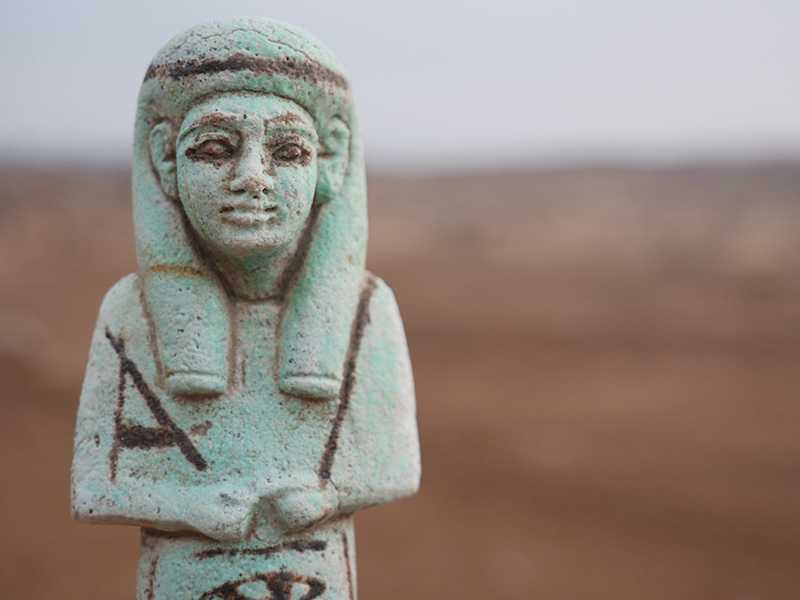
Tanis (Egypt). “What is he doing there? » This October 9, 2025, in the tomb of Pharaoh Osorkon II, Frédéric Payraudeau, director of the French Mission of the Tanis Excavations (École Pratique des Hautes Études), discovered 225 perfectly preserved earthenware statuettes, squeezed into a pit, in the immediate vicinity of a pink granite sarcophagus devoid of any inscription. These statuettes bear the name of a ruler of Libyan ancestry, who reigned between 830-791 BC. AD on a fragmented Egypt: Chechonq III, successor of Osorkon II. “This is the most important discovery made at Tanis in eighty years,” underlines Frédéric Payraudeau.
This unexpected presence in the tomb of Osorkon II is all the more surprising since Chechonq III has his own tomb in the royal necropolis of Tanis, this new capital built in the 11th century, at the end of the New Kingdom, in a period of division when the powerful high priests of Amun controlled Upper Egypt from the ancient city of Thebes. As early as 1945, the archaeologist Pierre Montet, who had discovered the royal tombs in 1939-1940, had suspected that the anonymous sarcophagus in the tomb of Osokron II could be that of Chechonq III, because of fragments of statuettes bearing his name and a bas-relief where he was represented. But these clues had been dismissed, the site having suffered from intrusions, and the bas-relief, poorly interpreted, did not provide solid proof. It was rather thought that Chechonq III had wanted to set up a burial chamber for a prince who had not reigned – perhaps his father, since he himself would be the grandson and not the son of his predecessor, Osorkon II.
Overview of the oushebtis discovered in the tomb of Chechonq III.
© MFFT / F. Payraudeau
Various hypotheses
The 225 ushabtis – funerary servants of the pharaoh for the afterlife – now tell another story. Currently, two hypotheses are favored by scientists: the king would have been buried in his tomb, then moved to the tomb of Osorkon II for security reasons in this troubled period, or, more likely, he would have been buried there directly after his death. “When a pharaoh has a tomb erected for himself, it is a gamble: during the 70 days separating the death of the sovereign and his burial, succession problems can arise,” explains Frédéric Payraudeau. His successor, Chéchonq IV, who we do not know if he was his son, may have wanted to keep for himself the tomb of Chéchonq III, where he is buried, or else have chosen to bury Chéchonq III in the tomb of Osorkon II for security reasons – the tomb of Chéchonq III being much more imposing and visible. He would then have hastily erected a wall in the tomb of Osorkon II, where he would have had a bas-relief sculpted of the two sovereigns adoring Osiris, and stored there the sarcophagus and funerary furniture, looted at the end of Antiquity.
The 225 exhumed statuettes will be studied before being exhibited in the place that the Egyptian authorities will have designated, perhaps alongside the fabulous treasure of Tanis exhumed in 1940 by Pierre Montet in inviolate tombs of the royal necropolis, and presented in the ancient Egyptian Museum in Cairo.
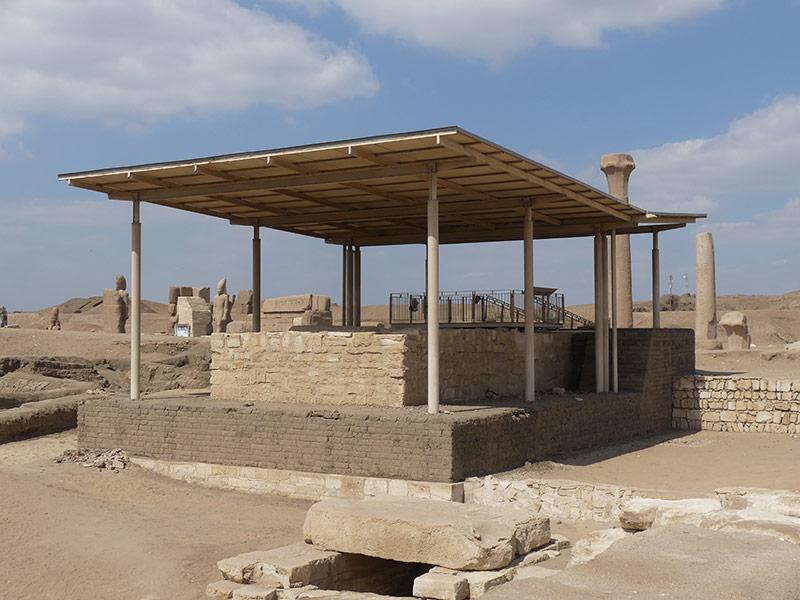
Royal necropolis of Tanis: tomb 5 attributed to Chéchonq III.
© MFFT / F. Payraudeau