Grenoble (Isère). There are only two photographs of Léon Tutundjian (1905-1968), although he frequented numerous Parisian artists from the 1930s. He remained discreet throughout his life and the posterity of his work suffered as a result. The Grenoble Museum brings together more than 130 works in partnership with the Léon Tutundjian Foundation, chaired by gallery owner Alain Le Gaillard, who initiated the exhibition. “The museum already had two works by the artist, but most of Tutundjian’s works are in private collections, which partly explains why he is little known to the general public”specifies Sophie Bernard, head of the modern and contemporary art collections at the Grenoble Museum and co-curator of the exhibition with Brigitte Léal, general curator of heritage. The director of the museum, Sébastien Gokalp, recalls that “this museum was one of the first in France to acquire a work by Tutundjian”.
The route is thematic rather than chronological because “the exhibition focuses on the period 1924-1930, when Tutundjian produced numerous series while frequenting Parisian artistic circles, but it allows us to see his work until 1966”, relates Sophie Bernard. Léon Tutundjian comes from an Armenian family in Türkiye, part of which suffered the 1915 genocide; he arrived in Paris in 1923 after several years spent in Greece and Venice.
His first works show an attraction to abstraction and “tachism”, where “the stain is associated with the power of the imagination”, observes the commissioner. Tutundjian left very few notes on his work. There is therefore research and interpretation work to be done on this corpus, here placed in dialogue with works from the museum’s collection: Klee, Hélion, Van Doesburg, Redon.
Biomorphism
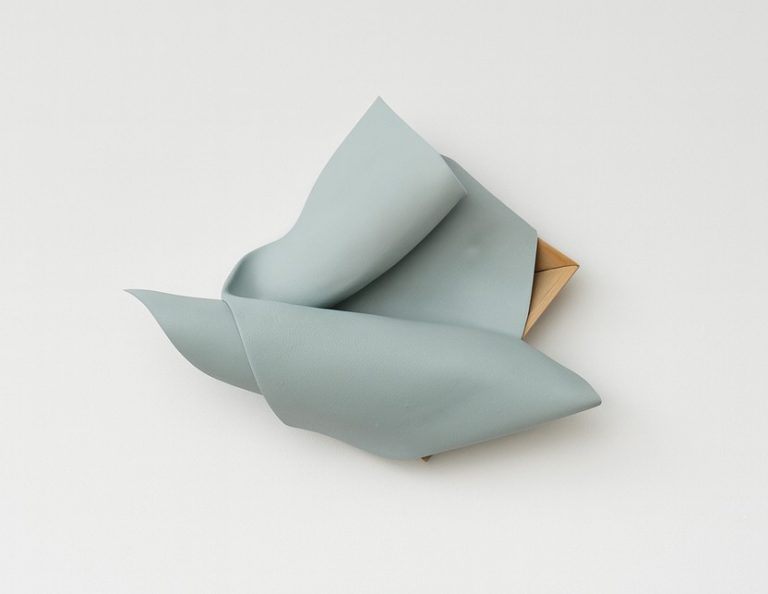
The visitor thus discovers several facets of the work of Tutundjian, who practiced drawing, collages, sculpture and relief paintings. Among the constants is the interest in science and time, and we note the omnipresence of spheres and biomorphic shapes in the series of the 1920s and 1930s. Even the monochrome “reliefs” include half-spheres and rods made of recycled materials linked to old drawings. In the absence of archives, the curators attempted formal and intellectual connections with the artists that Tutundjian frequented, such as Jean Arp and Joaquín Torres-García for the relief paintings. Some affinities are more hypothetical, like Odilon Redon for paint stains and halos, “probably images of the cosmos”, according to Sophie Bernard, because Tutundjian was passionate about the notion of space-time. Other works resist interpretation, such as the small “Japanese” abstract paintings: are these black ink lines and red spheres a direct influence of Japanese works that the artist would have seen and appreciated? If Parisian artists, such as Jean Hélion, testify in their writings to their meeting with Tutundjian, he did not leave a diary or notebook which could remove doubts about his influences. “It is likely that he did not have a good command of French when he arrived in 1923, and he remained discreet about his art in any case. »
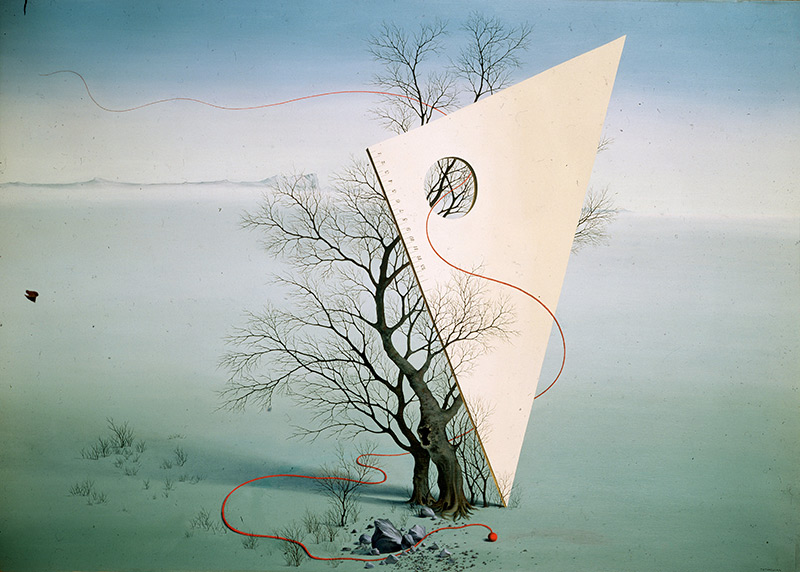
Some late works conclude the tour, notably surrealist paintings from the 1960s in a style radically different from his previous series. We see strangely colored still lifes, desert landscapes from which severed hands emerge, and red and black checkerboards. Did Tutundjian hang out with Dalí and De Chirico? “We know that in 1929 he saw a Dalí exhibition in Paris, and that he was influenced by De Chirico in his paintings evoking rebuses”specifies Sophie Bernard, who adds that “Tutundjian briefly associated with the Surrealists before moving away in 1959”. Because he was not part of any long-term artistic movement, even if he participated in the creation of the Art Concrete group. These late paintings which often contain checkerboard and box motifs constitute “a return to complexity and figuration” at the time when Tutundjian had achieved a certain notoriety and was exhibiting regularly in Europe.