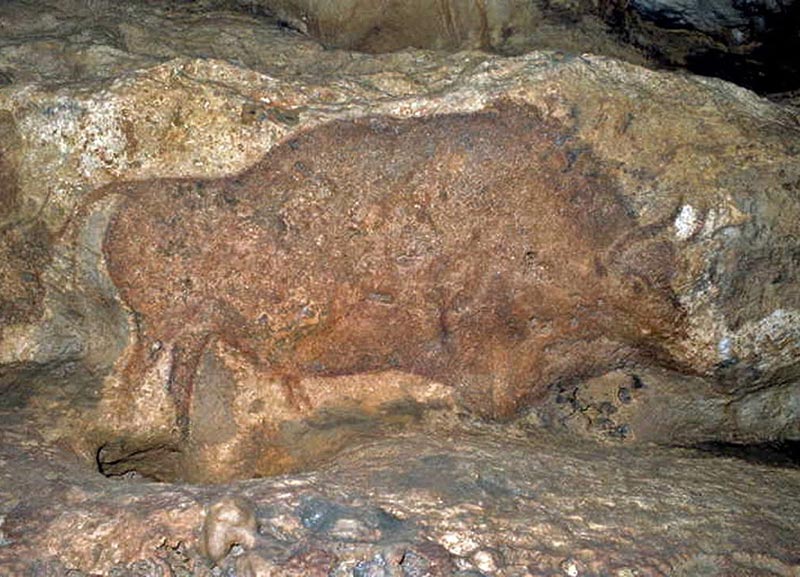
In March, a study published in Proceedings of the National Academy of Sciences established the first direct radiocarbon dates of parietal figures at Font-de-Gaume (Dordogne), discovered in 1901. Until now, no representation had been dated from its own material. The cave, which has around 200 polychrome figures, is traditionally attributed to the Magdalenian, between 18,000 and 16,000 BCE. This chronology is based on stylistic comparisons and indirect dating. It has never been based on the analysis of pigments.
This limit is due to an old hypothesis: the black lines were deemed exclusively mineral, composed of manganese or iron oxides, therefore inaccessible to radiocarbon. Formulated at the beginning of the 20th century, this hypothesis, accepted without direct verification, structured the interpretation of Périgord sites for more than a century.
In 2020, a team led by Franco-German physical chemist Ina Reiche undertook an analysis of the walls combining microscopy measurement techniques, X-ray fluorescence and infrared imaging. In 2024, reflectance imaging spectroscopy (RIS) made it possible to map the carbon distribution more finely. These examinations revealed charcoal drawings, invisible to the naked eye or confused with mineral pigments, sometimes superimposed on known figures, sometimes distinct. An article published in 2023 in Scientific Reports established its existence in several sectors of the cave. The organization of these lines, made up of continuous contours and partial silhouettes, excludes accidental deposits. The presence of organic carbon makes dating possible by accelerator mass spectrometry.
Four microsamples were taken in 2024. The samples, measuring a few tens of micrograms, were selected after imaging in order to limit any alteration.
The analyses, carried out at the LMC14 laboratory in Saclay, provided the first direct dates for figures from Font-de-Gaume. These results establish a chronological basis independent of stylistic criteria. They allow direct comparisons with other European sets dated by radiocarbon and raise the question of a possible stratification of interventions within the cave.
Samples were taken from two carbon black figures, a bison and a mask (human or animal face). The bison is dated between 13,461 and 13,162 years ago. The mask presents differences depending on the areas analyzed: 8,993 to 8,590 years for the left eye, 15,981 to 15,121 years for the upper lip, 15,297 to 14,246 years for the lower lip. With one exception, the results confirm the Paleolithic age of the whole.