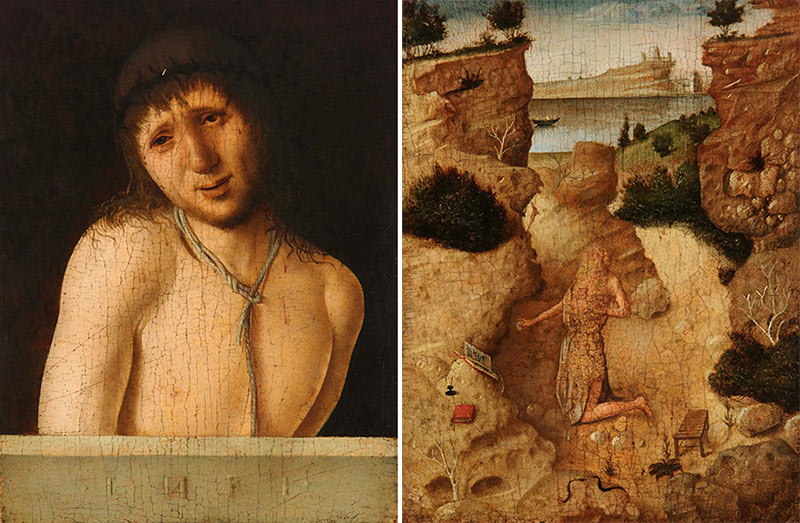
Rome. At the start of the year, the spotlight in the auction world was focused on Sotheby’s prestigious “Old Masters” sale, organized on February 5 in New York. In the shadows, the Italian state was working to repatriate one of the masterpieces of Antonello da Messina (1430-1479). An extremely rare Ecce Homo which, at the last moment, was withdrawn from the catalog. The painting in question is a small wooden panel measuring 19.5 x 14.3 cm painted on two sides. On one, a Christ, with a rope around his neck and a moist gaze, directly calls out to the viewer. On the other side, we observe a penitent Saint Jerome in a rocky landscape.
Discovered and attributed for the first time by the legendary expert Federico Zeri, this work dated 1460-1465 is considered the last by the Sicilian master still in private hands. His corpus includes around forty, nineteen of which are in Italy. Antonello da Messina painted four Ecce Homo preserved, three of them, at the Metropolitan in New York, at the Palazzo Spinola in Genoa and at the Galleria del Collegio Alberoni in Piacenza, Italy. The fourth, that of Sotheby’s, is the oldest and the only one to present another work on the reverse.
Enough to justify the saleroom’s estimate, an amount of 10 to 15 million euros. A simple preparatory drawing by Michelangelo, representing a foot, estimated at 2 million euros, was recently sold for 27.2 million dollars (22.8 million €) in New York. A risk that the Italian state did not want to take. Once the favorable opinion of the General Directorate of Museums had been obtained, the Ministry of Culture instructed the gallery owner Fabrizio Moretti to act as intermediary between the Chilean owner of theEcce Homo by Antonello da Messina and Sotheby’s. The painting will therefore return to Italy, which acquired it for 14.9 million dollars, or approximately 12.5 million euros.
The official announcement must have been anticipated given the enthusiasm that had been generated on social networks. The Federico Zeri Foundation in Bologna spilled the beans: “Hardly removed from auction, it is now the property of the Italian state. » An indiscretion which forced the ministry to confirm the information even though the contracts were still being signed. “This is an operation of the highest cultural importance, claims Culture Minister Alessandro Giuli. This work constitutes a unique example in the artistic landscape of the 15the Italian century. It represents a pillar of our strategy of extension and promotion of national heritage, (that we go) make it available to Italian citizens and visitors from all over the world. »
Where can they admire it? This is now the question that is being debated. Several prestigious institutions are already competing for the table. Sicily, the artist’s native land, can legitimately claim his return to Messina or Palermo. The Pinacoteca di Brera in Milan and the Gallerie dell’Accademia in Venice were candidates. Experts favor the Capodimonte Museum in Naples, the city where Antonello da Messina apprenticed with Colantonio. Other voices obviously suggest the Uffizi in Florence to complete the journey of the Italian Renaissance. A choice that will fall to the Minister of Culture.