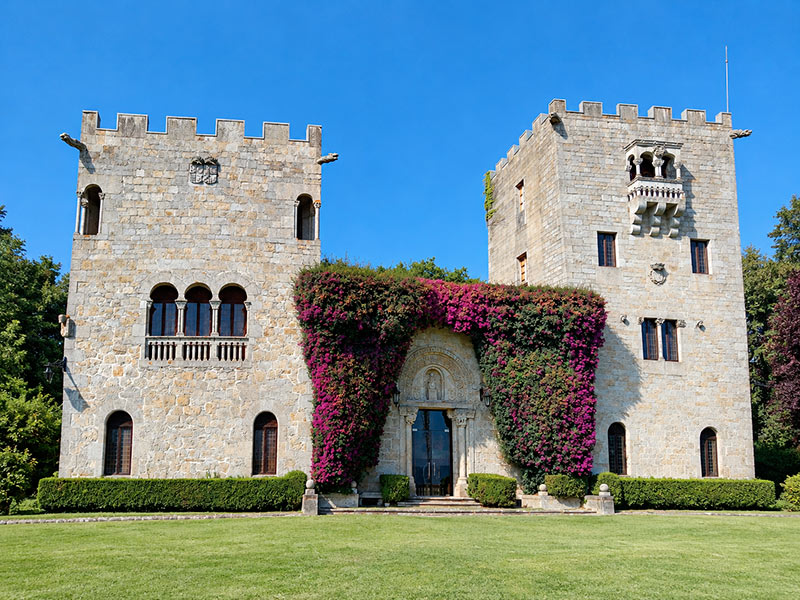
Madrid. On October 27, the heirs of Francisco Franco will auction, in Madrid, 689 lots from the Pazo de Meirás, the former summer residence of the dictator in Sada, Galicia. According to the Magna Art Auctions catalog, antique furniture, porcelain, paintings and portraits will be auctioned, a little over seven months after the Supreme Court definitively recognized the Spanish state as owner of the estate.
However, this decision does not automatically extend to furniture. The ownership of certain assets was examined in a separate procedure, but, according to the Spanish daily El Paísthe State’s lawyers did not claim the objects put up for sale, due to lack of sufficient legal basis. The heirs removed them from the Pazo in July, under the supervision of the legal services of the state and the regional government of Galicia, says José Miguel Carrillo de Albornoz, director of the auction house.
A property that remained in the family until 2020
The Pazo was first the residence of the novelist Emilia Pardo Bazán (1851-1921). In 1938, local notables offered it to Franco, thanks in particular to contributions imposed on the population. The dictator spends his summers there and sometimes organizes the holding of councils of ministers there. His descendants retained possession after the dictator’s death in 1975. The state only initiated proceedings in 2019, and the La Coruña court ordered its restitution in September 2020.
To establish the ownership of the objects, justice relied on an expertise from the Galician Culture Council submitted in May 2024. Inventories, archives and old photographs made it possible to trace the provenance of the goods linked to Emilia Pardo Bazán and the exercise of Franco’s power. In November 2024, the Court of First Instance No. 70 of Madrid recognized the State’s ownership of 559 items: two Spanish National Heritage properties, 409 archival items and 148 historical heritage objects. The 689 lots put up for sale have not been claimed. It remains to be seen whether some overlap with the 559 elements recognized as public property, due to a lack of documented reconciliation between the two inventories.
Classified as an asset of cultural interest since 2008 and recognized as a place of democratic memory in August 2026, the Pazo benefits from protection which does not extend to each of the objects it housed. The Supreme Court also recognized the heirs’ right to compensation for maintenance and work expenses incurred on the estate since 1975.
Circle of Luis Tristan, Saint Francis in prayerearly 17th century, oil on canvas, 110 x 80 cm.
© Magna Art Auctions
Linen embroidered with emblems, domestic objects…
In the sales catalogue, the line between family souvenirs and objects linked to the history of the estate sometimes appears tenuous. Among the highest estimates is a painting attributed to the circle of Luis Tristán, priced at 5,000 euros (see ill.). Lots 393 and 447, priced from 250 and 180 euros, include linen embroidered with the emblems of Franco’s official house and the initials of members of his family. Domestic objects which also bear traces of the official character of the residence, without their belonging to public heritage being established.
The Commission for the Recovery of Historical Memory of La Coruña is concerned about the sale of objects with more sensitive provenance: an ancient chest said to have belonged to Emilia Pardo Bazán and models of ships said to have been offered to Franco in his capacity as head of state. If these origins were confirmed, the status of these pieces could be re-examined. However, there is nothing to confirm at this stage that they are among the assets recognized as public property. The regional government of Galicia assures that the properties of particular interest have already been claimed. The Councilor for Culture, José López Campos, however announced that his services would examine the lots in order to consider, on the advice of specialists, the acquisition of certain pieces for the Pazo.