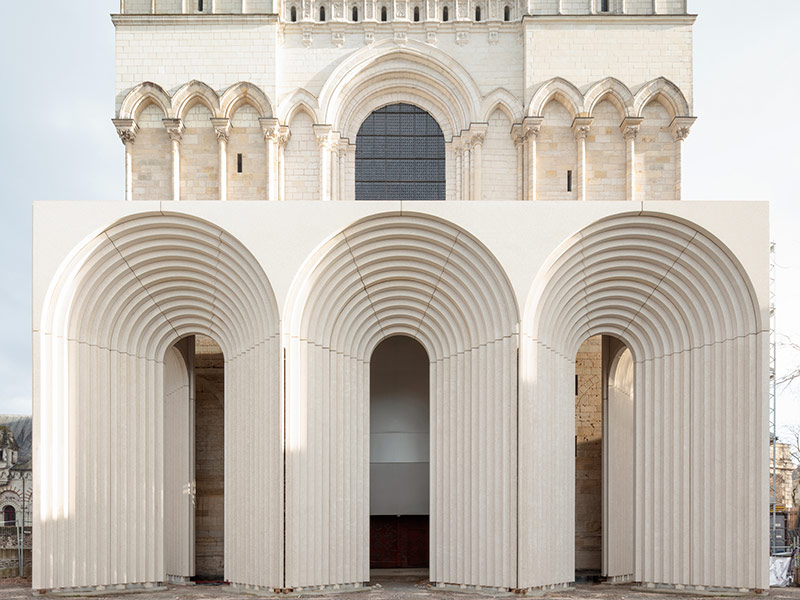
Angers (Maine-et-Loire). The three doors, a reference to the Trinity. The thirteen arches, a subtle allusion to the Apocalypse. And the pleated archivolts, an echo of the fineness of the drapery covered by the statue-columns of the western portal. When he imagined the new gallery of Angers Cathedral (see ill.), Kengo Kuma had a very clear intention: to dialogue with the existing. “The design of this new building is based on a simple idea: to continue the Romanesque style, while ensuring the protection of the 12th century facade.e century “confides the Japanese architect. In fact, the primary function of the contemporary gallery is not decorative. It is above all designed as a protective structure, dedicated to preserving the medieval polychrome masterpiece that it shelters.
For several decades, the project has been making progress. The need arose when the cleaning, in 2009, of the portal inspired by visions of the Apocalypse revealed a polychromy of great richness, composed of an original layer from the 12th century and a repainting from the 17th century. “Today, 70% of these sculpted surfaces still retain their polychromy! On a national scale, and for this period, only the portal of the Coronation of the Virgin in Senlis presents a comparable condition. exclaims Valérie Gaudard, regional director of cultural affairs for Pays de la Loire. A wooden formwork is then temporarily installed in front of the gate, equipped with a small weather station. “This confirmed what we feared: the humidity of the stone. The gate is exposed to the wind, so thermal variations, ultraviolet rays, all these climatic factors very quickly weakened the paintings”she specifies.
Angers Cathedral and the 12th century portal seen through the gallery designed by Kengo Kuma.
© Paul Hamelin
© Thierry Bonnet / City of Angers
If these paintings have survived to this day, it is precisely thanks to the existence of an old gallery, erected in the 13th century then destroyed in 1807, which protected them from the sun and bad weather for centuries. Impossible, however, to reconstruct it identically.
The choice of contemporary
Of this original gallery, only very divergent written and visual traces remain. The option of a contemporary creation then quickly emerged, a bias which did not fail to cause debate. In 2019, after the careful restoration of the polychromies, the Drac launched an international competition with very precise specifications: the space must be an effective and naturally ventilated climatic buffer, which does not weaken either the structure or the basement. The preventive excavations, carried out in 2024, have indeed uncovered important archaeological remains, including 182 medieval and modern tombs.
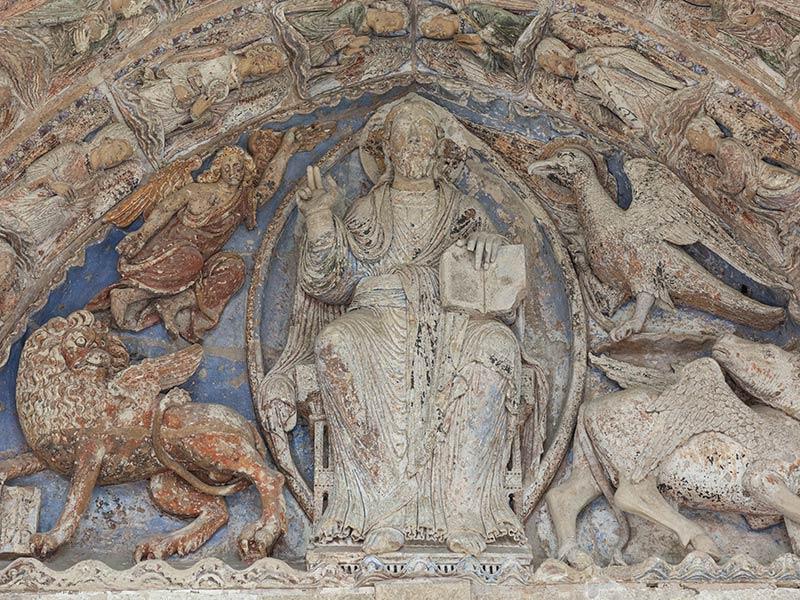
Polychrome tympanum of the portal of Angers Cathedral.
© Thierry Bonnet / City of Angers
Among the proposals from the five selected agencies, that of Kengo Kuma hits the mark. “ What won support was the accuracy of its responses in terms of climate, aesthetics and heritage. recaps Valérie Gaudard. Clean lines, minimalist aesthetic…: the bet is bold, and the gallery imposing. Designed as a threshold that is both closed and covered, it protects the structure but without hiding it thanks to its five openings. To avoid impacting the archaeological heritage of the basement, the structure rests on eight micropiles and fits into the contours of the old gallery. A lower impact also guaranteed by the lightness of the building, built entirely in concrete. The use of tuffeau, initially envisaged to resonate with that of the cathedral, was ultimately rejected. The emblematic stone of the territory turns out to be insufficiently resistant because it is too porous. “Despite everything, we wanted to echo it, get closer to its tone by using local resources. The concrete was made with sand coming directly from the Loire,” adds Kengo Kuma.
It is therefore a structure of textured whiteness which rises eleven meters high, after having been erected with a rope. 660 prefabricated parts were carefully installed and then assembled, starting with the walls, then the arches, then the roof. And the final touch of this 4.3 million euro project (entirely financed by the State): the installation of two large lighting fixtures within the alcoves, only visible from the inside, which provide soft, diffused light so as not to damage the polychrome sculptures. Always the same motto: aesthetics certainly, but above all protection.