
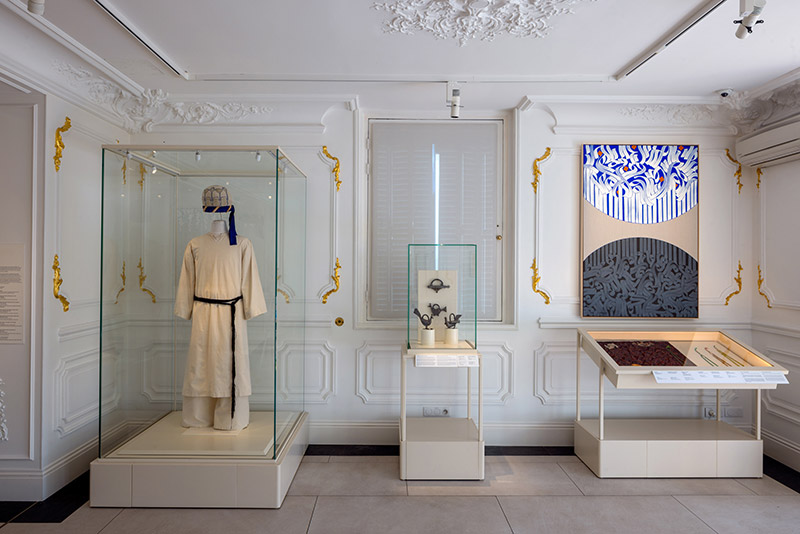
Chatou (Yvelines). Opening in September 2024, the MTO Museum of Sufi Art and Culture (MACS) now presents one to two exhibitions per year with guest curators. The current exhibition takes place in the middle of the permanent exhibition, with which the works attempt to establish a dialogue. “The exhibition offers several entry points into Sufism, and the journey is built on the visitors’ experience of the works,” explains Golzar Yousefi, the curator of the exhibition. As a common thread, the curator chose eight paintings by master calligrapher Bahman Panahi (born in 1967), inspired by central concepts of Sufism. Essentially abstract, these creations dominated by blue and green invite contemplation: Golzar Yousefi explains that visitors can understand the exhibition “even without familiarity with Sufism”. It is true that the false miniatures of Farkhondeh Ahmadzadeh (born in 1964) can be appreciated without knowing the tales that inspired them, as the materials (gold, natural pigments) shimmer on the paper. The strong symbolic dimension of most of the exhibited pieces, however, requires mediation, which allows us to understand how they are linked to the objects and manuscripts of the permanent exhibition. Thus the pastel fresco created by students from the School of Decorative Arts-PSL on the theme of “The Conference of the Birds”, a Persian text with multiple philosophical interpretations. On this subject, the president of the museum, Claire Bay, specifies that the garden is labeled an “LPO refuge” (Bird Protection League), and that this work thus establishes a dialogue with the outdoor space where many birds frolic.
View of the exhibition “When the mirror remembers the step” at MACS MTO.
© Jean-Yves Lacôte
A multisensory journey
The exhibition therefore oscillates between aesthetics, sensitivity and intellectual experience, as on the second floor of the museum where visitors hear Sufi music while looking at the mysterious paintings of Bahman Panahi, facing a bay window opening onto the garden: it is a multisensory experience, completed by a session of zikr (repetitive chanting practiced in a group) in virtual reality. On the third floor, the walls display abstract works and patterns in ayeneh-kari, artisanal mirror mosaic technique (see ill.): the large-format installation by Monir Shahroudy Farmanfarmaian thus immerses visitors in a space with imprecise landmarks. This mosaic technique here reflects the importance of divine light for Sufis, and the need to go “beyond illusions”as the follower of Sufism uses it. The dome carved into the ceiling of the central room on this floor broadcasts Sufi poems in several languages, subtly destabilizing visitors. The end of the visit offers a reading room with works on Sufism, Persian literature and Islamic arts, amid works by Rachid Koraïchi and Farkhondeh Ahmazadeh, like a loop that evokes the beginning of the exhibition.
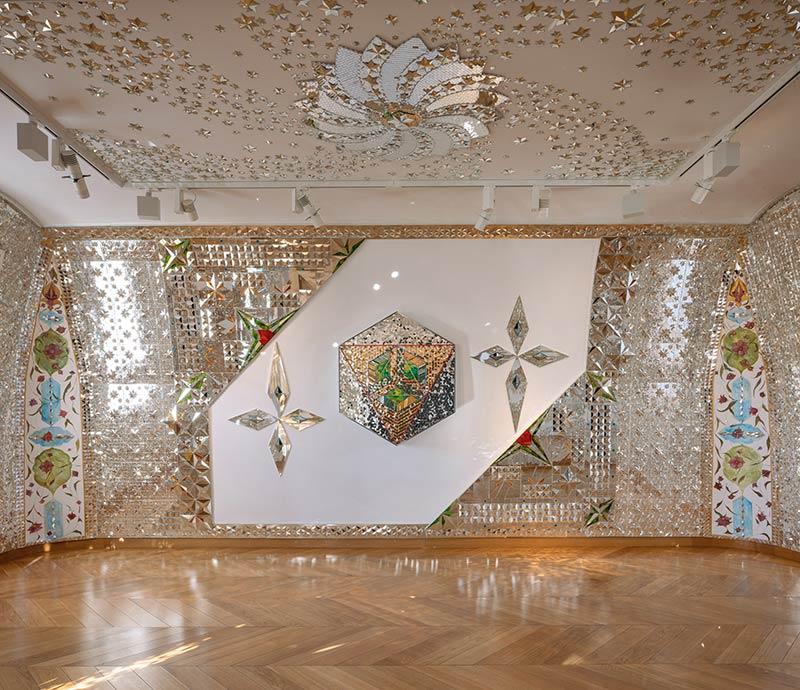
Mirror mosaic featuring āyeneh-kārī motifs, view from the exhibition “When the Mirror Remembers the Step” at MACS MTO.
© Jean-Yves Lacôte
The museum is still in its launch phase
Museum. Located on the banks of the Seine, the Museum of Sufi Art and Culture is supported and financed by two American philanthropic organizations (United States and Canada), and anonymous patrons. The 2026 budget has not been communicated, but Claire Bay, president of the board of directors, specifies that the museum is still making heavy investments. The museum has not had a director since April 2025, Alexandra Baudelot having left her position after two years. She explained to Arts Journal having completed the creation of the museum since 2023 and its territorial anchoring at the municipal and departmental levels. The museum employs six full-time equivalents, and several volunteers for mediation, so it is a small team. In eighteen months, it welcomed just over 12,800 visitors, 25% of whom were foreigners, “a figure which shows steady progress towards our objective”says Claire Bay. The latter underlines that the museum is expanding its institutional partnerships, and is strengthening its scientific committee as well as its acquisition committee, now chaired by the former director of the IMA Museum, Éric Delpont. The museum will announce its new director in spring 2026.


