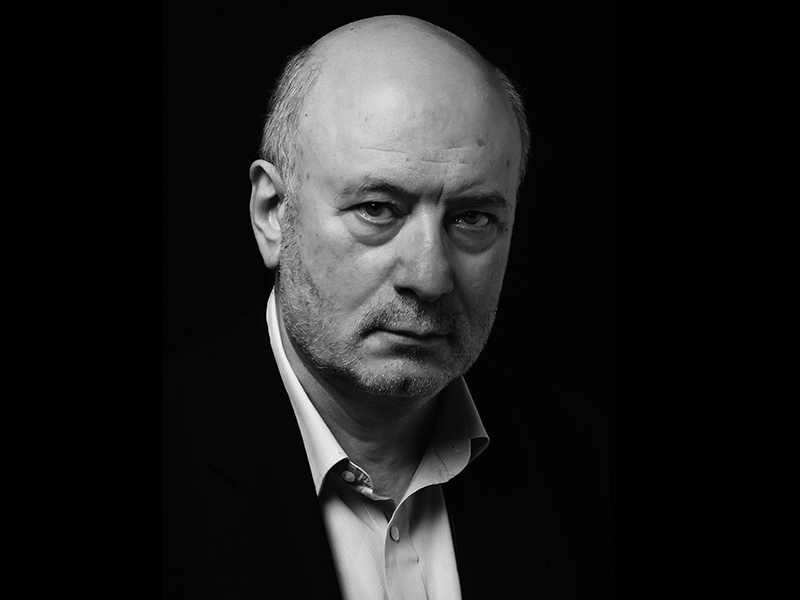
At the crossroads of visual and performing arts, Giovanni Lista illuminated the futurist movement through an innovative approach taking the stage as a starting point. The historian and art critic, who died on October 3 at the age of 83, was as interested in the protagonists of the movement, born in Italy at the beginning of the 20th century, as in its marginal figures, whose rediscovery he encouraged in the academic field.
Born in 1943 in Castiglione del Lago, in Umbria, Giovanni Lista moved to Paris in 1970, where he pursued research into futurism. His thesis, defended at the University of Naples – L’Orientale and dedicated to the playwright of the absurd Eugène Ionesco, is the foundation of the direction taken by his work on futurism, approached through the prism of stage performance. In 1973, he published the anthology Futurism: manifestos, documents, proclamations, before joining, the following year, the Modern Theater team directed by Denis Bablet at the CNRS.
“My father’s approach was to study art forms that were not sacralized by the institution, nor legitimized by the academic system, to understand how they were able to influence the aesthetics of futurism, and infuse a renewal of the idea of the arts in general”explains his daughter, the historian and curator Marcella Lista, at JdA. And to specify “he wanted to re-examine modernity by studying the way in which the futurists were inspired by the performing arts and the arts of the time, to explode old forms”.
The work of Giovanni Lista has thus contributed to highlighting the genealogy of futurism. An entry which led him to become interested in Dada. “He wanted to show how Dada artists took up part of the futurist strategies, to develop, in turn, radical forms and use the very direct language of performance », specifies Marcella Lista. In 1994, Giovanni Lista co-curated an exhibition dedicated to Dada at the Rome Exhibition Center, the purpose of which underlined the affinities between the two avant-garde movements.
It is therefore above all through theater and its variations that Giovanni Lista focuses his research. This is evidenced by the book La Scène futuriste, published in 1989 by Editions du CNRS, which presents the performing arts as catalysts of the aesthetic revolution initiated by the movement. He thus came to discover little-known figures of modernity, such as the American dancer Loïe Fuller, whose biography he published in 1994.
In 1988, Giovanni Lista founded the magazine Ligeia. Art fileswhich he directs until 2025. In 2011, he was named Knight of Arts and Letters by the Minister of Culture Frédéric Mitterrand and Cavaliere dell’Ordine al Merito by the Italian President Giorgio Napolitano.
A tribute was paid to him during a public ceremony organized on October 15 at the Notre-Dame-du-Travail church, in the 14th arrondissement of Paris.