Hide and seek at the museum, “seek and find” in the collections, awakening to the works… You have undoubtedly noticed that institutions are competing with each other with ideas to welcome an ever-younger audience. A fundamental trend that we observe both in large establishments and in modest territorial structures, places which, in the space of a short time, have all reviewed their policy for toddlers. If the reception of children from 3 years old has already been developed for a long time, museums now have a new target in their sights: visitors in diapers. Many places therefore offer a real offer from 18 months, or even from birth, in order to meet the new expectations of young parents but also a societal and political incentive. “We set up the “Bottles and albums” program in 2022 in the wake of the major national campaign on “The first 1,000 days of the child”, explains Aurélie Forestier, mediator at the Museum of Youth Illustration (MIJ) in Moulins (Allier). During this operation, we became aware of the fact that we were not offering activities for children before kindergarten and that this was lacking. »
For a long time this segment was in fact left fallow by institutions who thought that, below a certain age, there was little point in taking a child to the museum. “In reality, neuroscience shows that this makes sense from birth because babies are sensitive to lights, colors, shapes and spaces, summarizes the mediator. Newborns are very attracted to contrasts, so through the albums we can play on this facet. We also focus our activities on the sensory, which is a great gateway to reaching this audience. » And this offer is a hit, the slots are taken by storm. So much so that the MIJ has implemented the principle in a self-service suitcase intended for parents and nannies. “It takes the spirit of animated tours with color games and Memory for example. This tool is accessible without reservation because the idea is that it is as natural to go to the museum as to the park with a toddler, comments Aurélie Forestier. The sooner we get them used to coming, the sooner they feel at home at the museum. Moreover, we see this with babies who have come several times; They feel at home here and they point out the works. We feel that they are really taking possession of the place and the collections! »
Mediation material for very young audiences set up by the Moulins Youth Illustration Museum, and work hung at toddler height.
© BM / Museum of Youth Illustration
Political will
This familiarization from the cradle has the virtuous effect of creating a habit of visiting the museum which coincides with the objective of artistic democratization supported by the State and communities. This is why more and more municipalities are making access to museums for young children a development area of their cultural policy. In Lyon, a new system is, for example, being tested: the Colibri Pass. Since September, each family of an infant born at the Croix-Rousse maternity ward has received a voucher allowing them to accompany the baby free of charge from birth to the age of 3 at the Musée des Confluences.
The City of Marseille, for its part, has developed the “A crèche, a museum” operation, which notably includes activities led by cultural mediators, the construction of an edutainment kit and a family outing to a municipal museum. In Lille, this strategy is at the heart of a broader reflection. “We have a clearly assumed ethical ambition, we want to make Lille a city suitable for children; that is to say an inclusive city which takes into consideration children in their needs, explains Charlotte Brun, second deputy mayor. This policy materializes in different sectors including cultural places where the child is considered a sensitive spectator from birth. Obviously little ones will not leave the museum with in-depth knowledge of art history, but they will benefit from an essential psychosocial skill which is empathy. During a visit, the baby shares his emotion and his dazzlement with his companion; it’s something very positive for him as for the adult (who accompanies him), who becomes more of an actor in the visit. It’s a different way of activating the works. »
And parents are not the only ones concerned since the visits designed to measure for babies, from birth to 36 months, in different formats, have also been designed for childminders. The offer that the Palais des beaux-arts de Lille is launching this fall was even developed in conjunction with the Premiers Pas association (a network of early childhood professionals). “The educational trunk was created with childminders to place the question of artistic awakening at the heart of child development, explains Juliette Singer, director of the museum. We participated in the educational aspect and the choice of works, but the assistants created the materials for the little ones. They imagined elements to touch, to smell, to manipulate. They were trained to ensure visits to the museum with babies, as part of real continuing training co-financed by the City and the Family Allowance Fund. »
The nannies are not the only ones to have received training since the museum staff have been made aware of how to welcome these very young visitors and how to manage any difficulties as best they can. Objective: to provide them with the language elements and teach them the right attitude in the event of a problem (overly curious children, very loud tantrums, etc.), so as not to upset the parents.
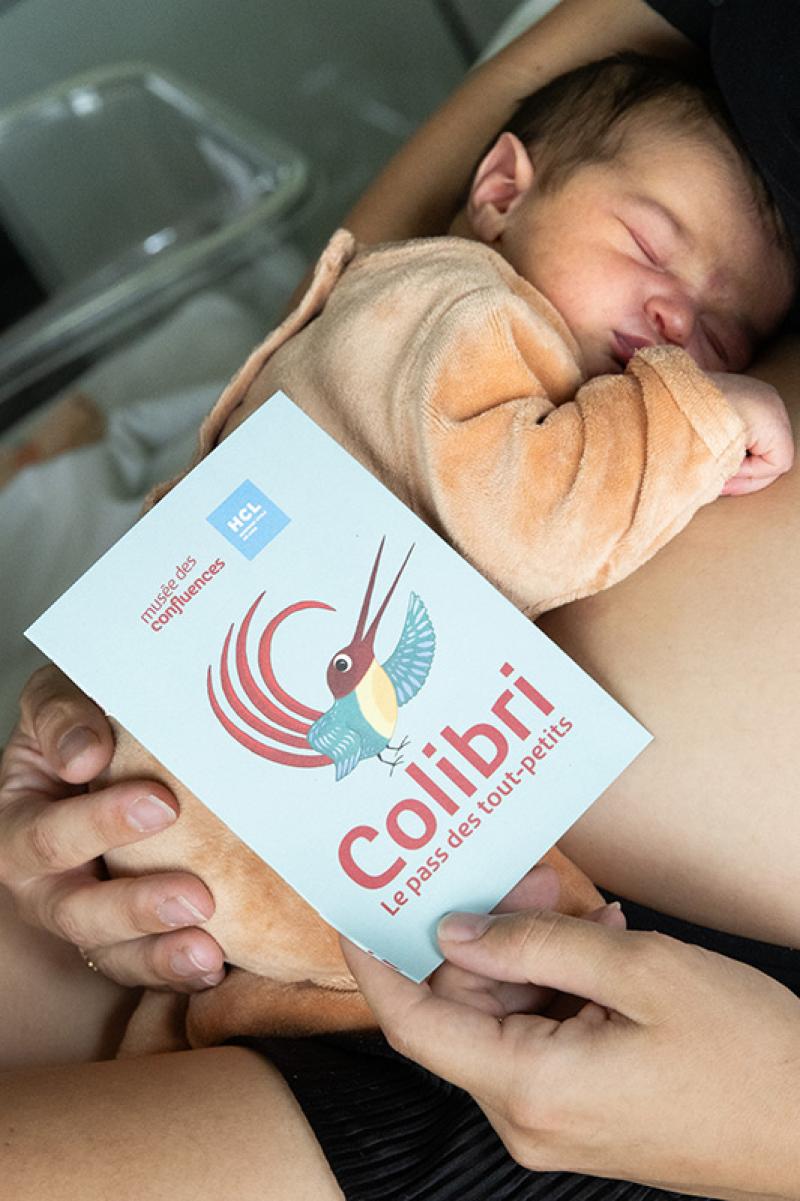
The Colibri pass set up by the Croix-Rousse maternity ward and the Musée des Confluences in Lyon.
© Bertrand Stofleth
Tailor-made spaces
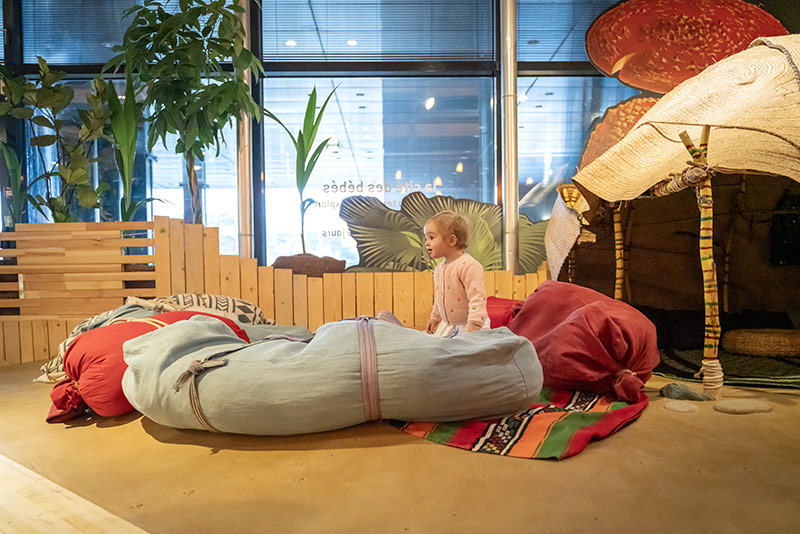
Because despite the growth of these offers, many parents censor themselves, for fear that the baby will not be cooperative or that the material conditions will not be suitable and that the expedition will turn into a fiasco. This concern explains the craze for spaces reserved for babies. “Here we are not afraid of bothering ordinary visitors if the baby starts screaming at the top of his lungs, slips Marie, a young mother met at the Cité des Bébés. And from a practical point of view, it’s perfect because there is absolutely everything for changing, feeding the child and even breastfeeding in a hammock. And there’s even a change of clothes in case of a diaper accident! » This new structure, opening in 2024 within the Cité des sciences in Parc de la Villette, is so successful that it is almost impossible to reserve a place on weekends. “We are not surprised by this popularity because we had identified a need for both parents and children to have a dedicated space, advances Sophie Lecuyer, museographic project manager at Universcience. Usually, the museum visit is designed for the parent; we have reversed this philosophy by creating courses made for little ones, at child height, so that the baby is the recipient and the parent the guide. To do this we worked with researchers, psychomotor therapists but also artists. »
During our visit, we were surprised to be approached by a baby choreographer and to live an experience that was atypical to say the least. Because these new places are cocoons where you can share a special moment around art and creativity with your child. Several facilities formally prohibit cell phones to fully experience the moment and reconnect. A dimension which largely explains their success. In fact, in just a few years, these places have multiplied at breakneck speed (Air and Space Museum at Le Bourget, Centquatre-Paris, Atelier Rodin and Orangerie in Paris, Museum of Fine Arts in Lyon). From now on, they are almost systematically integrated into renovation projects, as recently at the Dobrée museums in Nantes and Albert-Kahn museums in Boulogne-Billancourt. Without forgetting the Salon Seine du Grand Palais which offers a superb space (900 m2) for families, what’s more, in a “customs-free” zone. Its regularly renewed programming is linked to current events, like the Design weekend for toddlers which was held in September to echo Paris Design Week.