
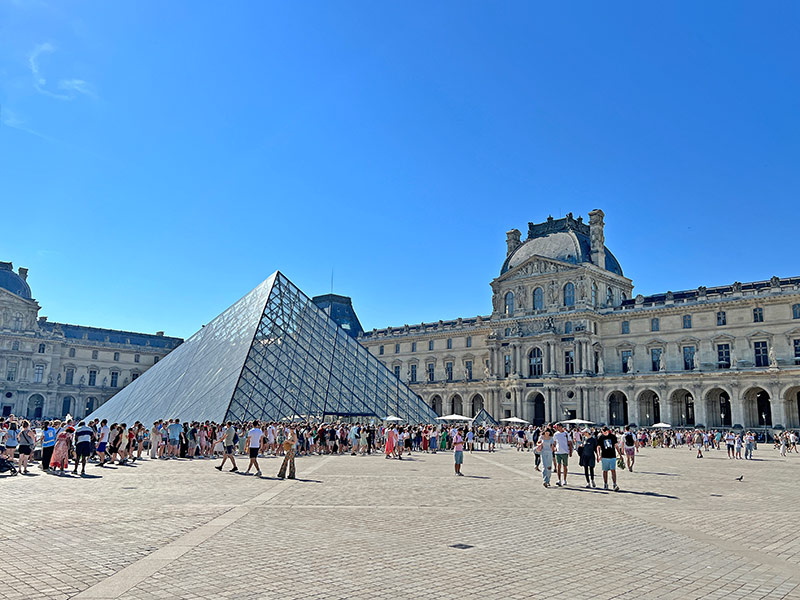
Paris. Restricted hours, free or closure of rooms: almost all museums had to reorganize their operations during the heat peaks of last summer. As the C2RMF (Centre for Research and Restoration of Museums of France) points out, only 60% to 70% of museums are equipped with temperature sensors, which makes a risk assessment complicated. In Île-de-France, museums reacted differently depending on whether they are air-conditioned or not, but all have applied a “heatwave plan” and adapted their opening hours. The high temperature in certain establishments indeed made the visit uncomfortable: social networks echoed visitors’ criticism on this point, for example at the Carnavalet Museum and the Museum of Modern Art of the City of Paris (MAMVP), devoid of air conditioning in the permanent collections. THE Arts Journal was able to observe that, in these two museums, the temperature in the rooms of the permanent tour still exceeded 28°C at the beginning of September, i.e. after the last major heat wave.
Many air-conditioned museums have, however, adapted their operation: the Orsay and Orangerie museums specify that they have carried out “early closures at 5 p.m. during red heatwave episodes (June 25 to 27 and July 11 to 15)”. At the Louvre, where a majority of rooms are cooled, “during the most significant heat peaks (from June 24 to 28 then from July 10 to 16), the museum experienced eleven days of early closure (last entry at 2 p.m., closing at 4 p.m.)”, signals the direction of communication. Finally, the Versailles estate, where the castle is partially cooled, experienced eleven days of early closure at the castle and the Grand Trianon, while the park remained open at usual times and “the Orangery was exceptionally open every afternoon”, specifies the establishment.
Air conditioning
Most museums have also adapted the working hours of agents, or their working conditions: the Louvre thus ensures that it has “encouraged teleworking” for certain positions, and recommended “extra breaks for gardeners”. The museum also installed “223 fans and 103 vaporizer fans” in showrooms and offices.
It should be noted that some museums have not changed the opening hours for visits, such as the Museum of Decorative Arts (MAD), whose general director, Sophie-Justine Lieber, specifies that “80% of the permanent and temporary galleries are air-conditioned.”
It appears from this quick overview that the central question is air conditioning or cooling in museums. If Icom (International Council of Museums) and the Ministry of Culture regularly draw up recommendations for the adaptation of museums to extreme climatic conditions, maintaining a stable temperature in these institutions is a headache. The ministry recommends, for example, activating the air conditioning as soon as the temperature exceeds 26°C, a threshold which does not take into account the differences in heat between the rooms of the same museum. Unlike reserves, museum rooms are subject to constraints linked to public attendance and the presence of staff: reconciling a comfortable temperature for visitors with an ideal temperature for the works and a controlled humidity level (read the box) requires trade-offs.
Constraints of old buildings
Added to this are the constraints of old classified or protected buildings, which hamper air conditioning work. In Saint-Denis (Seine-Saint-Denis), the Paul-Éluard Museum of Art and History had to resort to window caulking measures during the summer, because this former 17th century monastery could not withstand the scorching temperatures. In already equipped museums, recent heatwaves have prompted plans for additional work and modernization of existing facilities: at the MAD, Sophie-Justine Lieber thus announces “works in 2026 and 2027 to offer 100% air-conditioned spaces to visitors” ; Furthermore, reflection has been underway for several years on the “replacement of technical equipment” in order to better adapt them to the heat.
Same reflection in progress at the Louvre, establishment “where the cooling system powered by (the company) Fraîcheur de Paris was tested by extreme climatic conditions ». The establishment grants a “aging of technical installations and waterproofing defects in old buildings”, and recalls that the replacement of this equipment is part of the “issues of the Louvre transformation project” worn by President Emmanuel Macron. In Versailles, air cooling work continues in the north central building (King’s apartments), as part of the establishment’s master plan.
Another problem, finally, the extreme heat caused electrical failures due to overheating, as in Orsay and the Orangerie, where the high temperatures caused “tensions on technical networks” which led to a temporary closure.
The impact of heatwaves on the works
Conservation. In addition to the comfort of visitors and agents, heatwaves affect the exhibition conditions of works. Strong temperature variations can modify fragile materials, such as wood or wax, and the museums surveyed specify that they have carried out more frequent condition checks since June. The Louvre reports having temporarily put back in reserve “the wax works in room 226”. Regarding wooden works and furniture, the risks during heatwaves are “phenomena of detachment, cracks or play of assemblies”explains a member of the team responsible for preventive conservation at the Palace of Versailles. These alterations, which are the subject of increased monitoring, have been increasing in recent years. In the castle, “the works most sensitive to heat were preventively removed from the circuits most exposed to high temperatures, like the wax portrait of Louis XIV created by (Antoine) Benoist, sheltered during the June episode. The recent heatwaves are therefore confronting museums with urgent investments, and forcing them to rethink their operation under constraints.


