
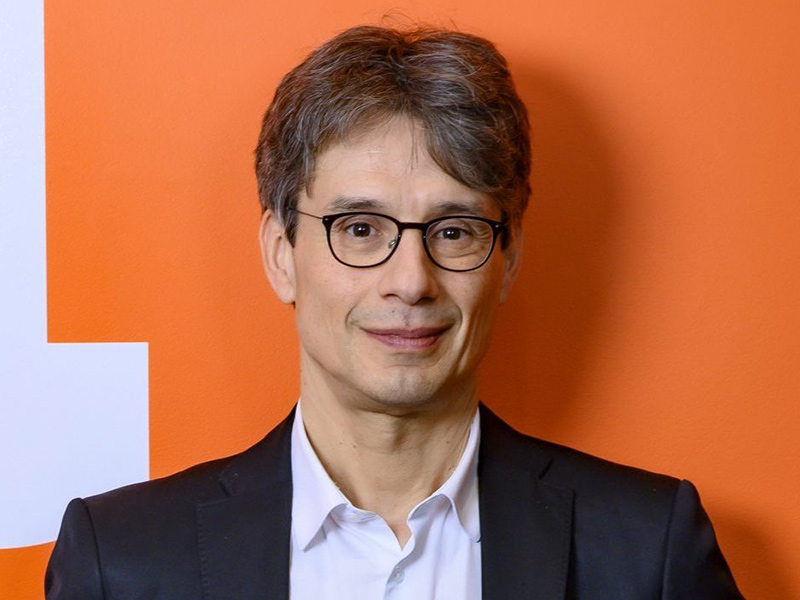
On July 7, Bruno Patino, president of Arte France, was appointed president of the board of directors of the National School of Photography in Arles. A specialist in media and digital issues, he was notably director general of Interactive World and deputy general director in charge of programs and digital developments at France Télévisions. In April, he published, with Grasset, an essay entitled The Age of Human Obsolescencea critical reflection on the development and challenges of artificial intelligence (AI), the pinnacle of the digital revolution.
Why did you accept the presidency of the National School of Photography (ENSP)?
When Véronique Souben (director of the ENSP) proposed it to me, I was both honored and surprised. As the mandate of (president) Régine Hatchondo was coming to an end, I presume that she wanted to be part of the continuity of a presidency both present in the field of culture and embodied by the president of a reference institution, which shares points in common with the fields studied at the ENSP. Image and photography are of primary interest to us at Arte. Véronique Souben also undoubtedly wanted to have someone who could share thoughts on the future of the image following the digital revolution. Arte has also been a partner of the Arles Photography Meetings for a very long time. I told myself that I could be useful for this school. So I accepted his proposal.
Bruno Patino, The time of human obsolescence2026.
© Grasset
ENPS has just created a post-graduate course focused on artificial intelligence and new technologies. Does the author of “Time of Human Obsolescence” believe that the ENSP, and more generally education, sufficiently trains students in the implications and impacts of AI?
The economic, political, ecological and ethical impacts of AI are clearly very significant. In my book, I make AI a stage of the digital revolution which plunges us into a post-Gutenberg era and leads us to re-examine fundamental achievements on which we have built our societies, our political regimes, our knowledge, our science and our knowledge. Obviously, for a photography school as for an audiovisual company, AI changes a lot of things in many areas. Especially since the digital revolution is profoundly changing our societies, and ultimately our political regimes. It is therefore essential to understand its nature, what it allows, what it does not allow, and the impacts it can have. What a machine produces, although it was once the fruit of individual reasoning or imagination, is not of the same nature. In my opinion, the two pitfalls that must be avoided, at Arte I hope and at ENSP I have the impression, is to think that AI is a tool that must simply be taught, mastered and that it does not fundamentally change things. Because we are not faced with the creation of a simple additional technological tool, but before a change of magnitude which has anthropological consequences.
You also show in your book that AI is an immense nebulous system with multiple consequences…
We are entering a life in which the data economy is becoming more and more significant. And therefore, an increasingly common part of our existence is either guided, driven, or produced by calculation. The part of calculation in human existence, which is not the same thing as reasoning, is becoming more and more important. What is produced by calculation has a status to which we are not yet accustomed.
Does this mean that the authenticity of a creation must be redefined, identified and protected even more clearly than it is today?
Certainly. It must even be completely redefined. In The Work of Art at the time of its technical reproducibility (1936), Walter Benjamin explained how reproduction techniques, such as photography and cinema, had disrupted the very nature of the work of art. By becoming accessible, the work lost its original “aura”, but gained a new social function. AI enables cloning of the artwork. The relationship between the artist and the work changes. What is the authenticity, what is the status of images created from prompts (instructions given to artificial intelligence, editor’s note)? They are not photographs, but they are nevertheless unpublished images and the result of the work of an author with a machine.
Google’s “AI summaries” (or “AI previews”) are now available in France. Media, publishers, art and culture circles fear that their traffic from the search engine will drop because visitors, after having had the answer to their search provided by the AI, feel less of the need to click on a link. How do you analyze this evolution of available data?
There is a very strong risk of invisibility for a certain amount of information and works. Over the last quarter of a century, we have seen the increasingly significant space taken by links sponsored by search engines. The weight of an algorithm means that there is no longer the equal visibility that could have existed at the beginning of the Internet. A growing part of our information, our culture and our entertainment will now pass through an intermediary which will be the AI agent. Added to this risk of invisibility is another risk, that of an increasing standardization of productions resulting from generative AI. We are still in the early stages.
In your book, you even mention the advent of “digital book burning”?
What the Doge (the Department of Government Efficiency led by Elon Musk from January to May 2025) has shown is that if you want to completely make data invisible, you no longer have to destroy it, you just have to make it inaccessible, inappropriate or unusable. Which raises the question of the status of the data.
Should we, individually and collectively, give ourselves limits in the use of AI?
The whole question is that of delegation. The economic model of AI will push us to delegate a very large number of tasks to them. Because it’s so easy and quick. However, AI is not a classic tool but something that must be mastered, supervised and organized. It’s a whole teaching mechanism that needs to be reviewed.


