To discover Hong Kong today is to experience a dense, vertical city where the flow of automobile traffic rubs shoulders with that of pedestrians, who often use wide, elevated footbridges spanning crossroads. This cosmopolitan city which has made efficiency its motto – particularly as a global financial center – offers an impressive collection of skyscrapers. Some, iconic, signed by big names in architecture such as IM Pei, Zaha Hadid or Norman Foster, form a skyline photogenic that can be seen from the mainland part of the city (Kowloon and the New Territories). Topped with lush tropical vegetation at its summit, Hong Kong Island is bordered by popular beaches to the south and you can reach one of the tiny, still bucolic islands that also make up its territory in a few minutes by boat. This unique site in the world, as a “special administrative region of China” has its own currency and relative autonomy – there is no need to obtain a visa to go there.
A skillfully created art district
For anyone returning to Hong Kong after twenty years of absence, with the nostalgic atmosphere of the films of Wong Kar-wai or Johnnie To in mind, the urban and cultural metamorphosis seems astonishing. The city has indeed established itself over the last decade as one of the most exciting destinations in Asia for art lovers. Two converging dynamics are at the origin of this spectacular change. On the one hand, the market was structured with the launch in 2013 of the powerful Art Basel Hong Kong fair, while the auction houses, Sotheby’s and Christie’s, had been established there for several years. On the other hand, the local government wanted to provide itself with a rich cultural offering thanks, in particular, to the implementation of a district dedicated to this objective, the West Kowloon Cultural District. This vast real estate program occupies no less than 40 hectares on the seafront, according to a development plan mixing museums, performance halls, public promenade, shops, offices and other infrastructures, including hotels. While at the beginning of the 2000s, there were no international art galleries on the island and its museums with their dilapidated scenography were unattractive, rehabilitation projects are being carried out at full speed, while leading institutions have sprung up from the ground. Magnetized by this gateway to Asia, between 2011 and 2018, major international galleries, from Gagosian to David Zwirner via White Cube, Perrotin, Pace and Hauser & Wirth, rushed to open branches there. In 2018, a new cultural hub appeared in the heart of the business district, in the nerve center of the city, where the Tai Kwun Culture & Arts project took over an abandoned colonial complex (a former police station, the central judiciary and a prison), transformed into a contemporary art and heritage center. The operation was financed thanks to subsidies from the Hong Kong Jockey Club – horse racing organizer and key philanthropic player in the city – which covers the operating costs. The remarkable Tai Kwun Contemporary art center, which organizes six to eight exhibitions per year, is frequented by both Hong Kongers and passing tourists.
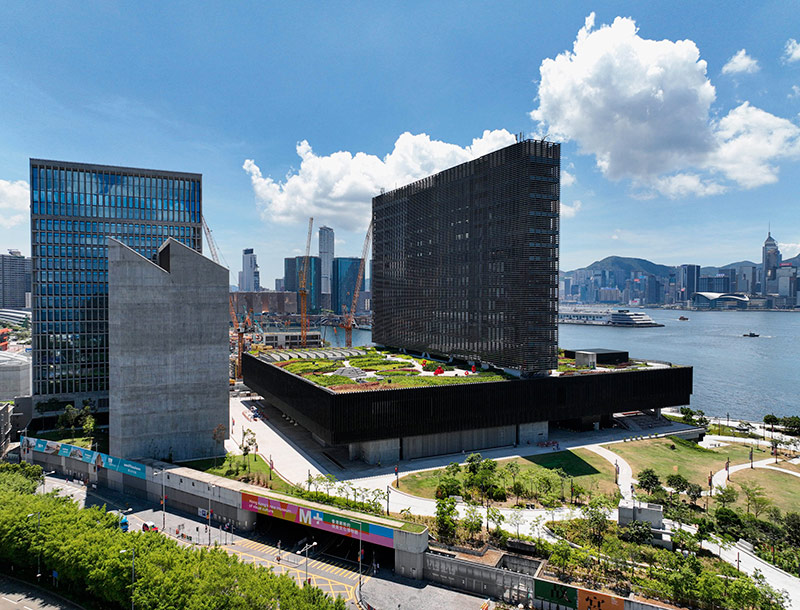
The Palace Museum in Hong Kong.
© Palace Museum
A remarkable cultural facility
At the same time, on the mainland of Hong Kong, the outlines of the West Kowloon Cultural District began to take shape, first with its first “art pavilions”, then with its sculpture park. Three years later, in November 2021, the colossal M+ building, dedicated to visual arts, design and architecture, opened its doors there, causing a sensation with its facade of more than 100 meters wide which serves as a giant screen for video works, specifically commissioned or from the museum’s collection. A true “digital lighthouse” visible from Victoria Harbour, on the opposite bank. In July 2022, the Hong Kong Palace Museum became, for its part, the local showcase of the immense collections of the Beijing Palace, of which it displays a selection of works of art and Chinese imperial objects. The establishment also regularly hosts world-class exhibitions in collaboration with major foreign museums – the Met in New York, the Musée d’Orsay, but also the Palace of Versailles, the Museum of Decorative Arts, and even Egyptian institutions, which have lent, in 2025, some of their historical treasures. Also in West Kowloon, the Performing Art Center, currently under construction, a vast complex dedicated to dance and theater, should be inaugurated by 2026-2027. And it’s not over. On the island, the Oil Street Art Space (called Oi!), a former royal club transformed into an experimental art space, programs contemporary art exhibitions and commissions emerging artists for site-specific installations. As for the Hong Kong Museum of Art, the superbly renovated historic public museum, it has once again attracted many visitors since 2019. “In a decade, Hong Kong has built a complete cultural ecosystem with major museums, art schools… Even on a logistical level, we now have very professional transport companies, which was not the case before,” relates Tobias Berger. This influential “curator”, who played a key role in the opening and recognition of Hong Kong on the international contemporary art scene, has just founded a brand new “art salon”, Gold, in a former jewelry store, with businessman and patron Benjamin Cha. Alongside the independent art space Current Plans, and a handful of galleries (Antenna Space, Blindspot, etc.), Gold is one of the flagships of Wong Chuk Hang, a former business district that has become in just a few months an artistic hive duly mapped by tourist brochures. Because art is a precious source of oxygen in this city where freedom of expression has suffered numerous attacks in recent years.
With its graphic facade inspired by the stylized pattern of traditional bricks, the Tai Kwun Contemporary is the art center entirely dedicated to contemporary art in this rehabilitated heritage complex. Its three floors host thematic exhibitions, demonstrating an approach in touch with social issues (for example, environmental pollution caused by industrialization), and monographic presentations, such as the first solo in Asia by the artist Anne Imhof (born in 1978) announced next September.
The M+
The M+ building, like many of those that shape the face of the new Hong Kong, is striking for its gigantism. Built by Herzog & de Meuron (with TFP Farrells and Arup), it covers 65,000 m2 and has more than thirty galleries and two cinemas. Its programming combines contemporary art exhibitions – with an Asian tropism – and film screenings, performances and other events in more hybrid formats integrating, for example, digital media.
38, Museum Drive, West Kowloon Cultural District, Kowloon, Hong Kong, www.mplus.org.hk
The Hong Kong Museum of Art
More encyclopedic and older than the Hong Kong Palace Museum, the Hong Kong Museum of Art is a public museum. Its permanent collection includes more than 19,000 works. It is structured around four axes: Chinese antiques, Chinese painting and calligraphy, Chinese commercial art, and finally modern and contemporary art from Hong Kong. Ceramics (from the Neolithic to the 20th century) hold an important place there, but we also admire sets of painted fans of great refinement.
10, Salisbury Road, Tsim Sha Tsui, Kowloon, Hong Kong, hk.art.museum
Empty Gallery
Opened in 2015, the Empty Gallery is known for its “back box” system, an exhibition space designed like a black box – as opposed to the “white cube” concept associated with contemporary art brands. The absence of visual cues gives the discovery of the works a unique sensory dimension. The programming focuses on contemporary, performative and multimedia practices.
18th & 19th Floor, Grand Marine Center, 3, Yue Fung Street, Tin Wan, Hong Kong, emptygallery.com
Oil Street Art Space (Oi!)
With its garden and historic Arts and Crafts building (actually the former clubhouse of the Royal Hong Kong Yacht Club, built in 1908 and renovated), Oi! is an oasis in the middle of the skyscrapers. The venue is known for its innovative exhibitions and its commitment to local creation. In 2026, Oi! notably hosts an installation from the “Swimming” series by artist Chan Wai-lap (born in 1988), composed of more than 1,200 artisanal tiles, exploring the swimming pool as a public space carrying stories, collective memories and subtle allusions to the difficulty of assuming a queer identity.
12, Oil Street, North Point, Hong Kong, www.apo.hk
Blindspot Gallery
This gallery highlights varied contemporary artistic practices, with particular attention to works that explore social, political and cultural themes. The gallery plays an active role in the Hong Kong art scene, supporting creators whose work reflects the diversity and complexity of Asian realities and contemporary issues, such as Trevor Yeung (born 1988 and read p. 130), who represented Hong Kong at the 60th Venice Biennale in 2024, in the collateral program.
Gold
By taking over the walls of a former jewelry store last March, 300 m2 on the ground floor of a building in the Wong Chuk Hang district, the “curator” Tobias Berger took the challenge of creating an artistic platform without commercial purposes, between experimental laboratory, 18th century salon and concept store with interdisciplinary programming combining art, design and visual culture. Its inaugural exhibition, “Certainly,” brought together local and international artists in a black and white graphic presentation, without sacrificing substance for form.
G/F, Remex Centre, 42, Wong Chuk Hang Road, Hong Kong, www.serakai.studio/gold
The Hong Kong Palace Museum
Through an ambitious program that combines careful scenography and transversal themes devoted to ancient civilizations, the Hong Kong Palace Museum is not limited to Chinese collections: it also mounts flagship exhibitions with institutions such as the Musée d’Orsay or the Met in New York. Until October 2026, the HKPM is hosting a major jewelry exhibition, the first major tour of the American museum’s jewelry collection.
8, Museum Drive, West Kowloon Cultural District, Kowloon, Hong Kong, www.hkpm.org.hk