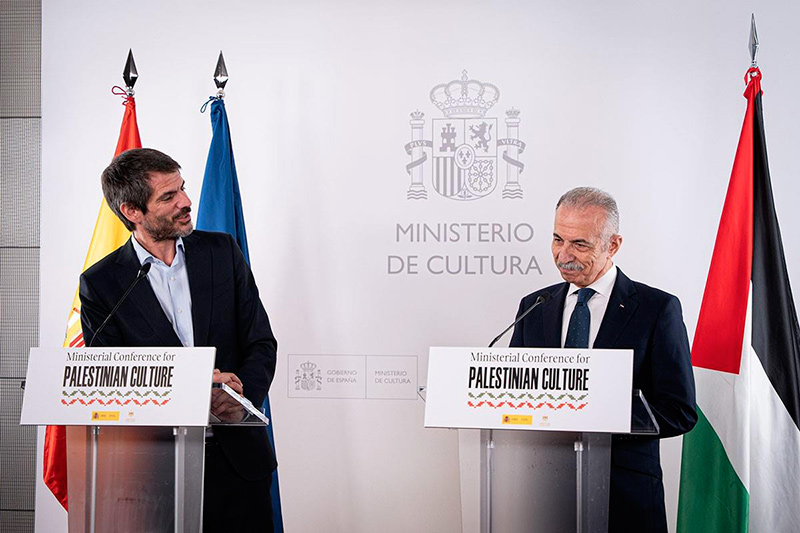
Organized at the initiative of the Spanish and Palestinian Ministries of Culture, an International Forum for Palestinian Culture led around thirty international delegations to commit to the protection of the heritage and identity of Palestine, threatened by the Israeli offensive in Gaza. The meeting ended with the signing, last Thursday, July 16, of a “Declaration for the protection of the cultural sector in Palestine”.
The signatories, including France, are calling for the creation of“a pact for the resilience of Palestinian culture”. Without imposing a concrete commitment, the text appears more symbolic, emphasizing the need to encourage the sustainability of the cultural sector in Palestine. A concern reflected in the progress of the Forum, which took place from July 14 to 16 in Madrid’s major cultural institutions. Before the interministerial conference, where major supporters of Palestine – Egypt, Algeria –, countries historically close to Israel – Greece, Austria – and international organizations – UNESCO and the Arab League – were represented, a “Agora” citizen composed of members of civil society from the field of culture was organized.
Find a “coordinated and effective response” to a “deliberate attempt to erase the age-old splendor of Palestinian culture” was the objective of the demonstration, as formulated by the Spanish Minister of Culture Ernest Urtasun. Already included on the agenda of intergovernmental organizations, the cultural question is thus moved onto the political and diplomatic levels, providing itself as consensual common ground for non-aligned states. From the point of view of Mohammad Rabah, director of the Palestinian Circus School of Birzeit who participated in the Agora, “culture can be a light at the end of the tunnel. While everything is blocked politically, and finding a peaceful solution with the Israeli far-right government seems impossible, culture can be a way to maintain hope.he explained to Arts Journal.
The Al-Mathaf Museum, Gaza City, after its destruction in January 2024.
© Maher Skaik
Karim Kattan, Franco-Palestinian writer, was invited to speak during a round table alongside a Palestinian artist based in Ramallah (present by videoconference), and committed Spanish actors, including a representative of the Finestres Palestina bookstore, a space specializing in Palestinian culture opened in May in Madrid, and a member of the Teja network, which organizes residencies for artists and workers in the cultural sector threatened in their country. “It was really liberating to be able to talk about these complex subjects, think out loud in a dedicated listening environment”he told the JdA. From this event, he remembers that he was not “There is no question of separating culture from politics. It was a reflection on the arts in the light of politics”.
Mohammad Rabah regrets, for his part, that the separation between the civil and governmental aspects was so marked: “Meeting and interacting with people working in the field could have had a considerable impact on government representatives. We must create a common understanding of reality, raising the voices of those on the front lines. ».
With this Forum, Madrid continues its commitment to the Palestinian cause. Ernest Urtasun recalled various initiatives of his ministry, including an allocation of 200,000 euros to the UNESCO Fund for the reconstruction of Gaza, and an annual contribution of 100,000 euros to the Teja network. “There is an immeasurable gap between what the Spanish government is doing and what the French government is doing. The Spanish Minister of Culture made a remarkable speech, which no one in French politics would dare to make in such a committed manner, on the genocide, but also on the importance of culture as a target of the genocide in Gaza.believes Karim Kattan. And he added that the isolated initiative of a government cannot lead to effective measures: “I would have liked the inter-European question to be asked”.
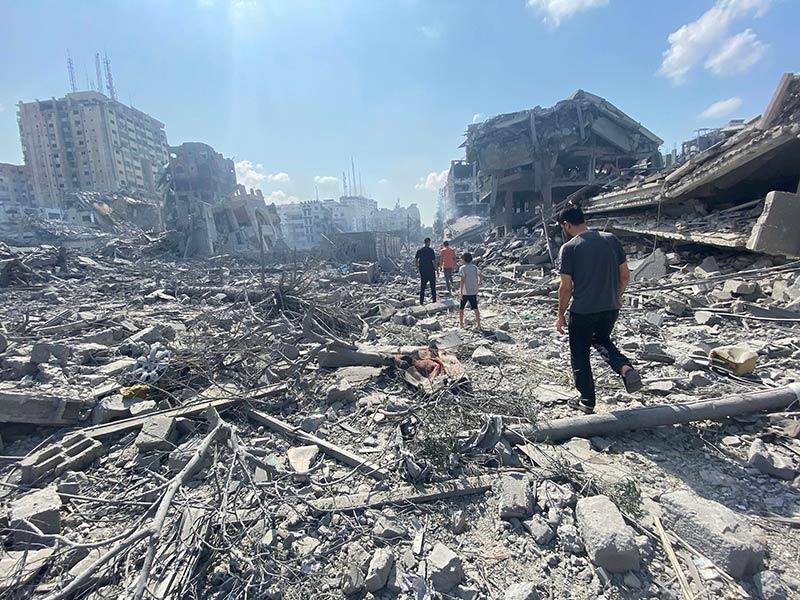
State of destruction in Gaza City in October 2023, during the conflict against Israel.